Le patient volontaire de 1930
Le Mental Treatment Act de 1930 permettait à qui voulait être soigné pour une maladie mentale d'être admis comme patient volontaire, sans ordre d'internement, sur demande écrite au responsable d'un établissement, d'un hôpital ou d'une maison agréée ; un enfant de moins de seize ans seulement sur demande de son parent avec un avis médical. Le patient volontaire pouvait partir sur préavis écrit de soixante-douze heures, et celui qui devenait incapable de dire s'il voulait rester ne pouvait être gardé comme tel plus de vingt-huit jours.
Les formulaires n'ont pas été trouvés : la demande et le préavis que Bearer imprime sont des reconstitutions d'après la loi, et l'office le dit au-dessus. Les papiers d'internement du Lunacy Act de 1890, lus, ont leur propre page.
Bearer fabrique les papiers d'un investigateur pour L'Appel de Cthulhu et toute campagne de jeu de rôle des années 1920 ou 1930 : le passeport qu'un consul aurait rempli, avec les visas et tampons de frontière qu'une campagne y laisse, et les permis, certificats et bulletins de l'époque, à imprimer ou à partager.
Un exemple
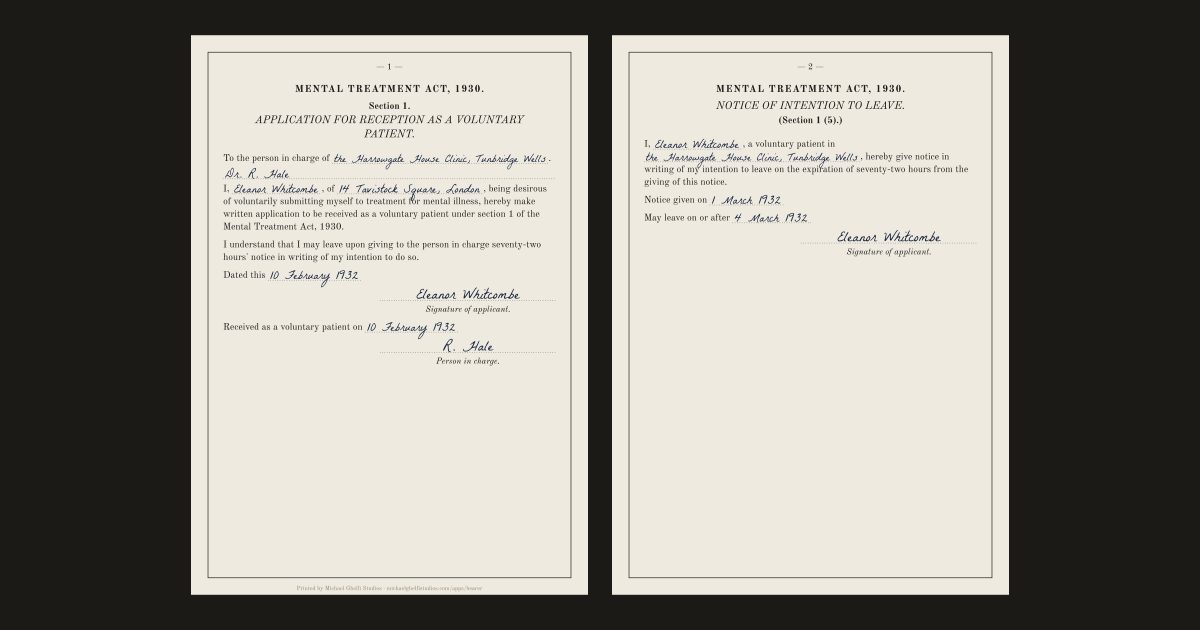
Ouvrir cet exemple dans l'office
Le papier
| Proposé | à partir du 1er janvier 1931 |
| Imprimé en | anglais |
| Feuilles | 2 |
| Comment on le connaît | une reconstitution : aucun document de l'époque n'a été retrouvé |
Une reconstitution
Ce papier est une reconstitution. Le Mental Treatment Act de 1930 permettait d'être admis comme patient volontaire sur sa propre demande écrite au responsable de l'établissement, sans ordre d'internement, et de partir sur préavis écrit de soixante-douze heures (art. 1) ; les formulaires qui portaient l'une et l'autre n'ont pas été trouvés, et leurs mots et leur mise en page sont les nôtres.
Encore à confirmer
- the whole paper. Ce qui trancherait: the forms of the Mental Treatment Rules, 1930.
Sources
- Parliament of the United Kingdom; text at legislation.gov.uk, Mental Treatment Act, 1930 (20 & 21 Geo. 5 c. 23), sections 1 and 2, s. 1: any person desirous of voluntarily submitting himself to treatment for mental illness who makes a written application to the person in charge may be received as a voluntary patient without a reception order; under sixteen, on the written application of a parent or guardian with a medical recommendation; a voluntary patient may leave on giving the person in charge seventy-two hours' notice in writing of his intention to do so; s. 2: notice of his reception sent to the Board of Control before the end of the second day; a patient become incapable of expressing himself willing or unwilling kept no longer than twenty-eight days (lu directement)
- Parliament of the United Kingdom; the King's Printer's copy at legislation.gov.uk, Mental Treatment Act, 1930 (20 & 21 Geo. 5 c. 23), as enacted: sections 5, 20 and 22 and the First Schedule, s. 20(1): asylums provided by local authorities to be called mental hospitals, and in any order or other document issued under the Lunacy Acts a reference to a mental hospital substituted; s. 20(4): "pauper" to cease, "rate-aided" instead; s. 20(5): the word "lunatic" (save "criminal lunatic") to cease in any enactment, order or other document, "person of unsound mind", "patient" or such other expression as the context may require substituted; s. 22(3): the Act does not apply to Scotland or Northern Ireland; s. 22(4): in operation on 1 January 1931, save as otherwise provided; First Schedule: the forms of application for the reception of a temporary patient and of the recommendation for temporary treatment (two practitioners, one approved by the Board of Control; suffering from mental illness, likely to benefit, for the time being incapable of expressing himself as willing or unwilling; a period not exceeding six months) (lu directement)
Ouvrir le bureau des passeports · MGS Toolbox