Le permis de fouilles irakien, 1924 à 1939
La loi irakienne sur les antiquités du 26 juin 1924 subordonnait toute fouille à un permis du ministre des Communications et des Travaux, par l'intermédiaire du directeur des Antiquités. Le premier, le permis n° 1, alla à l'expédition conjointe du British Museum et de l'université de Pennsylvanie pour Ur, du temps où Gertrude Bell était directrice.
Bearer l'imprime tel que ce permis fut tapé : une feuille, l'anglais à gauche et l'arabe à droite, bloc pour bloc, les tells nommés dans les deux langues, signée du directeur du moment.
Bearer fabrique les papiers d'un investigateur pour L'Appel de Cthulhu et toute campagne de jeu de rôle des années 1920 ou 1930 : le passeport qu'un consul aurait rempli, avec les visas et tampons de frontière qu'une campagne y laisse, et les permis, certificats et bulletins de l'époque, à imprimer ou à partager.
Un exemple
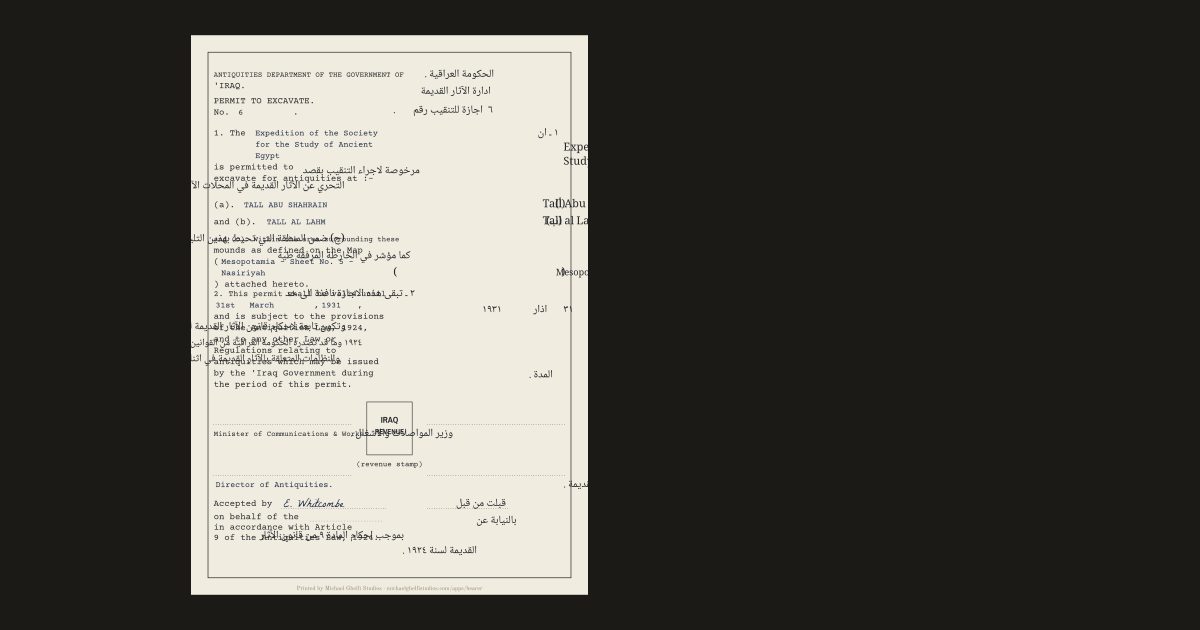
Ouvrir cet exemple dans l'office
Le papier
| Proposé | à partir du 26 juin 1924 |
| Imprimé en | anglais + arabe |
| Feuilles | 1 |
| Comment on le connaît | lu sur un document de l'époque |
Parties reconstituées
- le timbre fiscal sur la ligne du ministre : le permis lu en porte un ; celui qu'on dessine est le nôtre
Le même papier ailleurs
Encore à confirmer
- the day and the place of issue are not on the permit read, so Bearer prints neither; the date of issue only chooses who signs. Ce qui trancherait: another Iraqi permit to excavate, dated.
- clause (c) speaks of "these mounds" (هذين التلين, two of them), as the permit read does: a permit for one site or for three has not been found. Ce qui trancherait: an Iraqi permit for one site or for more than two.
- the Arabic of clause 1 agrees the verb with البعثة (the expedition, feminine: مرخوصة), as on the permit read; a grantee named by a masculine noun would take مرخوص. Ce qui trancherait: an Iraqi permit granted to a person or to a masculine body.
- four years when no expiry is typed in: the permit read runs from 1924 to 31 March 1928; what the Antiquities Law itself allows has not been found. Ce qui trancherait: the Antiquities Law, 1924.
- the Arabic months other than March (اذار, on the permit read) are the Iraqi names, spelt as the permit spells its words, without hamza. Ce qui trancherait: an Iraqi paper of the period dated in those months.
- Gertrude Bell signs until her death on 12 July 1926, a date from secondary sources; after it the title is printed Director of Antiquities (مدير الآثار القديمة, masculine) and the name left to the pen, since her successors' own permits have not been found. Ce qui trancherait: a permit to excavate signed after July 1926.
- the Minister of Communications and Works is the minister of the permit read; the ministry's name in later years has not been found. Ce qui trancherait: a permit of the thirties.
- the Antiquities Law of 1936 replaced that of 1924; the permits granted under it have not been found, so the type runs on unchanged. Ce qui trancherait: a permit to excavate of 1936 or later.
- the sheet is set at A4. Ce qui trancherait: the permit measured.
Sources
- Gertrude Bell, Honorary Director of Antiquities, for the Minister of Communications and Works; accepted by C. Leonard Woolley. Original in the British Museum; photograph published by the Penn Museum, Expedition magazine, 'Archaeology in the Digital Age', Antiquities Department of the Government of 'Iraq, Permit to Excavate No. 1: the joint Expedition of the British Museum and the University of Pennsylvania at Tall al Muqaiyir (Ur) and Tall al 'Ubaid, valid until 31 March 1928, typed in English on the left and in Arabic on the right, line for line: the department and the permit's number; clause 1, the expedition permitted to excavate for antiquities at (a) and (b), two mounds, and (c) the area round them defined on a map attached; clause 2, valid until a date and subject to the Antiquities Law, 1924 and to any law or regulations the 'Iraq Government issues meanwhile; the Minister of Communications and Works (a revenue stamp over his line); the Honorary Director of Antiquities, signed in English and in Arabic; accepted on behalf of the two institutions in accordance with article 9 of the Antiquities Law, 1924. The Arabic writes its figures in Arabic-Indic digits and the month as اذار. (lu directement)
- Colonial Office, London, 1928, Report by His Britannic Majesty's Government on the Administration of 'Iraq for the period 1920-1927, the list of the laws of 1924 gives the Antiquities Law, 1924, of 26 June 1924; the reports of the following years name the excavations licensed (Ur, Kish, Nineveh, Nuzi, Warka, Khorsabad) but do not print the law (lu directement)
Ouvrir le bureau des passeports · MGS Toolbox