Royaume-Uni
Le passeport britannique prit la forme du type international en 1920, un livret cartonné bleu foncé en anglais et en français resté en usage jusqu'en 1988. Tout y était écrit à la main, ce qui explique qu'il ne pouvait être délivré que par les bureaux des passeports et les consulats.
Le passeport d'un mari pouvait porter sa femme, avec son propre signalement et sa photographie : un passeport conjoint. Les enfants étaient inscrits sur celui d'un parent ou d'un autre membre de la famille. Une modification se faisait en barrant l'ancienne mention et en authentifiant la nouvelle par un timbre officiel.
Bearer fabrique les papiers d'un investigateur pour L'Appel de Cthulhu et toute campagne de jeu de rôle des années 1920 ou 1930 : le passeport qu'un consul aurait rempli, avec les visas et tampons de frontière qu'une campagne y laisse, et les permis, certificats et bulletins de l'époque, à imprimer ou à partager.
Un exemple
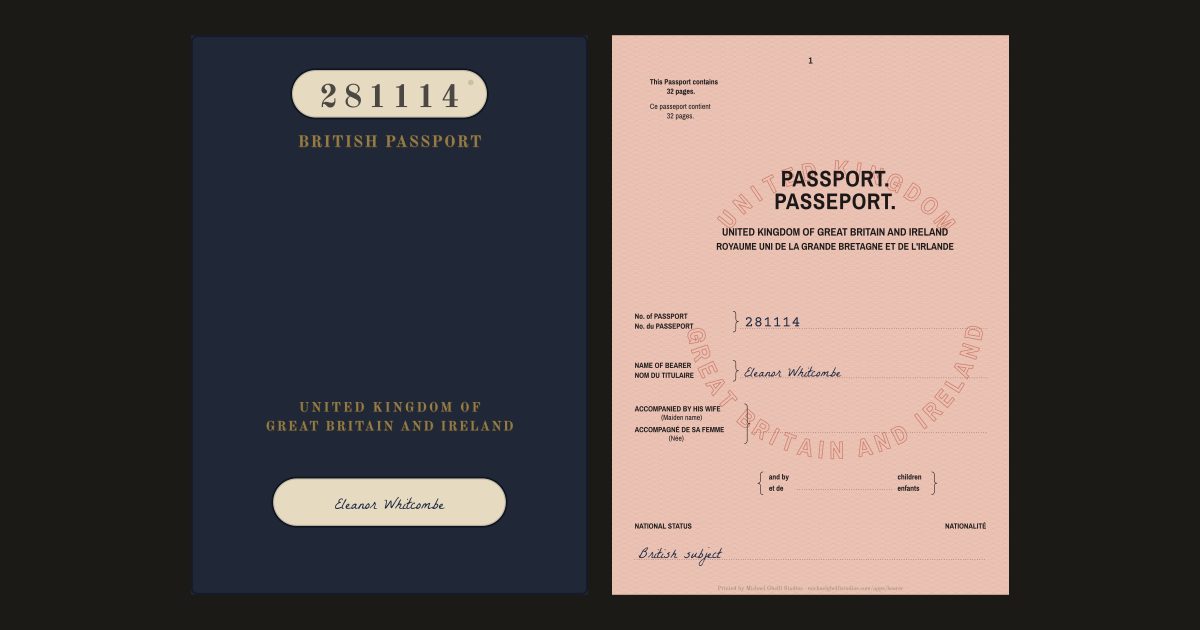
Ouvrir cet exemple dans l'office
Le passeport
| Délivré | à partir du 21 octobre 1920 |
| Forme | un livret de 32 pages |
| Langues | anglais + français |
| Validité | 5 ans |
| Renouvellements admis | 4 |
| Pays | énumérés en page 4 |
| Femme et enfants | un passeport conjoint est possible ; enfants de moins de 16 ans |
| Armes | permises, pas encore dessinées. Permis (la loi vise la croyance d'une autorisation, qu'un accessoire de jeu daté ne crée pas) ; à dessiner d'après un rendu d'époque ou d'après le blason, jamais d'après un rendu moderne. |
Le signalement
- Profession
- Lieu et date de naissance
- Domicile
- Taille
- Couleur des yeux
- Couleur de cheveux
- Signes particuliers
Le nom du pays, selon la date
| jusqu'au 11 avril 1927 | Royaume Uni de la Grande Bretagne et de l'Irlande |
| à partir du 12 avril 1927 | Royaume Uni de la Grande Bretagne et de l'Irlande du Nord |
La requête, sur l'intérieur de la couverture
| jusqu'au 22 janvier 1924 | George Nathaniel, Marquess Curzon of Kedleston |
| à partir du 23 janvier 1924, jusqu'au 5 novembre 1924 | Ramsay MacDonald |
| à partir du 6 novembre 1924, jusqu'au 4 juin 1929 | Sir Austen Chamberlain |
| à partir du 7 juin 1929, jusqu'au 24 août 1931 | Arthur Henderson |
| à partir du 25 août 1931, jusqu'au 4 novembre 1931 | Rufus Isaacs, Marquess of Reading |
| à partir du 5 novembre 1931, jusqu'au 6 juin 1935 | Sir John Simon |
| à partir du 7 juin 1935, jusqu'au 18 décembre 1935 | Sir Samuel Hoare |
| à partir du 22 décembre 1935, jusqu'au 20 février 1938 | Anthony Eden |
| à partir du 21 février 1938 | Edward Wood, Viscount Halifax |
Le livret britannique garde sa phrase la plus connue hors de ses pages numérotées : elle est imprimée sur l'intérieur de la couverture, en regard de la page 1, dans une anglaise, au-dessus des armes personnelles du ministre et de sa signature, avec un timbre fiscal de six pence frappé en haut. Elle est écrite à la première personne, en son nom et sous ses titres, et change donc avec le titulaire de la charge.
« We, … His Majesty's Principal Secretary of State for Foreign Affairs. Request and require in the Name of His Majesty all those whom it may concern to allow the bearer to pass freely without let or hindrance, and to afford him every assistance and protection of which he may stand in need. »
Ses ports et ses villes dans Passage
Le même papier ailleurs
Encore à confirmer
- validity. Ce qui trancherait: page 4 of a dated booklet of 1920-1925: HM Passport Office says five years from the start, the 1915 passport ran two and the Irish Free State raised its own from two to five around 1926.
- page 4 (countries, expiry, place and date of issue, renewals), still in the League's words. Ce qui trancherait: page 4 of a British booklet of the twenties.
- the French of the country's name after 1927, set after the 1923 form with 'du Nord' added. Ce qui trancherait: page 1 of a booklet issued after April 1927.
- the label of the bearer's own signature on page 3, hidden under the signature strip of the booklet read. Ce qui trancherait: another booklet of the twenties.
- the day the booklet's words changed: the Royal and Parliamentary Titles Act, read, styled Parliament that of the United Kingdom of Great Britain and Northern Ireland from its passing on 12 April 1927 (s. 2), and Bearer changes the booklet's words that day; when the Passport Office's printer did has not been found. Ce qui trancherait: a booklet on either side of April 1927.
- the request printed on the inside of the cover names the Secretary of State of the day in his own titles, and only Lord Curzon's have been read; from January 1924 the page prints the name and the office alone. Ce qui trancherait: British booklets issued under each of the eight Foreign Secretaries who followed him.
- the words the form leaves for the bearer, filled in by hand on the booklet read ("him", "he"). Ce qui trancherait: a booklet issued to a woman, to see what the clerk wrote there.
Sources
- Foreign Office; photographs of the Robert Byron Papers, Beinecke Rare Book and Manuscript Library, Yale University, on Wikimedia Commons, British passport no. 330155, issued by the Foreign Office on 8 March 1923, read inside cover and pages 1 to 3, inside front cover (the Secretary of State's request, the six-penny revenue stamp), page 1 (identity), page 2 (description, wife's column, children), page 3 (photographs of bearer and wife) (lu directement)
- HM Passport Office, Historic passport information, version 11, pp. 8-9, Old Blue (hardback style) passports (lu directement)
- Parliament of the United Kingdom; text at legislation.gov.uk, Royal and Parliamentary Titles Act, 1927 (17 & 18 Geo. 5 c. 4), as enacted, passed 12 April 1927; s. 1: the King may alter the royal style by proclamation within six months; s. 2(1): Parliament shall hereafter be known as and styled the Parliament of the United Kingdom of Great Britain and Northern Ireland; s. 2(2): in every Act passed and public document issued after the passing of this Act the expression "United Kingdom" shall, unless the context otherwise requires, mean Great Britain and Northern Ireland (lu directement)
- Wikipedia, Foreign Secretary (United Kingdom): the holders of the office, the dates of every Secretary of State for Foreign Affairs between 1919 and 1940, a plain record; the style each was known by is theirs, not the wording a passport printed (source secondaire)

Ouvrir le bureau des passeports · MGS Toolbox