Égypte
Le Royaume d'Égypte délivrait un livret de 32 pages en français et en arabe, le français à gauche de chaque ligne et l'arabe à droite, chaque page numérotée dans les deux écritures. Il est proposé à partir de la proclamation du Royaume, le 15 mars 1922.
Un feuillet avant la page 1 porte le numéro du modèle (Modèle No. 117), le ministère de l'Intérieur et la Direction générale de la Sécurité publique, et la requête aux fonctionnaires et consuls égyptiens dans les deux langues, signée du gouverneur de la ville. La page 1 nomme le titulaire, l'épouse avec son nom de jeune fille, les enfants et la nationalité ; le commis écrivait les valeurs dans les deux écritures.
Lu sur le livret délivré au Caire le 12 juillet 1938 (Modèle No. 117). Les pages suivantes n'ont pas été trouvées : Bearer les imprime dans le français de la Société des Nations, les libellés arabes pris au livret palestinien, et le dit sur le papier.
Bearer fabrique les papiers d'un investigateur pour L'Appel de Cthulhu et toute campagne de jeu de rôle des années 1920 ou 1930 : le passeport qu'un consul aurait rempli, avec les visas et tampons de frontière qu'une campagne y laisse, et les permis, certificats et bulletins de l'époque, à imprimer ou à partager.
Un exemple
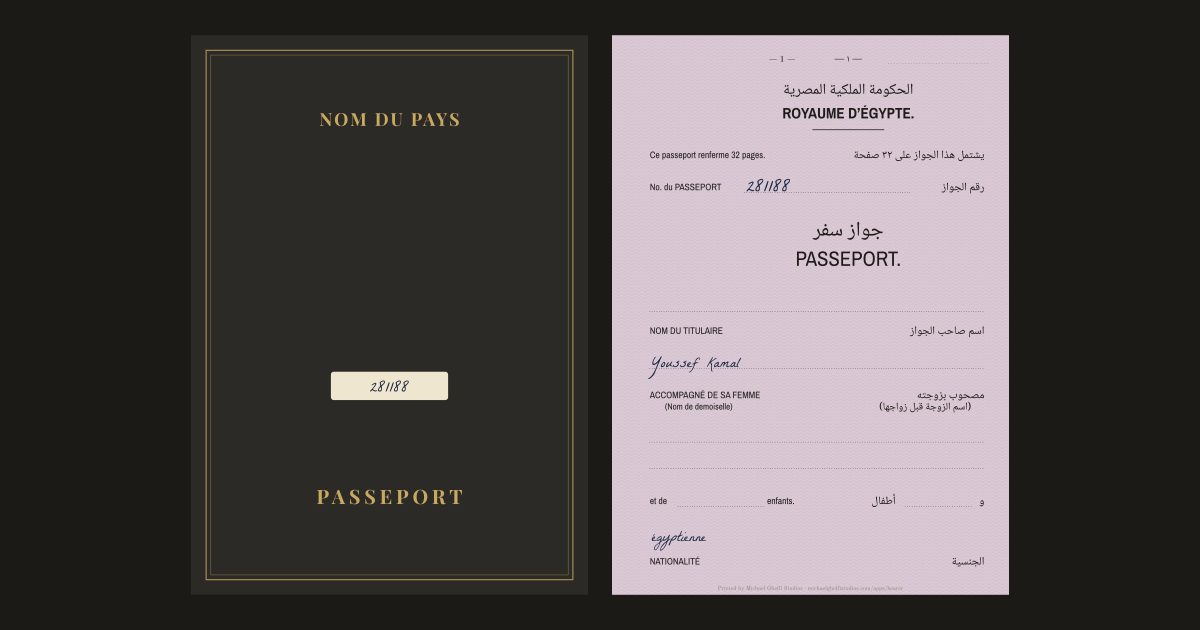
Ouvrir cet exemple dans l'office
Le passeport
| Délivré | à partir du 15 mars 1922 |
| Forme | un livret de 32 pages |
| Langues | français + arabe |
| Validité | 2 ans, ou un seul voyage |
| Renouvellements admis | 4 |
| Pays | énumérés en page 4 |
| Femme et enfants | un passeport conjoint est possible ; les enfants y sont inscrits |
| Armes | permises, pas encore dessinées. Le livret lu porte les armes royales en filigrane sur sa page 1 ; elles attendent la passe de dessin. |
Le signalement
- Profession
- Lieu et date de naissance
- Domicile
- Visage
- Couleur des yeux
- Couleur des cheveux
- Signes particuliers
- Nom du titulaire, en arabe
- Ville, en arabe
Ses ports et ses villes dans Passage
Le même papier ailleurs
Encore à confirmer
- the booklet read was issued in 1938; the type is offered from the Kingdom's proclamation on 15 March 1922, its earlier forms not found. Ce qui trancherait: Egyptian passports of the twenties.
- the Arabic months other than July (يوليه, on the booklet read) are the Egyptian names, spelt as the booklet spells its words. Ce qui trancherait: Egyptian passports issued in other months.
- pages 2 to 4 (the description, the photographs, the validity) have not been found; they are printed in the League's French, which page 1 follows line for line. Ce qui trancherait: pages 2 to 4 of an Egyptian passport.
- the term of validity and the number of renewals are the League's. Ce qui trancherait: page 4 of an Egyptian passport.
Sources
- Gouvernement égyptien, Ministère des Travaux Publics; printed in the Annales du Service des Antiquités de l'Égypte, vol. XII (1912), pp. 245-263, Loi n° 14 de 1912 sur les antiquités, and the arrêtés ministériels n° 50, 51 and 52 of 8 December 1912 (Réglement pour les fouilles), Law no. 14, art. 1: every antiquity on or in the soil of Egypt belongs to the public domain; art. 11: a finder keeps half; art. 12: nobody may dig for antiquities, even on his own land, without an authorisation of the Ministry of Public Works on the proposal of the Director General of the Service des Antiquités, which fixes the place and the period and grants the excavator a share of the finds; art. 14: no export without a special authorisation. Decree no. 52 (in force 1 January 1913): authorisations granted by the Minister after a favourable opinion of the Comité d'Égyptologie (art. 1), only to scholars on a mission or officially recommended, or to private persons with a reputed scholar to direct the work (art. 2), for one season, 15 November to 14 November (art. 3), never more than two sites at once (art. 4), applied for before 25 October (art. 5), P.E. 10 a day for the guarding of the site or P.E. 20 a day for a delegate of the Service travelling with the excavator (art. 7), sixty days' work at least (art. 8), the finds divided between the excavator and the Government under art. 11 of the law (art. 11), transport and export permits on request (art. 12), trenches filled and the ground put back at the end of the season before any share may leave (art. 13), a plan, a list and a report handed in (art. 14), renewal as of right to one who kept to his conditions (art. 16), suspension or withdrawal for breach (art. 17). (lu directement)
- Royaume d'Égypte, Ministère de l'Intérieur, Direction Générale de la Sécurité Publique; photograph on Wikimedia Commons ('1938 Egyptian passport used for travelling to Germany', CC BY-SA 4.0), Passport of the Kingdom of Egypt, Modèle No. 117, no. 56826, issued at Cairo on 12 July 1938 to Mohamed Hosni Bey, the leaf before page 1: the form number, the Kingdom, the Ministry of the Interior and the Directorate General of Public Security, PASSEPORT, the town, the request to Egypt's officials and consuls in French and Arabic side by side, made at … on the … day of the month of … 19.., the Governor's signature; page 1: the Kingdom, the count of 32 pages, the number, PASSEPORT, the bearer's name, accompanied by his wife (maiden name), and … children, nationality; French on the left, Arabic on the right, the page numbered in both scripts. (lu directement)
- League of Nations, Advisory and Technical Committee for Communications and Transit, Resolution adopted by the Conference on Passports, Customs Formalities and Through Tickets in Paris on October 21st, 1920 (Passport Conference, Preparatory Documents II), C.641.M.230.1925.VIII (lu directement)

Ouvrir le bureau des passeports · MGS Toolbox