Les mandats de perquisition par pays
Le mandat qui fait entrer la police dans une maison pour y chercher des biens volés, et ramener celui qui les gardait. Pour la porte de cave que les investigateurs ne peuvent pas ouvrir eux-mêmes.
Bearer l'imprime pour 2 bureaux : État de New York, Royaume-Uni. Chacun est lu sur un document de l'époque ou reconstitué d'après la loi du pays, et le dit.
Bearer fabrique les papiers d'un investigateur pour L'Appel de Cthulhu et toute campagne de jeu de rôle des années 1920 ou 1930 : le passeport qu'un consul aurait rempli, avec les visas et tampons de frontière qu'une campagne y laisse, et les permis, certificats et bulletins de l'époque, à imprimer ou à partager.
Un exemple
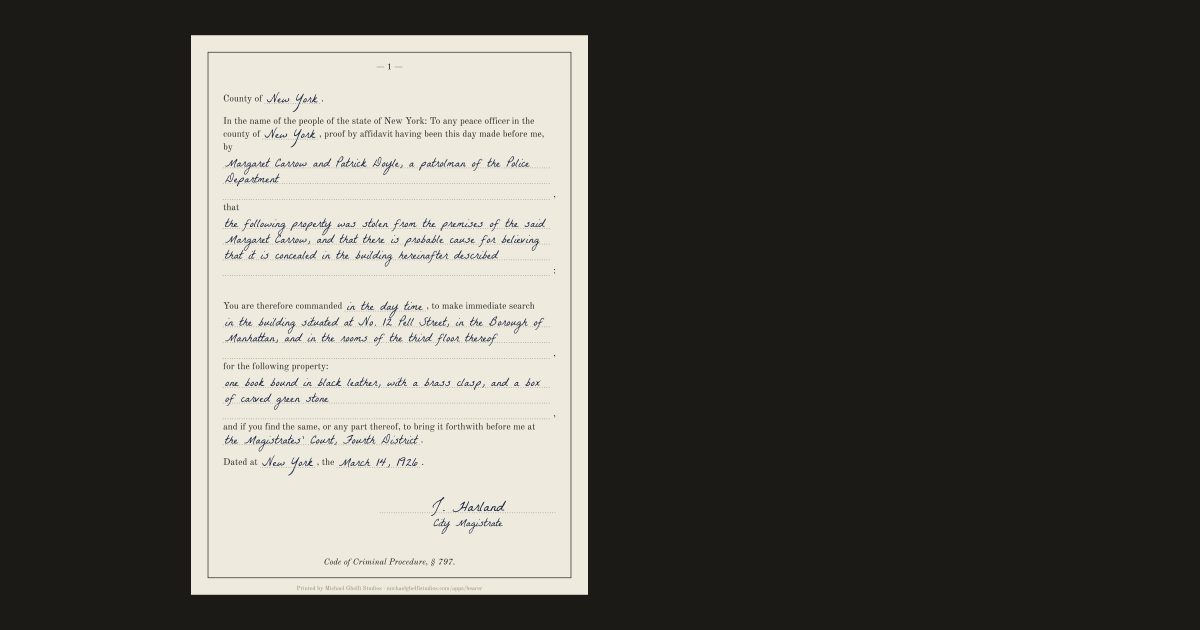
Ouvrir cet exemple dans l'office
Tous les bureaux pour lesquels Bearer l'imprime
| Bureau | Proposé à partir du | Jusqu'au | Comment on le connaît | Imprimé en |
|---|---|---|---|---|
| État de New York | 21 octobre 1920 | lu, certaines parties sont les nôtres | anglais | |
| Royaume-Uni | 21 octobre 1920 | reconstitué d'après la loi | anglais |
Chaque version en détail
Sources
- Matthew Bender & Co., Albany; Cornell University Library copy on the Internet Archive, New York Code of Criminal Procedure, as printed in Bender's Justices' Manual (1921): §§ 150-153 (the warrant of arrest) and §§ 791-811 (search warrants), § 151: a warrant of arrest is an order in writing in the name of the people, signed by a magistrate, commanding the arrest of the defendant, substantially in this form: County of …; In the name of the people of the State of New York, to any peace officer in the …: Information, upon oath, having been this day laid before me that the crime of … has been committed and accusing … thereof, You are therefore commanded forthwith to arrest the above-named … and bring him before … at …; Dated at … this … day of …, 19..; … Justice of the Peace; § 152: the name or description of the defendant, the offense, the time and the town, signed with the magistrate's name of office; § 791: a search warrant is an order in writing, in the name of the people, signed by a magistrate, directed to a peace officer, commanding him to search for personal property and bring it before the magistrate; § 792: stolen or embezzled property, property used to commit a felony, or held to commit a public offense; § 793: only upon probable cause supported by affidavit; § 797: the form (To any peace officer in the county of …, proof by affidavit having been this day made before me, by …, that …; You are therefore commanded in the day time [or at any time of the day or night] to make immediate search … for the following property: …, and if you find the same, or any part thereof, to bring it forthwith before me at …; Dated at …, the … day of …; …, Justice of the peace) (lu directement)
- Butterworth & Co.; on the Internet Archive (Middle Temple Library copy), Oke's Magisterial Formulist, tenth edition, by S. E. Major, joint clerk to the justices at Barrow-in-Furness (Butterworth, 1922), Indictable offences, chap. I, forms 4 and 5, pp. 468-469: Information to ground Search Warrant for Stolen Goods (… hath a reasonable cause to suspect, and doth suspect, that A. B. has in his possession [or on his premises] the said property on or with respect to which the said offence has been committed) and Search Warrant for Stolen Goods, under the Larceny Acts, 1861 and 1916, s. 42 (To each and all of the constables of the parish of …, in the [county] of …: … These are therefore to command you, in His Majesty's name, forthwith, with proper assistance, to enter the said dwelling-house and premises … in the daytime, and there diligently search for the said goods; and if the same, or any part thereof, shall be found upon such search, that you bring the goods so found, and also the body of the said A. B., before me, or some other of His Majesty's Justices of the Peace … to be disposed of and dealt with according to law). The book is the forms a justices' clerk wrote out, the Act of 1848 declaring forms to the same effect good (s. 28) (lu directement)
- Parliament of the United Kingdom; the Act as enacted at legislation.gov.uk, Larceny Act, 1916 (6 & 7 Geo. 5 c. 50), section 42, s. 42(1): if it is made to appear by information on oath before a justice of the peace that there is reasonable cause to believe that any person has in his custody or possession or on his premises any property whatsoever, with respect to which any offence against this Act has been committed, the justice may grant a warrant to search for and seize the same; s. 42(2): a constable authorised in writing by a chief officer of police may enter and search the premises of a person convicted of receiving or of harbouring thieves within twelve months (lu directement)
- Parliament of the United Kingdom; text at legislation.gov.uk, Indictable Offences Act, 1848 (11 & 12 Vict. c. 42), Schedule, Form (B.): Warrant to apprehend a Person charged with an indictable Offence, To the Constable of … and to all other Peace Officers in the said [County] of …; Whereas A.B. of … [Labourer] hath this Day been charged upon Oath before the undersigned, [One] of Her Majesty's Justices of the Peace in and for the said County of …, for that he on … at … did [stating shortly the Offence]: These are therefore to command you, in Her Majesty's Name, forthwith to apprehend the said A.B., and to bring him before [me], or some other of Her Majesty's Justices of the Peace in and for the said [County], to answer unto the said Charge, and to be further dealt with according to Law. Given under my Hand and Seal, this … Day of … in the Year of our Lord … at … in the [County] aforesaid. J.S. (L.S.) (lu directement)
Ouvrir le bureau des passeports · MGS Toolbox