La carte d'identité d'étranger
À partir du décret du 2 avril 1917, tout étranger de plus de quinze ans séjournant plus de quinze jours en France devait posséder une carte d'identité, qui tenait lieu de l'ancien permis de séjour. Il déclarait son état civil, sa famille, sa nationalité, sa résidence et ses références, apportait trois photographies de face et sans chapeau, de 4 centimètres sur 4, et faisait viser sa carte à l'arrivée et au départ dans chaque localité où il résidait, par le maire ou le commissaire de police.
Ses volets sont lus sur la carte que la Préfecture de police délivra le 27 décembre 1938, valable un an : le numéro et la durée à côté de la photographie, la signature et le cachet du préfet ; le nom, la naissance, le père et la mère, la profession et la nationalité du titulaire, le mode d'acquisition de cette nationalité et sa situation de famille, les mentions inutiles rayées par l'employé ; le conjoint, les enfants dispensés de la carte, et l'adresse au jour de la remise. La carte des années vingt n'a pas été trouvée et s'imprime sous la même forme ; la couverture et les pages de visas sont les nôtres, et l'office le dit.
Bearer fabrique les papiers d'un investigateur pour L'Appel de Cthulhu et toute campagne de jeu de rôle des années 1920 ou 1930 : le passeport qu'un consul aurait rempli, avec les visas et tampons de frontière qu'une campagne y laisse, et les permis, certificats et bulletins de l'époque, à imprimer ou à partager.
Un exemple
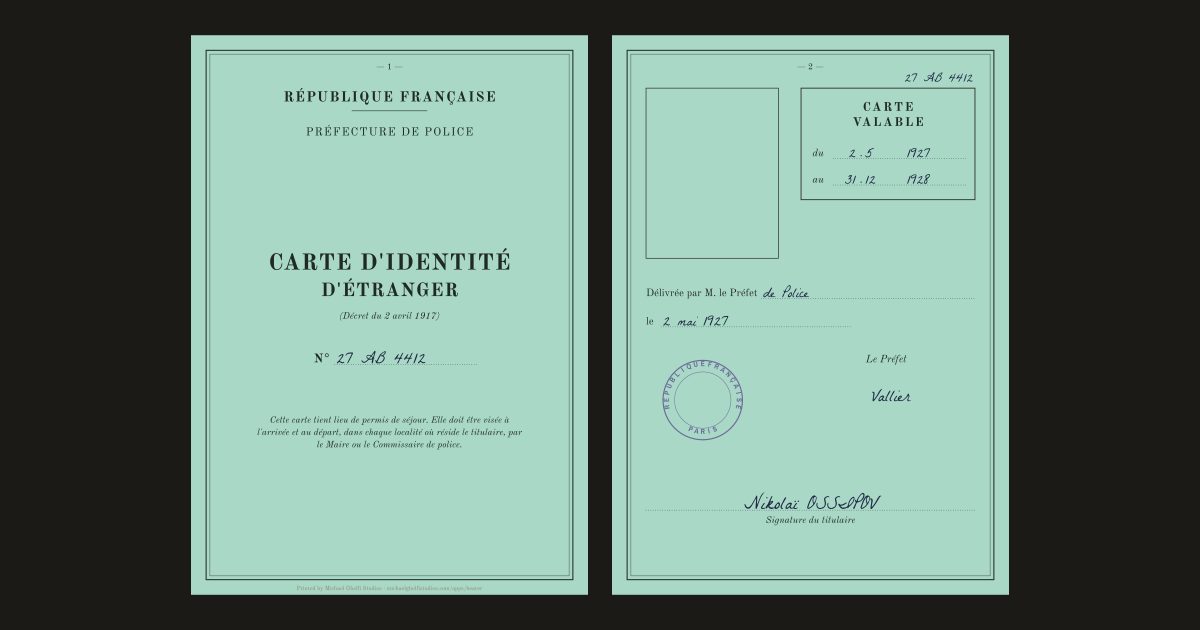
Ouvrir cet exemple dans l'office
Le papier
| Proposé | à partir du 21 octobre 1920 |
| Imprimé en | français |
| Feuilles | 6 |
| Comment on le connaît | lu sur un document de l'époque |
Parties reconstituées
- La couverture de la carte et ses pages de visas sont des reconstitutions : la carte lue, de décembre 1938, est photographiée ouverte sur ses volets intérieurs, et son volet des visas est coupé.
Encore à confirmer
- the leaves inside are read on one card, issued in Paris on 27 December 1938; the card of the twenties, under the decree of 2 April 1917, has not been found and is printed in the same form. Ce qui trancherait: a carte d'identité d'étranger of 1917 to 1935.
- the cover (the Republic, the prefecture, the title, the decree) and the visa pages (arrival and departure, as the notice of 1917 asks) are ours. Ce qui trancherait: a card photographed closed, and its visa leaf.
- the term follows the decrees read: three years by calendar years from the decree of 25 October 1924, two years by calendar years under the finance law of 26 March 1927 and the decrees after it, two years day for day from the decree of 10 July 1929; the card of 1917 to 1924 is given two years, its decree unread; the card read of December 1938 ran one year, and the decree-laws of 1938 that may have changed it are not followed. Ce qui trancherait: the decree of 2 April 1917 and the decree-laws of 1938.
- the worker's and the non-worker's card, the reduced tariff and the words on the worker's situation are not printed. Ce qui trancherait: a card of 1925 to 1937.
Sources
- Préfet de police E. Laurent; poster, Paris Musées (AFF5397), on Wikimedia Commons (CC0), Préfecture de police, Avis relatif à la délivrance d'une Carte d'Identité aux étrangers, Paris, 8 May 1917, the decree of 2 April 1917: every foreigner over fifteen staying more than fifteen days in France holds the card, which stands for the permis de séjour; the declaration (civil status, family, nationality, residence, references), three photographs full face without a hat, 4 by 4 cm; the card viséed on arrival and on departure in every locality by the mayor or the commissaire de police (art. 2) (lu directement)
- Wikimedia Commons (public domain), Carte d'identité d'étranger No. CC 41778, issued by the Préfet de police, Paris, on 27 December 1938 to Vladimir Jabotinsky, journalist, first leaf: the number, CARTE VALABLE du 1.1 1939 au 1.1 1940, the photograph under two eyelets, Délivrée par M. le Préfet [de Police] le 27 DEC 1938, Le Préfet, the office's round stamp, Signature du titulaire; second leaf: Nom, Prénoms, Né le, à, de, et de … née, Profession, Nationalité, Mode d'acquisition de cette nationalité : filiation, mariage, naturalisation (rayer les mentions inutiles), Situation de famille : célibataire, marié, veuf, divorcé (rayer les mentions inutiles); third leaf: RENSEIGNEMENTS SUR LE CONJOINT (Nom, Prénoms, Né le, à, Nationalité), ENFANTS dispensés de la carte d'identité (Prénoms, Date et lieu de naissance, Nationalité), Lieu de résidence et adresse au moment de la remise de la carte; fourth leaf: the visas (Vu … à … le …), cut off in the photograph; green paper printed with the RF monogram and laurel (lu directement)
- Ministère de l'Intérieur; Gallica (BnF), Instruction générale concernant l'application des dispositions du décret du 25 octobre 1924 relatif à la carte d'identité des étrangers (décret au Journal officiel du 1er novembre 1924), every foreigner over fifteen staying more than fifteen days asks for the card within forty-eight hours of his arrival, at the commissariat or the mairie, proving his regular entry, with four photographs full face without a hat, and pays the tax; a récépissé valid fifteen days, a month at most; the card made by the prefecture alone, the tax stamp at the top left of page 1, the photograph on page 2, blind-stamped on two corners; validity three years (art. 8 of the decree), every year begun counting whole (valable pour les années 192.., 192..), cut to the visa's term when the visa is limited (valable jusqu'au …); the salaried worker's contract, and for the others the words 'affirme qu'il n'est salarié à aucun titre' (lu directement)
- Hayard, Paris; Gallica (BnF, 8-F PIECE-6992), Ministère de l'Intérieur, Nouveaux décrets réglementant le séjour des étrangers en France (Hayard, 1932): the report of 9 July 1929, the decree of 10 July 1929 on the delivery of identity cards to foreigners, and the decree on their tariff, the report: since 1924 the decrees (of 9 September 1925, 30 November 1926, 20 January 1928, 26 April 1929) made the card valid 'en principe' two years, every year begun counting whole, and the commission asked for two years day for day; the decree, art. 1: within eight days of arrival (or of his fifteenth year), at the commissariat or the mairie, four photographs, the particulars (name, forenames, filiation, profession, nationality, family, the children with him, last domicile abroad); art. 2: made by the prefect alone, the photograph blind-stamped on two corners; art. 5: valid, save contrary indication, for two years from the day of entry into France, renewal in the first quarter after the last year of validity; art. 7: a salaried worker's health certificate and work contract; the tariff (loi de finances of 26 March 1927, art. 88): 100 francs full, 20 francs reduced (students, scholars, writers and journalists, wage-earners under 18,000 francs a year, farmers working their own land …), the card required of every foreigner staying more than two months, valid two years (lu directement)


Ouvrir le bureau des passeports · MGS Toolbox