Les cartes d'identité par pays
La carte d'identité qu'un État délivrait à ses propres ressortissants pour la police intérieure : le signalement, la photographie, les empreintes.
Bearer l'imprime pour 3 bureaux : Allemagne, Colonie et protectorat du Kenya, Royaume-Uni. Chacun est lu sur un document de l'époque ou reconstitué d'après la loi du pays, et le dit.
Bearer fabrique les papiers d'un investigateur pour L'Appel de Cthulhu et toute campagne de jeu de rôle des années 1920 ou 1930 : le passeport qu'un consul aurait rempli, avec les visas et tampons de frontière qu'une campagne y laisse, et les permis, certificats et bulletins de l'époque, à imprimer ou à partager.
Un exemple
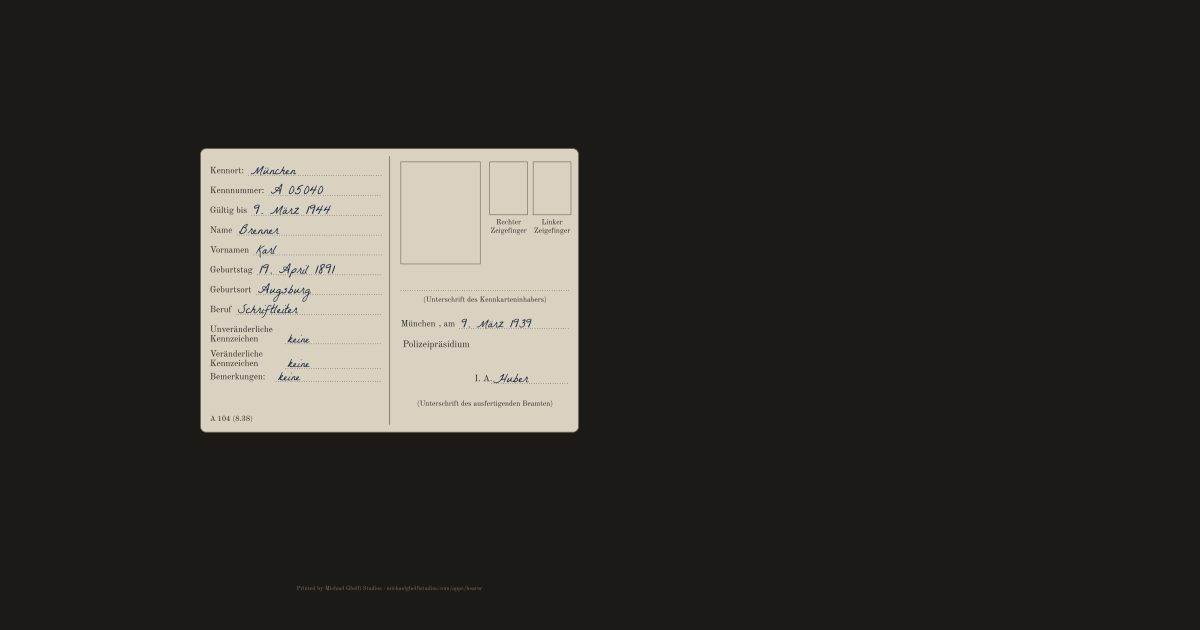
Ouvrir cet exemple dans l'office
Tous les bureaux pour lesquels Bearer l'imprime
| Bureau | Proposé à partir du | Jusqu'au | Comment on le connaît | Imprimé en |
|---|---|---|---|---|
| Allemagne | 1er octobre 1938 | lu sur un document de l'époque | allemand | |
| Colonie et protectorat du Kenya | 1er janvier 1921 | lu sur un document de l'époque | anglais | |
| Royaume-Uni | 29 septembre 1939 | lu sur un document de l'époque | anglais |
Chaque version en détail
Sources
- Wikimedia Commons (public domain), Kennkarte, form A 104 (8.38), issued by the Polizeipräsidium München on 9 March 1939 to Hugo Erlanger, with the J and the forename Israel, left: Kennort, Kennnummer, Gültig bis (five years), Name, Vornamen, Geburtstag, Geburtsort, Beruf, Unveränderliche Kennzeichen, Veränderliche Kennzeichen, Bemerkungen, the large J across the table; right: the photograph, Rechter Zeigefinger and Linker Zeigefinger (the prints), (Unterschrift des Kennkarteninhabers), München, am … 19.., Polizeipräsidium, I. A., (Unterschrift des ausfertigenden Beamten), the office's round stamps; foot: A 104 (8.38) (lu directement)
- Reichsgesetzblatt 1938 I, p. 913 (Wikisource transcription), Verordnung über Kennkarten, 22 July 1938, § 1 (a general police identity card for German nationals from their fifteenth year, compulsory for the groups the Minister names), § 2 (applied for at the local police, issued by the Paßbehörde), § 3 (photographs, fingerprints, signature), § 5 (the Minister’s model, no alteration), § 6 (five years, no extension), § 7 (three Reichsmark, one for a new card after a change of name or profession), § 14 (in force on 1 October 1938) (lu directement)
- Wikimedia Commons (public domain), Kipande (certificate under the Native Registration Ordinance, 1921) No. S.K. 305096, South Kavirondo, 4 May 1931, as photographed in 1936, N.P.R.; COLONY AND PROTECTORATE OF KENYA.; A. (To be retained by Native.); CERTIFICATE ISSUED UNDER THE NATIVE REGISTRATION ORDINANCE, 1921.; Name, Father's name, District, Tribe, Location, Sub-location, Group, Clan, Circumcision Age (or year); Signature of Registering Officer; the date; District; the number with the district's letters; the box for the thumb; the table: (1) Name of Employer and District, (2) Nature of Employment, (3) Date of Employment, (4) Rate of Wages: On Engagement, On Discharge, (5) If Posho given, add "Posho", (6) Date of Discharge, (7) Employer's Signature (when discharging Native); typed and written in (lu directement)
- Imperial War Museums, on Wikimedia Commons (public domain), National Registration Identity Card, inside and cover (photographs D1886 and D1887 of the Ministry of Information, a card of 21 May 1940, Hampstead), cover: NATIONAL REGISTRATION IDENTITY CARD under the Royal Arms, a double rule; inside, left: NATIONAL REGISTRATION, the code in three boxes (the enumeration district's letters, the household, the person), the name (surname, forenames); 1. This Identity Card must be carefully preserved. You may need it under conditions of national emergency for important purposes. You must not lose it or allow it to be stolen. If, nevertheless, it is stolen or completely lost, you must report the fact in person at any local National Registration Office. 2. You may have to show your Identity Card to persons who are authorised by law to ask you to produce it. 3. You must not allow your Identity Card to pass into the hands of unauthorised persons or strangers. Every grown up person should be responsible for the keeping of his or her Identity Card. The Identity Card of a child should be kept by the parent or guardian or person in charge of the child for the time being. 4. Anyone finding this Card must hand it in at a Police Station or National Registration Office.; right: NATIONAL REGISTRATION, the code and name again, DO NOTHING WITH THIS PART UNTIL YOU ARE TOLD, Full Postal Address of Above Person, (Signed), Date (lu directement)
- Parliament of the United Kingdom; the King's Printer's copy at legislation.gov.uk, National Registration Act, 1939 (2 & 3 Geo. 6 c. 91), as enacted, 5 September 1939, s. 1: a register of all persons in the United Kingdom at the appointed time, and of all persons entering or born after it; s. 6(1): the Registrar-General to issue a card containing the prescribed particulars (an identity card) for every registered person; s. 6(2): the form of the card prescribed by regulations; a constable in uniform, or any person authorised, may require the person responsible for its custody to produce it (lu directement)


Ouvrir le bureau des passeports · MGS Toolbox