L'ordre d'internement
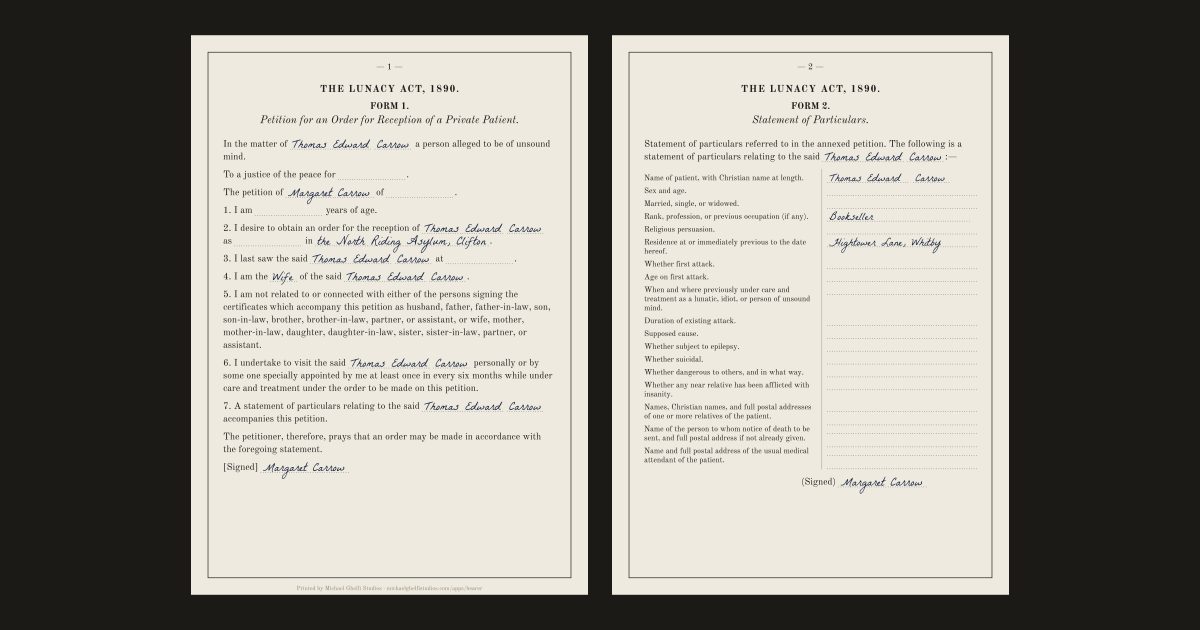
Sous la loi de 1890, un malade privé pouvait être reçu dans un asile, un hôpital ou une maison autorisée sur quatre papiers. Une requête d'une personne d'au moins vingt et un ans, le plus souvent un parent, qui l'avait vu dans les quatorze derniers jours et s'engageait à lui rendre visite tous les six mois. Un état de renseignements. Deux certificats de médecins, chacun l'examinant séparément et consignant ce qu'il avait vu et ce qu'on lui avait dit. Et un ordre signé d'un juge de paix désigné à cet effet, d'un juge de comté ou d'un magistrat stipendié, qui pouvait avoir vu le malade ou non.
Les médecins certificateurs ne pouvaient être ni le conjoint, ni un parent, un enfant, un frère ou une sœur, un allié, un associé ou un assistant du requérant, et une fausse déclaration délibérée dans un certificat était un délit. Une fois reçu, le malade avait le droit de demander à être vu par un juge. Bearer imprime les quatre papiers tels que l'annexe de la loi les dispose, remplis : une scène pour le gardien, et la peur autour de laquelle tourne l'Appel de Cthulhu, telle que la loi de l'époque l'écrivait.
À partir du 1er janvier 1931, le Mental Treatment Act de 1930 garda l'ordre mais en changea les mots : l'asile d'une autorité locale devint un hôpital psychiatrique (mental hospital), et les mots « lunatic » et « pauper » furent rayés de tout ordre et document délivré sous les lois sur l'aliénation (art. 20). Un papier daté de 1931 ou après imprime les formules avec ces mots remplacés. La même loi permit d'entrer comme patient volontaire sur sa propre demande, et de recevoir pour six mois au plus, sans ordre, un malade incapable de dire oui ou non, comme patient temporaire.
Bearer fabrique les papiers d'un investigateur pour L'Appel de Cthulhu et toute campagne de jeu de rôle des années 1920 ou 1930 : le passeport qu'un consul aurait rempli, avec les visas et tampons de frontière qu'une campagne y laisse, et les permis, certificats et bulletins de l'époque, à imprimer ou à partager.
Un exemple
Ouvrir cet exemple dans l'office
Les papiers
| Formule | Ce que c'est |
|---|---|
| 1 | Requête aux fins d'un ordre de réception d'un malade privé. |
| 2 | État de renseignements : âge, profession, religion, l'accès, s'il est suicidaire ou dangereux, les parents. |
| 8 | Certificat de médecin, deux fois : faits observés, faits rapportés par d'autres. |
| 3 | Ordre de réception, adressé au médecin-directeur de l'asile. |
Le même papier ailleurs
Encore à confirmer
- the forms are the ones the Act's Second Schedule prints, as read in Archbold's edition of 1895; the papers an asylum actually kept, printed by law stationers, have not been found. Ce qui trancherait: a reception order and its certificates of the twenties or thirties.
- the words the forms leave to the one who fills them (a lunatic, an idiot, or a person of unsound mind; asylum, hospital or house) are written as they are filled in, and the bracketed alternatives the Act prints are left out. Ce qui trancherait: nothing: the Act prints the alternatives for the one who fills the form.
- England and Wales: Scotland and Ireland had laws of their own. Ce qui trancherait: the Scottish and Irish forms.
- the Mental Treatment Act, 1930, read, kept the reception order of 1890 and struck the words "lunatic", "asylum" and "pauper" from every order and document issued under the Lunacy Acts from 1 January 1931 (s. 20): the forms are the ones of 1890 with its substitutions, and where the Act says "such other expression as the context may require" the words chosen are ours. Ce qui trancherait: a reception order printed after 1930.
- the three forms. Ce qui trancherait: a request, a certificate and a prefect's order of 1920 to 1939.
- the voluntary request is drawn only when someone asks, and the prefect's order only when its circumstances are given. Ce qui trancherait: nothing: the law made them two ways of placing a patient.
- the forms are read as the Board of Lunacy printed them in 1859; the Act was amended in 1862 and 1866 and governed until 1960, and the forms of the twenties and thirties are taken to be the same. Ce qui trancherait: a Scottish petition, certificate or Sheriff's order of 1920 to 1939.
- the dates are written as the day of the Petition; the forms read print “one thousand eight hundred and”. Ce qui trancherait: a form printed after 1900.
Sources
- Parliament of the United Kingdom; printed in J. F. Archbold, Lunacy (4th ed., 1895), pp. 476-481, on the Internet Archive (Wellcome Collection), The Lunacy Act, 1890 (53 & 54 Vict. c. 5), Second Schedule, Forms 1, 2, 3 and 8, Form 1: Petition for an Order for Reception of a Private Patient (the petitioner at least twenty-one, having seen the patient within fourteen days, related or saying why not, unrelated to the certifying doctors, undertaking to visit every six months); Form 2: Statement of Particulars; Form 3: Order for reception of a private patient by a Justice appointed under the Act, a Judge of County Courts or a Stipendiary Magistrate; Form 8: Certificate of Medical Practitioner (registered under the Medical Act, 1858; facts observed, facts communicated by others; the extract of section 317 on wilful misstatement). Checked against the Lunacy Acts Amendment Act, 1889, whose forms the Act of 1890 consolidated. (lu directement)
- Parliament of the United Kingdom; the King's Printer's copy at legislation.gov.uk, Mental Treatment Act, 1930 (20 & 21 Geo. 5 c. 23), as enacted: sections 5, 20 and 22 and the First Schedule, s. 20(1): asylums provided by local authorities to be called mental hospitals, and in any order or other document issued under the Lunacy Acts a reference to a mental hospital substituted; s. 20(4): "pauper" to cease, "rate-aided" instead; s. 20(5): the word "lunatic" (save "criminal lunatic") to cease in any enactment, order or other document, "person of unsound mind", "patient" or such other expression as the context may require substituted; s. 22(3): the Act does not apply to Scotland or Northern Ireland; s. 22(4): in operation on 1 January 1931, save as otherwise provided; First Schedule: the forms of application for the reception of a temporary patient and of the recommendation for temporary treatment (two practitioners, one approved by the Board of Control; suffering from mental illness, likely to benefit, for the time being incapable of expressing himself as willing or unwilling; a period not exceeding six months) (lu directement)
Ouvrir le bureau des passeports · MGS Toolbox