L'autorisation de fouilles égyptienne, 1912 à 1939
Nul ne pouvait fouiller en Égypte, pas même sur sa propre terre, sans une autorisation du ministre des Travaux publics, accordée sur la proposition du directeur général du Service des Antiquités (loi n° 14 de 1912 et arrêté n° 52). Toute antiquité du sol égyptien appartenait à l'État ; le fouilleur recevait une part de ce qu'il trouvait.
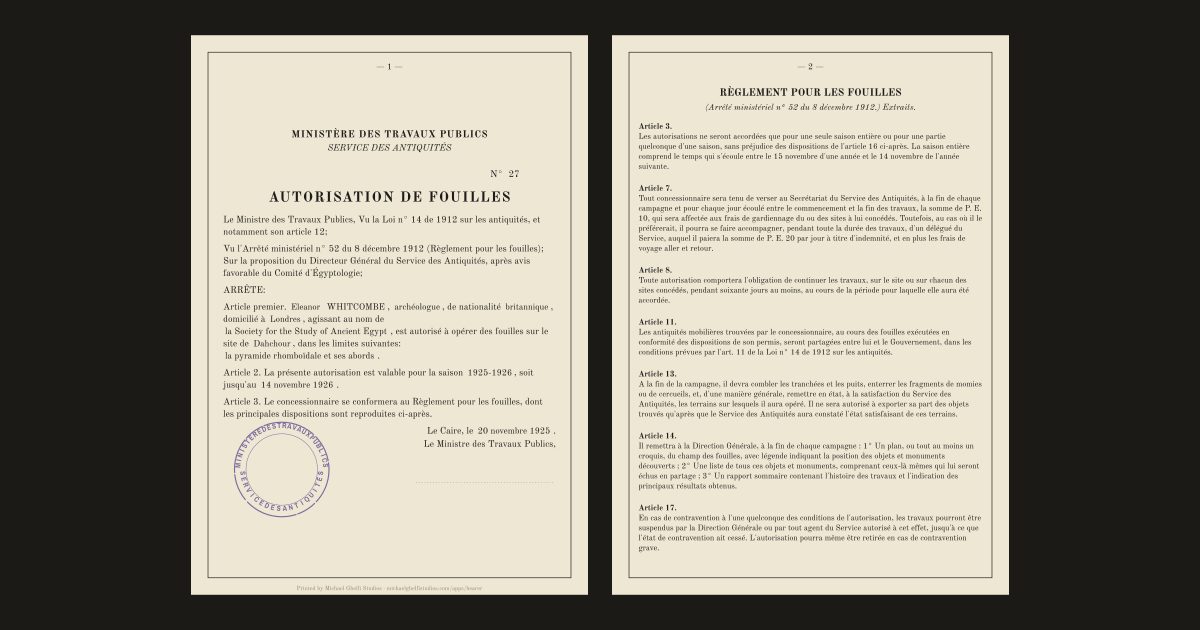
Bearer l'imprime sur trois feuilles en français, la langue dans laquelle la loi fut publiée à côté de l'arabe : la décision qui nomme le fouilleur, le site et la saison ; les articles de l'arrêté ; et le partage des trouvailles, chaque objet attribué au Musée ou au fouilleur.
Bearer fabrique les papiers d'un investigateur pour L'Appel de Cthulhu et toute campagne de jeu de rôle des années 1920 ou 1930 : le passeport qu'un consul aurait rempli, avec les visas et tampons de frontière qu'une campagne y laisse, et les permis, certificats et bulletins de l'époque, à imprimer ou à partager.
Un exemple
Ouvrir cet exemple dans l'office
Le papier
| Proposé | à partir du 21 octobre 1920 |
| Imprimé en | français |
| Feuilles | 3 |
| Comment on le connaît | lu sur un document de l'époque |
Le même papier ailleurs
Encore à confirmer
- no authorisation actually granted has been found: page 1 is set in the form the ministry's own decrees of 1912 take (Le Ministre des Travaux Publics, Vu…, ARRÊTE, articles), and says what the law and decree no. 52 require an authorisation to say (the person, the site and its limits, the season). Ce qui trancherait: an Egyptian autorisation de fouilles of the twenties or thirties.
- the rules printed on page 2 are those of decree no. 52 of 1912; how far the terms granted after 1922 changed them (the division of finds after the discovery of Tutankhamun's tomb) has not been found. Ce qui trancherait: the conditions of an Egyptian concession granted after 1922.
- French alone: the law and the decree were published in French and in Arabic, and Bearer has no Arabic face. Ce qui trancherait: an Arabic face in the print shop and the Arabic text of the decree (Journal officiel, 19 Safar 1331).
- the page is set at A4. Ce qui trancherait: an Egyptian authorisation measured.
Sources
- Gouvernement égyptien, Ministère des Travaux Publics; printed in the Annales du Service des Antiquités de l'Égypte, vol. XII (1912), pp. 245-263, Loi n° 14 de 1912 sur les antiquités, and the arrêtés ministériels n° 50, 51 and 52 of 8 December 1912 (Réglement pour les fouilles), Law no. 14, art. 1: every antiquity on or in the soil of Egypt belongs to the public domain; art. 11: a finder keeps half; art. 12: nobody may dig for antiquities, even on his own land, without an authorisation of the Ministry of Public Works on the proposal of the Director General of the Service des Antiquités, which fixes the place and the period and grants the excavator a share of the finds; art. 14: no export without a special authorisation. Decree no. 52 (in force 1 January 1913): authorisations granted by the Minister after a favourable opinion of the Comité d'Égyptologie (art. 1), only to scholars on a mission or officially recommended, or to private persons with a reputed scholar to direct the work (art. 2), for one season, 15 November to 14 November (art. 3), never more than two sites at once (art. 4), applied for before 25 October (art. 5), P.E. 10 a day for the guarding of the site or P.E. 20 a day for a delegate of the Service travelling with the excavator (art. 7), sixty days' work at least (art. 8), the finds divided between the excavator and the Government under art. 11 of the law (art. 11), transport and export permits on request (art. 12), trenches filled and the ground put back at the end of the season before any share may leave (art. 13), a plan, a list and a report handed in (art. 14), renewal as of right to one who kept to his conditions (art. 16), suspension or withdrawal for breach (art. 17). (lu directement)
Ouvrir le bureau des passeports · MGS Toolbox