Le certificat d'enregistrement des étrangers
L'étranger qui s'installait en Grande-Bretagne entre les deux guerres se faisait enregistrer par la police de son district et portait un certificat d'enregistrement. La couverture disait quand le présenter : quand il annonçait à la police qu'il allait déménager, quand il signalait son arrivée dans un nouveau district, quand il se rendait au poste pour son enregistrement, et chaque fois que la police ou un agent de l'immigration le demandait. Dedans : son numéro, son nom, le nom de famille d'abord en capitales romaines, un éventuel pseudonyme, sa photographie, sa signature (ou l'empreinte de son pouce gauche s'il ne savait pas signer en caractères anglais), sa nationalité, sa naissance, sa profession, son adresse, le jour de son arrivée au Royaume-Uni, sa dernière adresse à l'étranger et le passeport qu'il détenait.
La police tamponnait chaque changement d'adresse dans les pages de mentions. L'avis au dos lui disait de signaler un déménagement avant de le faire, de se présenter à la police d'un nouveau district dans les quarante-huit heures, de signaler une absence de plus de deux mois, de signer le registre de tout hôtel ou garni à l'arrivée et au départ, et que ses enfants auraient besoin de leur propre certificat à seize ans. Manquer à l'une de ces règles pouvait coûter 100 livres ou six mois de prison.
Bearer fabrique les papiers d'un investigateur pour L'Appel de Cthulhu et toute campagne de jeu de rôle des années 1920 ou 1930 : le passeport qu'un consul aurait rempli, avec les visas et tampons de frontière qu'une campagne y laisse, et les permis, certificats et bulletins de l'époque, à imprimer ou à partager.
Un exemple
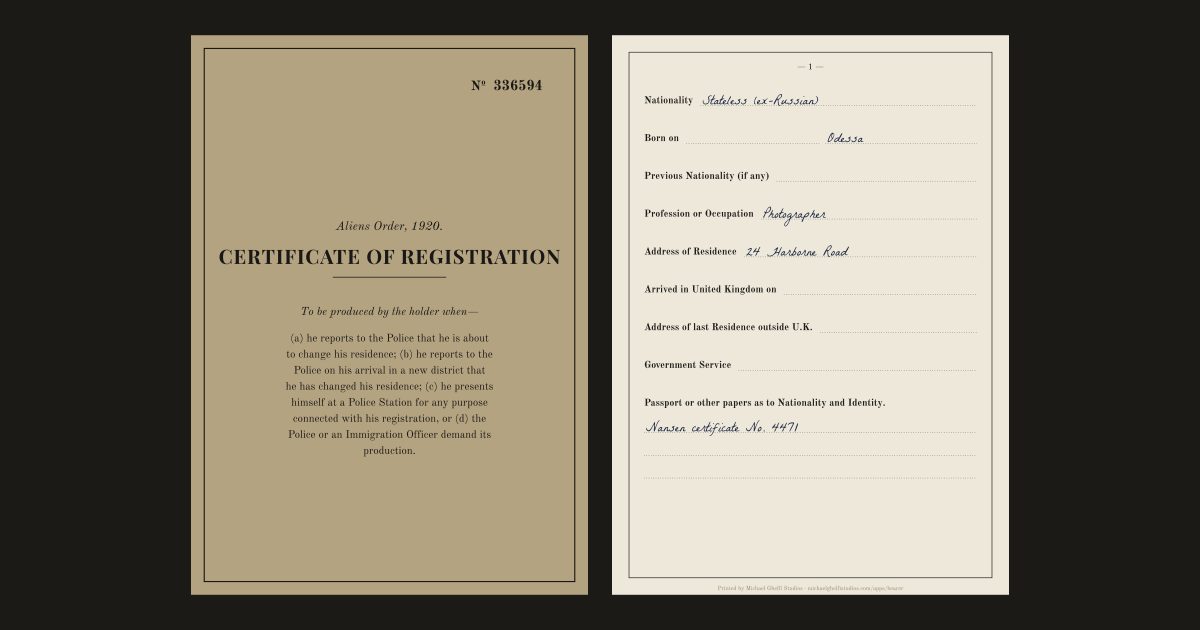
Ouvrir cet exemple dans l'office
L'avis au titulaire, tel qu'imprimé
- 1. Before you change your residence (i.e. the address shown in this Certificate) you must give the Police of the district in which you reside your new address and the date on which you intend to move.
- 2. If your new residence is in another Police district you must, within 48 hours of your arrival there, report to the Police of the new district.
- 3. If you are absent for more than two months from your residence you must report your temporary address and all subsequent changes of address (including your return home) to the Police of the district where you are registered. This may be done by letter.
- 4. If you stay at an hotel, lodging-house, boarding-house or other place where lodging is provided for payment, you must on arrival, write your name, nationality and the address from which you have come, and, before leaving, must write the address to which you intend to go in the register provided for the purpose.
- 5. You must report to the Police of the district where you are registered any change in any of the personal particulars given within.
- 6. Your children, if not British, must have separate Certificates when they reach the age of 16.
Le même papier ailleurs
Encore à confirmer
- the booklet read was printed in January 1927 and issued at Birmingham in 1928; a certificate of the first years of the Order has not been found. Ce qui trancherait: a certificate of registration issued between 1920 and 1926.
- the number of pages is not known; sixteen are drawn. Ce qui trancherait: a certificate of registration whose pages are all photographed.
- the notice to the holder is printed on the back of the cover in the booklet read; Bearer prints it on the last leaf. Ce qui trancherait: nothing: the booklet's cover has two faces Bearer draws, the front and its inside.
- the police's stamp for a change of address is drawn from the one Birmingham struck ("BIRMINGHAM CITY POLICE, A.R.O., Serial No. … Arrived … Address … Date"); every force had its own. Ce qui trancherait: the stamps of other police forces.
Sources
- Birmingham City Police; the booklet printed in January 1927 ("(23386A) Wt 20053/C832 25,000 Bks 1/27 H & J, Ld Gp 191"); scanned from the original, on Wikimedia Commons (CC0), Aliens Order, 1920: Certificate of Registration no. 336594, issued at Birmingham on 18 February 1928, front cover: No., Aliens Order, 1920., CERTIFICATE OF REGISTRATION, to be produced when the holder (a) reports that he is about to change his residence, (b) reports his arrival in a new district, (c) presents himself at a police station about his registration, (d) the Police or an Immigration Officer demand it; inside of the cover: registration certificate no., issued at, on, name (surname first in Roman capitals), alias, left thumb print (if unable to sign name in English characters), photograph, signature of holder; page 1: nationality, born on, in, previous nationality, profession or occupation, address of residence, arrived in United Kingdom on, address of last residence outside U.K., government service, passport or other papers as to nationality and identity; pages 2 on: endorsements and remarks (the police's stamp for a change of address); back cover: notice to the holder of this certificate, six rules and the penalties. (lu directement)
Ouvrir le bureau des passeports · MGS Toolbox