Le certificat de port d'armes
À partir du Firearms Act de 1920, nul au Royaume-Uni ne pouvait acheter, garder, utiliser ou porter une arme à feu ou ses munitions sans un certificat, délivré par le chef de la police de son district s'il avait « une bonne raison » et ne menaçait ni la sécurité publique ni la paix. Le fusil de chasse à canon lisse, le pistolet et la carabine à air n'étaient pas des armes à feu au sens de la loi en Grande-Bretagne.
Le certificat nommait chaque arme, son fabricant et son numéro, et les munitions que le titulaire pouvait acheter et garder à la fois ; il valait trois ans en Grande-Bretagne et un an en Irlande, coûtait cinq shillings et une demi-couronne pour le renouveler. Chaque vendeur remplissait l'un des formulaires du dos, et tout agent pouvait demander à le voir.
Bearer fabrique les papiers d'un investigateur pour L'Appel de Cthulhu et toute campagne de jeu de rôle des années 1920 ou 1930 : le passeport qu'un consul aurait rempli, avec les visas et tampons de frontière qu'une campagne y laisse, et les permis, certificats et bulletins de l'époque, à imprimer ou à partager.
Un exemple
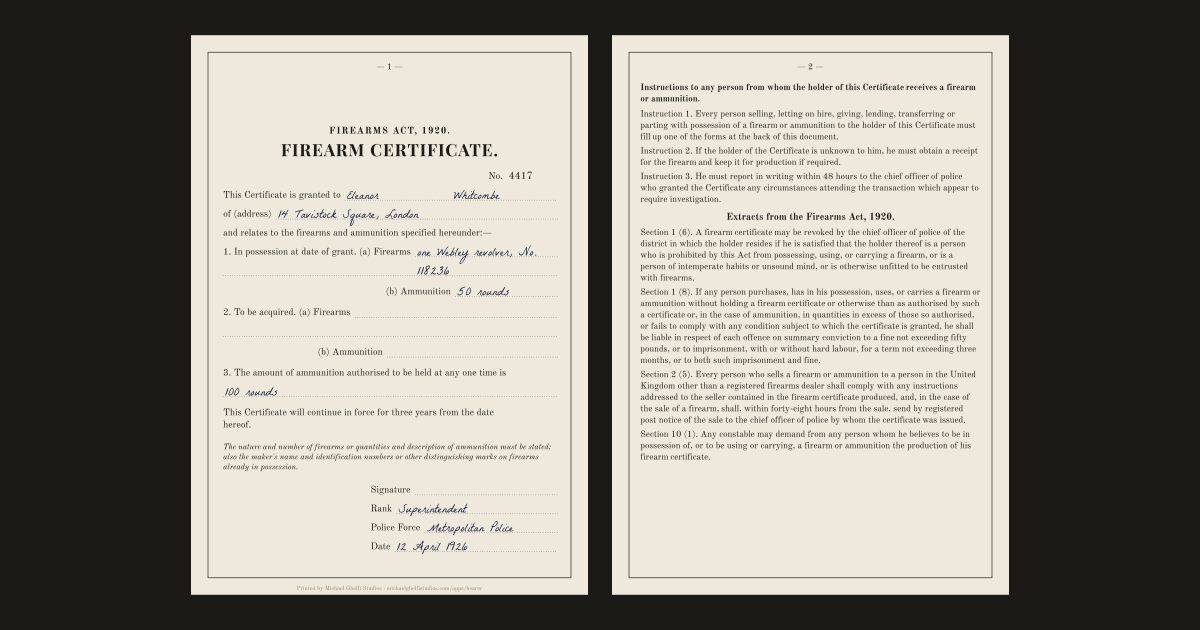
Ouvrir cet exemple dans l'office
Ce que la loi demandait
| Article | Ce qu'il dit |
|---|---|
| 1 (2) | Délivré par le chef de la police du district où réside le demandeur, s'il a une bonne raison et qu'on peut lui faire confiance. |
| 1 (3) | Dans la forme prescrite, nommant la nature et le nombre des armes et les munitions à acheter et à détenir à la fois. |
| 1 (5) | Trois ans, renouvelable trois ans ; un an en Irlande (art. 18). |
| 1 (6) | Retiré à une personne intempérante ou d'esprit dérangé, ou autrement indigne de confiance avec une arme. |
| 2 (5) | Le vendeur suit les instructions du certificat et signale la vente à la police sous quarante-huit heures. |
| 10 | Tout agent peut demander à le voir, et saisir l'arme s'il n'est pas présenté. |
| Première annexe | Cinq shillings ; une demi-couronne pour le renouvellement. |
Ailleurs
La loi Sullivan de New York (1911) faisait du permis de pistolet une affaire de police, et la plupart des États américains et des pays européens avaient leurs propres règles ; aucun de leurs permis n'a été trouvé, et Bearer n'imprime que le certificat britannique.
Le même papier ailleurs
Encore à confirmer
- the form is the one the Minister for Home Affairs of Northern Ireland prescribed on 12 February 1922 under the Act; the form the Home Secretary prescribed for Great Britain has not been found, and Bearer takes the words to be the same. Ce qui trancherait: a British firearm certificate of the twenties or the rules of 1920-21 for Great Britain.
- three years, the Act's term for Great Britain (s. 1(5)); the Northern Irish form says one year, the term the Act gave Ireland (s. 18(4)). Ce qui trancherait: a British firearm certificate.
- the Firearms Act, 1937 consolidated the law from 1 May 1937 and kept the rules and certificates made under the Act of 1920 in force until replaced (s. 33); Bearer keeps the form of 1922 after it. Ce qui trancherait: a firearm certificate issued after 1937.
- the notice prints four of the sections the rules name (1(6), 1(8), 2(5), 10(1)); the rules allow "the essential portions thereof". Ce qui trancherait: a certificate of the period, to see which portions the police printed.
- the size of the sheet. Ce qui trancherait: a firearm certificate measured.
Sources
- Parliament of the United Kingdom; the Act as printed, on Wikimedia Commons, Firearms Act, 1920 (10 & 11 Geo. 5, c. 43), s. 1: no one may purchase, possess, use or carry a firearm or ammunition without a firearm certificate, granted by the chief officer of police of the district the applicant lives in if he has a good reason for it and is no danger to the public safety or the peace (s. 1(2)), in the prescribed form, naming the nature and number of the firearms and the quantities of ammunition to be purchased and held at any one time (s. 1(3)), in force for three years and renewable for three (s. 1(5)), revocable (s. 1(6)); fees in the First Schedule: five shillings, half a crown on renewal; s. 2(5): a seller follows the certificate's instructions and reports a sale to the police within forty-eight hours; s. 10: any constable may demand the certificate; s. 18(4): in Ireland one year instead of three; s. 19(3): in operation from 1 September 1920, or a later day not after 1 December 1920. (lu directement)
- Ministry of Home Affairs for Northern Ireland; Statutory Rules and Orders issued in 1922, pp. 2-6, on the Internet Archive, Rules of the Minister for Home Affairs, dated 12th February, 1922, for carrying into effect the Firearms Act, 1920 (S.R. & O. of Northern Ireland, 1922, No. 19), rule 1: the form of a firearm certificate ("This Certificate is granted to … of … and relates to the firearms and ammunition specified hereunder: 1. In possession at date of grant. (a) Firearms. (b) Ammunition. 2. To be acquired. (a) Firearms. (b) Ammunition. 3. The amount of ammunition authorised to be held at any one time is … This Certificate will continue in force for one year from the date hereof. Signature. Rank. Police Force. Date."), the maker's name and numbers to be stated, the three instructions to a seller, the forms attached at the back for every transfer, a notice of sections 1(6), (8), (9), 2(3), (5), (7), 10, 12(2) and 13(3), and spaces for variations and renewals. (lu directement)
- Parliament of the United Kingdom; on Wikimedia Commons, Firearms Act, 1937 (1 Edw. 8 & 1 Geo. 6, c. 12), s. 2: grant, renewal, variation and revocation, three years; s. 3: five shillings, half a crown on renewal; s. 33: rules and certificates under the Act of 1920 continue in force; s. 34: not extending to Northern Ireland, in operation from 1 May 1937. (lu directement)
Ouvrir le bureau des passeports · MGS Toolbox