Police warrant cards by country
The card a plain-clothes officer or a federal agent shows at the door: his name, rank and service.
Bearer prints it for 2 offices: United Kingdom, United States. Each is read off a document of the time or reconstructed on the country's law, and says which.
Bearer makes an investigator's papers for Call of Cthulhu and any 1920s or 1930s tabletop campaign: the passport a consul would have filled in, with the visas and frontier stamps a campaign leaves in it, and the permits, certificates and tickets of the period, to print or to share.
An example
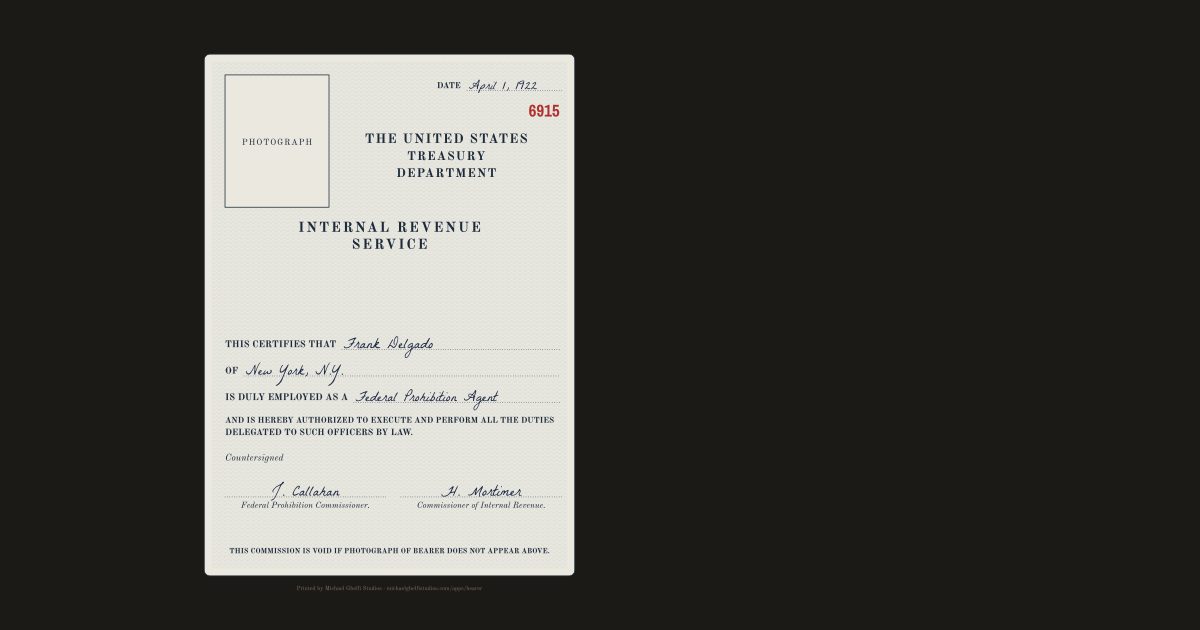
Open this example in the office
Every office Bearer prints it for
| Office | Offered from | Until | How it is known | Printed in |
|---|---|---|---|---|
| United Kingdom | 21 October 1920 | reconstructed on the law | English | |
| United States | 16 January 1920 | 30 June 1930 | read off a document of the period | English |
Each version in full
Sources
- Wikipedia, Warrant card, that a warrant card is proof of identification and authority carried by police constables, its text saying that the holder is granted authority by a named official; nothing about the cards before 1940 (secondary source)
- Wikimedia Commons (public domain), Identification card of Federal Prohibition Agent Isidor Einstein, New York, 1 April 1920 (Treasury Department, Internal Revenue Service, No. 6915), top leaf: PHOTOGRAPH, two photographs, full face and profile, under the Treasury's embossed seal; bottom leaf: DATE …, the number in red, THE UNITED STATES / TREASURY DEPARTMENT / INTERNAL REVENUE SERVICE, THIS CERTIFIES THAT … OF … IS DULY EMPLOYED AS A (Federal Prohibition Agent) AND IS HEREBY AUTHORIZED TO EXECUTE AND PERFORM ALL THE DUTIES DELEGATED TO SUCH OFFICERS BY LAW. Countersigned … Federal Prohibition Commissioner; … Commissioner of Internal Revenue. THIS COMMISSION IS VOID IF PHOTOGRAPH OF BEARER DOES NOT APPEAR ABOVE. (read directly)

Open the passport office · MGS Toolbox