United Kingdom
The British passport took the form of the international type in 1920, a dark blue hard-backed booklet in English and French that stayed in use until 1988. Everything in it was written by hand, which is why it could only be issued by passport offices and consulates.
A husband's passport could carry his wife, with her own description and photograph: a joint passport. Children were written on a parent's or another relative's. A change was made by striking the old detail through and authorising the new one with an official stamp.
Bearer makes an investigator's papers for Call of Cthulhu and any 1920s or 1930s tabletop campaign: the passport a consul would have filled in, with the visas and frontier stamps a campaign leaves in it, and the permits, certificates and tickets of the period, to print or to share.
An example
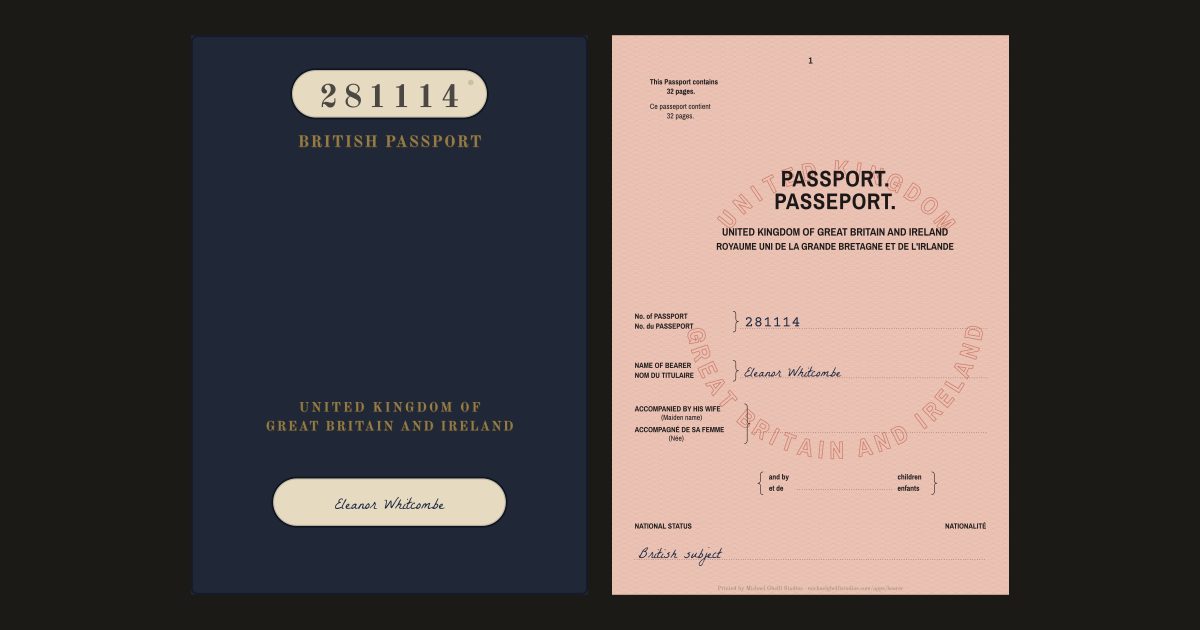
Open this example in the office
The passport
| Issued | from 21 October 1920 |
| Form | a booklet of 32 pages |
| Languages | English + French |
| Validity | 5 years |
| Renewals allowed | 4 |
| Countries | listed on page 4 |
| Wife and children | a joint passport is possible; children under 16 |
| Coat of arms | allowed, not drawn yet. Allowed (the statute turns on a belief of authorisation, which a dated game prop does not create); to be drawn from a period rendering or from the blazon, never from a modern one. |
The description of the bearer
- Profession
- Place and date of birth
- Domicile
- Height
- Colour of eyes
- Colour of hair
- Special peculiarities
The name of the country, by date
| until 11 April 1927 | United Kingdom of Great Britain and Ireland |
| from 12 April 1927 | United Kingdom of Great Britain and Northern Ireland |
The request, on the inside of the cover
| until 22 January 1924 | George Nathaniel, Marquess Curzon of Kedleston |
| from 23 January 1924, until 5 November 1924 | Ramsay MacDonald |
| from 6 November 1924, until 4 June 1929 | Sir Austen Chamberlain |
| from 7 June 1929, until 24 August 1931 | Arthur Henderson |
| from 25 August 1931, until 4 November 1931 | Rufus Isaacs, Marquess of Reading |
| from 5 November 1931, until 6 June 1935 | Sir John Simon |
| from 7 June 1935, until 18 December 1935 | Sir Samuel Hoare |
| from 22 December 1935, until 20 February 1938 | Anthony Eden |
| from 21 February 1938 | Edward Wood, Viscount Halifax |
The British booklet keeps its most famous sentence off its numbered pages altogether: it is printed on the inside of the cover, facing page 1, in a script face, over the Secretary of State's own arms and his signature, with a six-penny revenue stamp struck at the top. It is written in the first person, in his own name and titles, and so it changes with the office.
« We, … His Majesty's Principal Secretary of State for Foreign Affairs. Request and require in the Name of His Majesty all those whom it may concern to allow the bearer to pass freely without let or hindrance, and to afford him every assistance and protection of which he may stand in need. »
Its ports and cities in Passage
The same paper elsewhere
Still to be confirmed
- validity. What would settle it: page 4 of a dated booklet of 1920-1925: HM Passport Office says five years from the start, the 1915 passport ran two and the Irish Free State raised its own from two to five around 1926.
- page 4 (countries, expiry, place and date of issue, renewals), still in the League's words. What would settle it: page 4 of a British booklet of the twenties.
- the French of the country's name after 1927, set after the 1923 form with 'du Nord' added. What would settle it: page 1 of a booklet issued after April 1927.
- the label of the bearer's own signature on page 3, hidden under the signature strip of the booklet read. What would settle it: another booklet of the twenties.
- the day the booklet's words changed: the Royal and Parliamentary Titles Act, read, styled Parliament that of the United Kingdom of Great Britain and Northern Ireland from its passing on 12 April 1927 (s. 2), and Bearer changes the booklet's words that day; when the Passport Office's printer did has not been found. What would settle it: a booklet on either side of April 1927.
- the request printed on the inside of the cover names the Secretary of State of the day in his own titles, and only Lord Curzon's have been read; from January 1924 the page prints the name and the office alone. What would settle it: British booklets issued under each of the eight Foreign Secretaries who followed him.
- the words the form leaves for the bearer, filled in by hand on the booklet read ("him", "he"). What would settle it: a booklet issued to a woman, to see what the clerk wrote there.
Sources
- Foreign Office; photographs of the Robert Byron Papers, Beinecke Rare Book and Manuscript Library, Yale University, on Wikimedia Commons, British passport no. 330155, issued by the Foreign Office on 8 March 1923, read inside cover and pages 1 to 3, inside front cover (the Secretary of State's request, the six-penny revenue stamp), page 1 (identity), page 2 (description, wife's column, children), page 3 (photographs of bearer and wife) (read directly)
- HM Passport Office, Historic passport information, version 11, pp. 8-9, Old Blue (hardback style) passports (read directly)
- Parliament of the United Kingdom; text at legislation.gov.uk, Royal and Parliamentary Titles Act, 1927 (17 & 18 Geo. 5 c. 4), as enacted, passed 12 April 1927; s. 1: the King may alter the royal style by proclamation within six months; s. 2(1): Parliament shall hereafter be known as and styled the Parliament of the United Kingdom of Great Britain and Northern Ireland; s. 2(2): in every Act passed and public document issued after the passing of this Act the expression "United Kingdom" shall, unless the context otherwise requires, mean Great Britain and Northern Ireland (read directly)
- Wikipedia, Foreign Secretary (United Kingdom): the holders of the office, the dates of every Secretary of State for Foreign Affairs between 1919 and 1940, a plain record; the style each was known by is theirs, not the wording a passport printed (secondary source)

Open the passport office · MGS Toolbox