Germany
The German Reich issued a booklet of 32 pages in German alone, and the Geneva conference of 1926 named the booklets in use in England, Germany, Austria and France as the type to recommend: this is a passport of the international type.
Page 1 carries the name, the wife, the number of children and the nationality, with a space for the revenue stamp; page 2 the photograph, riveted through and struck with the office's seal, the signatures of bearer and wife, and the office certifying that the two belong to the same person; page 3 the description, with a column for the wife and a table of the children; page 4 where the passport is good for, when it stops being valid unless renewed, and the office that made it; page 5 three blocks of renewals; the visas begin on page 6, on pages that print no heading at all.
The booklet read was issued at Karlsruhe on 10 August 1939 and runs one year. Its owner was a Jewish chemist leaving Germany: page 1 carries the red J the Reich forced on Jewish passports from October 1938, and the seals struck in it carry the swastika. Bearer prints the J, and the forename Israel or Sara, only when you write them in as a mark of the state, each on its own; it never draws the swastika, and its page on the arms of Germany says why.
Bearer makes an investigator's papers for Call of Cthulhu and any 1920s or 1930s tabletop campaign: the passport a consul would have filled in, with the visas and frontier stamps a campaign leaves in it, and the permits, certificates and tickets of the period, to print or to share.
An example
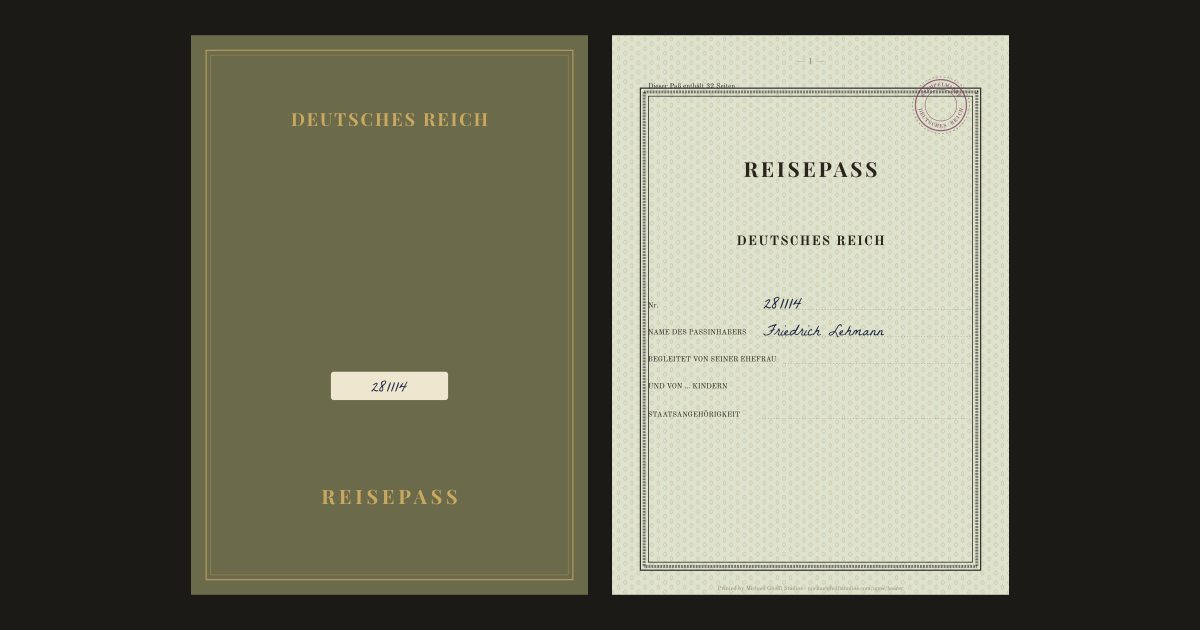
Open this example in the office
The passport
| Issued | from 21 October 1920 |
| Form | a booklet of 32 pages |
| Languages | German |
| Validity | 1 year |
| Renewals allowed | 3 |
| Countries | all countries |
| Wife and children | a joint passport is possible; the children are written in |
| Coat of arms | allowed, not drawn yet. The eagle of the Weimar Republic, which page 1 of the booklet read still carries in 1939: the arms the passport itself prints never changed inside the window. To be drawn from a period rendering or from the blazon, never from a modern one. |
| Seals struck in it | withheld. The seals the police and the district offices struck in a German passport carry the swastika from 1933, as the booklet read shows. Bearer does not draw it: the seals of every authority are a blank ring, and anyone who wants that emblem on their own prop draws it themselves. |
The description of the bearer
What an office put on a passport already issued
The red J, from 5 October 1938. The mark the Reich put on the passport of a German Jew from October 1938.
On 5 October 1938 an ordinance declared invalid every German travel document held by a Jew. It had to be handed to the passport office within a fortnight, and it became valid again only once the office had struck on it "a mark determined by the Reich Minister of the Interior identifying the holder as a Jew". The mark was a red J, some three centimetres high, stamped on page 1.
It came out of a bilateral agreement. Switzerland gave notice on 30 August 1938 that it would require a visa of every German, ending the visa waiver of 1926; to keep German travellers free of visas the German side proposed, in the talks of September at Berne and Berlin, marking the passports of German Jews alone, and the Federal Council accepted on 4 October. Heinrich Rothmund, head of the Swiss aliens police and long held to have invented the mark, had in fact put legal and ethical objections to measures aimed at Jews alone; the mark was proposed and introduced by Germany, and Switzerland bears a share of the responsibility for accepting it. The reciprocal marking of Swiss Jews' passports, which the agreement provided for, was never carried out.
Bearer prints it because the booklet it read to build the German passport carries it: it belonged to a chemist leaving Germany in 1939. It is offered on no other passport and on no earlier date.
The added forename, from 1 January 1939. The forename the Reich made a German Jew add to his own, from January 1939.
An ordinance of 17 August 1938 provided that from 1 January 1939 a Jew whose forename was not on a list drawn up by the ministry must take a further one, Israel for a man and Sara for a woman, and use it in every legal and business dealing. It was written into the passport after the bearer's own forenames, and the passport office entered it like any other change of a detail.
It is offered on a German passport dated after that day and on nothing else.
Its ports and cities in Passage
The same paper elsewhere
Still to be confirmed
- the booklet read was issued at Karlsruhe on 10 August 1939, on a form whose page 1 still carries the eagle of the Weimar Republic. What would settle it: a German booklet of the twenties, to say whether it printed the same pages in the same order.
- validity of one year: the booklet read runs from 10 August 1939 to 10 August 1940, and it was issued to a man the Reich had marked. What would settle it: German booklets issued to other people and in other years.
- page 4 names the issuing office (Der Polizeipräsident, Passamt) where Bearer writes the place of issue. What would settle it: a decision on whether a passport should carry the name of the office that made it, which no other form in the dataset asks for.
- the outside of the cover: the scan shows a plain olive card, which may be its back. What would settle it: a photograph of the front of a German booklet of the period.
- the size of the booklet: the League's 15.5 by 10.5 cm is used. What would settle it: a German booklet measured.
Sources
- Deutsches Reich; photographs of the Georg Bredig papers, Science History Institute, through the Digital Public Library of America, on Wikimedia Commons, Reisepass of the German Reich no. 4480, issued by the police president of Karlsruhe on 10 August 1939, read page by page, page 1 (identity, the Weimar eagle, the notice of 32 pages), page 2 (photographs, signatures and the office's certificate), page 3 (Personenbeschreibung and the children), page 4 (Geltungsbereich, expiry, issuing authority), page 5 (Verlängerungen, three blocks), pages 6 to 32 (visas, with no printed heading) (read directly)
- Reichsminister des Innern, Deutsches Reich, Verordnung über Reisepässe von Juden, vom 5. Oktober 1938, Reichsgesetzblatt 1938 I, S. 1342. §1: every German travel document held by a Jew in the Reich is invalid and is to be surrendered to the passport office within two weeks; it becomes valid again once the office has put on it "ein vom Reichsminister des Innern bestimmtes Merkmal, das den Inhaber als Juden kennzeichnet". The mark the ministry chose was a red J, some three centimetres high. (read directly)
- Historisches Lexikon der Schweiz, «J»-Stempel, Switzerland gave notice on 30 August 1938 that it would require visas of every German; in the talks of 2 September at Berne and 27 to 29 September at Berlin the German side proposed marking the passports of German Jews alone instead, and the Federal Council accepted on 4 October. Rothmund, long held to have invented the mark, had put legal and ethical objections to measures aimed at Jews alone to the Federal Council; recent work holds that the mark was proposed and introduced by Germany and that Switzerland bears a share of the responsibility for accepting an antisemitic agreement. The reciprocal marking of Swiss Jews' passports was never carried out. (secondary source)
- Reichsminister des Innern, Deutsches Reich, Zweite Verordnung zur Durchführung des Gesetzes über die Änderung von Familiennamen und Vornamen, vom 17. August 1938, Reichsgesetzblatt 1938 I, S. 1044. §2: from 1 January 1939 a Jew whose forename is not on the ministry's list must take a further one, Israel for a man, Sara for a woman, and use it in every legal and business dealing. (read directly)
.jpg)
Open the passport office · MGS Toolbox