The English search warrant
When someone swore before a justice of the peace that there was reasonable cause to suspect that stolen goods were hidden in a house, the justice could grant a warrant commanding the constable to enter and search, and bring the goods and the person in whose keeping they were found before a justice. For the investigators it is the paper that opens the cellar door, or the one that brings the police to theirs.
The power is the Larceny Act, 1916's, read: on an information on oath that there was reasonable cause to believe someone had stolen property in his custody or on his premises, a justice could grant a warrant to search for and seize it (s. 42). The words are the form of the search warrant for stolen goods that Oke's Magisterial Formulist, the justices' clerks' book of forms, printed in 1922. No warrant printed by a law stationer and signed by a justice has been found, so the layout is ours, and the office says so above the warrant.
Bearer makes an investigator's papers for Call of Cthulhu and any 1920s or 1930s tabletop campaign: the passport a consul would have filled in, with the visas and frontier stamps a campaign leaves in it, and the permits, certificates and tickets of the period, to print or to share.
An example
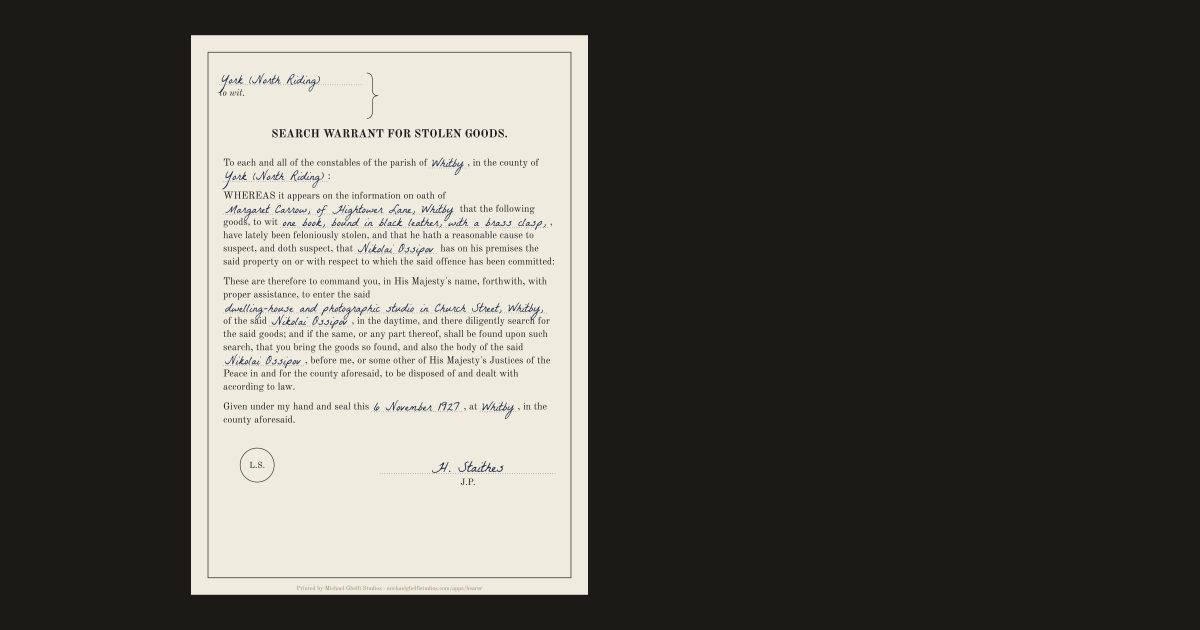
Open this example in the office
The paper
| Offered | from 21 October 1920 |
| Printed in | English |
| Sheets | 1 |
| How it is known | a reconstruction: no document of the period has been found |
A reconstruction
This paper's words are read; its layout is ours. The Larceny Act, 1916 let a justice grant a warrant to search for and seize property stolen, on an information on oath (s. 42); the warrant's words are those of the form the justices' clerks used, printed in Oke's Magisterial Formulist of 1922. A warrant a law stationer printed and a justice signed has not been found, so its layout is ours.
The same paper elsewhere
Still to be confirmed
- the layout: the words are the form book's. What would settle it: a search warrant of 1920 to 1939, printed and signed.
Sources
- Parliament of the United Kingdom; the Act as enacted at legislation.gov.uk, Larceny Act, 1916 (6 & 7 Geo. 5 c. 50), section 42, s. 42(1): if it is made to appear by information on oath before a justice of the peace that there is reasonable cause to believe that any person has in his custody or possession or on his premises any property whatsoever, with respect to which any offence against this Act has been committed, the justice may grant a warrant to search for and seize the same; s. 42(2): a constable authorised in writing by a chief officer of police may enter and search the premises of a person convicted of receiving or of harbouring thieves within twelve months (read directly)
- Butterworth & Co.; on the Internet Archive (Middle Temple Library copy), Oke's Magisterial Formulist, tenth edition, by S. E. Major, joint clerk to the justices at Barrow-in-Furness (Butterworth, 1922), Indictable offences, chap. I, forms 4 and 5, pp. 468-469: Information to ground Search Warrant for Stolen Goods (… hath a reasonable cause to suspect, and doth suspect, that A. B. has in his possession [or on his premises] the said property on or with respect to which the said offence has been committed) and Search Warrant for Stolen Goods, under the Larceny Acts, 1861 and 1916, s. 42 (To each and all of the constables of the parish of …, in the [county] of …: … These are therefore to command you, in His Majesty's name, forthwith, with proper assistance, to enter the said dwelling-house and premises … in the daytime, and there diligently search for the said goods; and if the same, or any part thereof, shall be found upon such search, that you bring the goods so found, and also the body of the said A. B., before me, or some other of His Majesty's Justices of the Peace … to be disposed of and dealt with according to law). The book is the forms a justices' clerk wrote out, the Act of 1848 declaring forms to the same effect good (s. 28) (read directly)
- Parliament of the United Kingdom; text at legislation.gov.uk, Indictable Offences Act, 1848 (11 & 12 Vict. c. 42), Schedule, Form (B.): Warrant to apprehend a Person charged with an indictable Offence, To the Constable of … and to all other Peace Officers in the said [County] of …; Whereas A.B. of … [Labourer] hath this Day been charged upon Oath before the undersigned, [One] of Her Majesty's Justices of the Peace in and for the said County of …, for that he on … at … did [stating shortly the Offence]: These are therefore to command you, in Her Majesty's Name, forthwith to apprehend the said A.B., and to bring him before [me], or some other of Her Majesty's Justices of the Peace in and for the said [County], to answer unto the said Charge, and to be further dealt with according to Law. Given under my Hand and Seal, this … Day of … in the Year of our Lord … at … in the [County] aforesaid. J.S. (L.S.) (read directly)
Open the passport office · MGS Toolbox