The Nansen certificate
In 1921 the Soviet government revoked the citizenship of Russians living abroad, some 800,000 refugees of the civil war among them. A person with no state has no passport, and so no visa, no frontier, no work.
Bearer prints it. You name the country that issued it, and the form is the one the conference agreed on, word for word.
Bearer makes an investigator's papers for Call of Cthulhu and any 1920s or 1930s tabletop campaign: the passport a consul would have filled in, with the visas and frontier stamps a campaign leaves in it, and the permits, certificates and tickets of the period, to print or to share.
An example
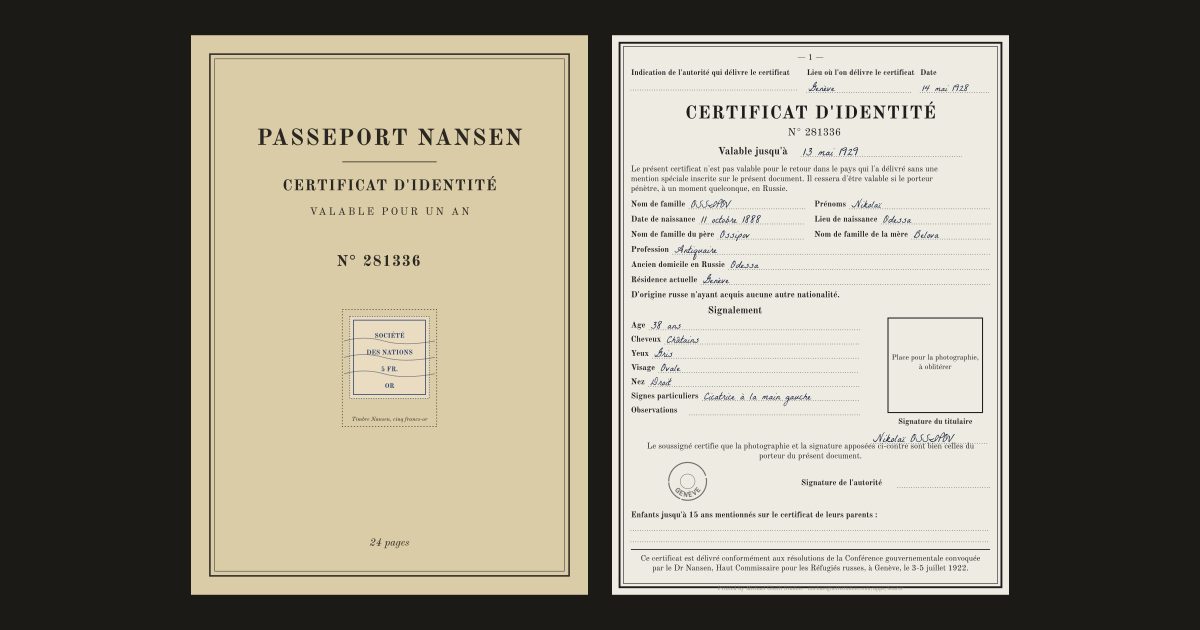
Open this example in the office
What it was
- It came out of the conference Fridtjof Nansen called at Geneva from 3 to 5 July 1922, which agreed on one form of certificate and recommended it to the states represented, to the members of the League and to states outside it.
- The text was to be in at least two languages, the national language of the issuing authority and French, as the Paris conference of 1920 had asked for passports. To the destitute it was free.
- The state that issued it was the only one that could renew it, as long as the bearer went on living there.
- It was extended to Armenian refugees in 1924, and in June 1928 to Turkish, Assyrian, Assyro-Chaldaean and assimilated refugees.
- About 450,000 were provided. By 1942 the governments of 52 countries honoured them. The Nansen International Office for Refugees received the Nobel Peace Prize in 1938, the year it closed.
What the form said
The authority issuing it, the place and the date. A number. How long it ran. Then the notice that decided everything: "The present certificate is not valid for return to the country which issued it without a special provision to that effect contained in it. It will cease to be valid if the bearer enters Russian territory."
Surname, Christian names, date and place of birth, the surname of the father and the surname of the mother, the line "Person of Russian origin not having acquired another nationality", occupation, former residence in Russia, present residence.
A short description: age, hair, eyes, face, nose, special peculiarities, remarks. Beside it the square for the photograph, to be struck through with the seal, and the holder's signature.
At the foot, the authority certifying that the photograph and the signature are the bearer's, its own signature and its seal, and the line saying the certificate is issued in conformity with the resolutions of the conference of 3 to 5 July 1922.
From 12 May 1926
The conference approved the principle of a return visa on certificates of refugees leaving a country, governments free to make exceptions. Children under 15 were to be mentioned on their parents' certificate. Validity should in principle not exceed one year, and the fee should be no more than that of the country's own passport.
On top of it came five gold francs for the League's revolving fund, paid by every Russian and Armenian refugee except the destitute, and no more than once a year: a stamp issued by the High Commissioner, stuck on the certificate or on the identity card and cancelled by the authority that issued it. That stamp is the one people mean by the Nansen stamp.
From 30 June 1928
The notice about coming back was turned round: "This certificate is valid for the return journey to the country by which it was delivered during the period of its validity. It shall cease to be so valid if at any time the bearer enters the territory of the Union of Socialist Soviet Republics (in the case of Russian refugees) or of Turkey (in the case of Armenian refugees)." A refugee could now leave and be let back in.
In Bearer
Pick the Nansen certificate, name the country that issued it, and choose its languages: French alone, English and French, or German and French. The French and English are the official texts of the arrangement; the German is read off a blank German form of 1924. Three forms follow the date of issue, the 1922 one, the 1926 one with its stamp, and the 1928 one with the return written the other way round. It takes visas and frontier stamps like any other booklet, which is the whole point: a certificate no consulate stamps is a person who cannot move.
The same paper elsewhere
Still to be confirmed
- 24 pages, and the title page that carries the number, the year of validity, the price and the Nansen stamp, as on the Bulgarian certificate of 1929 read; the German certificates were a single sheet (one of 1939 read), which Bearer does not print. What would settle it: certificates of France, Britain and other issuing countries.
- the size of the document: the League's 15.5 by 10.5 cm is used. What would settle it: a certificate measured.
- validity of one year. What would settle it: certificates of 1922 to 1926: the model prints 'valable jusqu'à' and fixes no term, and the one year is the rule the conference of May 1926 laid down afterwards.
- which page of the booklet carries the form: in the Bulgarian certificate read, the title page is page 1, so its form stands on page 2; Bearer prints the title page as the cover and the form as page 1. What would settle it: certificates of several issuing countries, to say whether the title page was always counted.
- 24 pages, and the title page that carries the number, the year of validity, the price and the Nansen stamp, as on the Bulgarian certificate of 1929 read; the German certificates were a single sheet (one of 1939 read), which Bearer does not print. What would settle it: certificates of France, Britain and other issuing countries.
- the size of the document: the League's 15.5 by 10.5 cm is used. What would settle it: a certificate measured.
- which page of the booklet carries the form: in the Bulgarian certificate read, the title page is page 1, so its form stands on page 2; Bearer prints the title page as the cover and the form as page 1. What would settle it: certificates of several issuing countries, to say whether the title page was always counted.
- 24 pages, and the title page that carries the number, the year of validity, the price and the Nansen stamp, as on the Bulgarian certificate of 1929 read; the German certificates were a single sheet (one of 1939 read), which Bearer does not print. What would settle it: certificates of France, Britain and other issuing countries.
- the size of the document: the League's 15.5 by 10.5 cm is used. What would settle it: a certificate measured.
- the German of the return notice of 1928: the German column is read off a blank form of 1924; a German certificate issued at Frankfurt in June 1939, read, is still on the form the Reichsdruckerei printed in September 1923, with the notice of 1922, so no German wording of the notice of 1928 is known to have been printed, and this line is left in French and English only. What would settle it: a certificate of another issuing country printed after June 1928.
- the origin line, still the Russian one. What would settle it: a certificate issued to an Armenian, an Assyrian or a Turkish refugee after the Arrangements of 30 June 1928 extended the measures to them.
- which page of the booklet carries the form: in the Bulgarian certificate read, the title page is page 1, so its form stands on page 2; Bearer prints the title page as the cover and the form as page 1. What would settle it: certificates of several issuing countries, to say whether the title page was always counted.
Sources
- League of Nations, Arrangement with regard to the issue of certificates of identity to Russian Refugees, signed at Geneva, July 5, 1922, with the form of certificate annexed, Treaty Series, vol. XIII, no. 355, pp. 237-241 (French and English official texts) (read directly)
- League of Nations, Arrangement relating to the issue of identity certificates to Russian and Armenian refugees, supplementing and amending the previous Arrangements dated July 5th, 1922, and May 31st, 1924, signed at Geneva, May 12, 1926, Treaty Series, vol. LXXXIX, no. 2004, pp. 47-51 (read directly)
- League of Nations, Arrangement relating to the legal status of Russian and Armenian refugees (no. 2005) and Arrangement concerning the extension to other categories of refugees of certain measures taken in favour of Russian and Armenian refugees (no. 2006), both signed at Geneva, June 30, 1928, Treaty Series, vol. LXXXIX, nos. 2005 and 2006, pp. 53-65 (read directly)
- Deutsches Reich, reproduced on Wikimedia Commons, Personalausweis / Certificat d'identite, blank German Reich form of the Nansen certificate, model of 1924, the printed form itself, German and French, read line by line (read directly)
- photograph on Wikimedia Commons, Nansen certificate issued in Bulgaria in 1929, page 1, the booklet's title page: 'PASSEPORT NANSEN / CERTIFICAT D'IDENTITE / VALABLE POUR UN AN', 24 pages, price, and the cancelled Nansen stamp of 1929 (read directly)
- Wikipedia, Nansen passport (secondary source)


Open the passport office · MGS Toolbox