The British Museum Reading Room
A reader applied in writing to the Director of the British Museum, giving his profession or business, his place of abode and the particular purpose for which he sought admission, two days at least before he needed it, with the written recommendation of a householder of recognised position who knew him personally. "Study", "Research" or "Literary work" would not do; the Trustees would not take the word of a hotel keeper or a lodging-house keeper for their lodgers. A ticket of admission was granted for a single day to six months, was not transferable, and was re-dated on renewal.
Inside, the reader found the work in the General Catalogue and filled in a ticket for each book: his name, the date, the letter and number of his seat, the press-mark, the author, the date of publication and the title. The attendants brought the book to the seat, and the reader answered for it until the ticket was reclaimed. White tickets were for books, blue for music, pink for maps.
Bearer makes an investigator's papers for Call of Cthulhu and any 1920s or 1930s tabletop campaign: the passport a consul would have filled in, with the visas and frontier stamps a campaign leaves in it, and the permits, certificates and tickets of the period, to print or to share.
An example
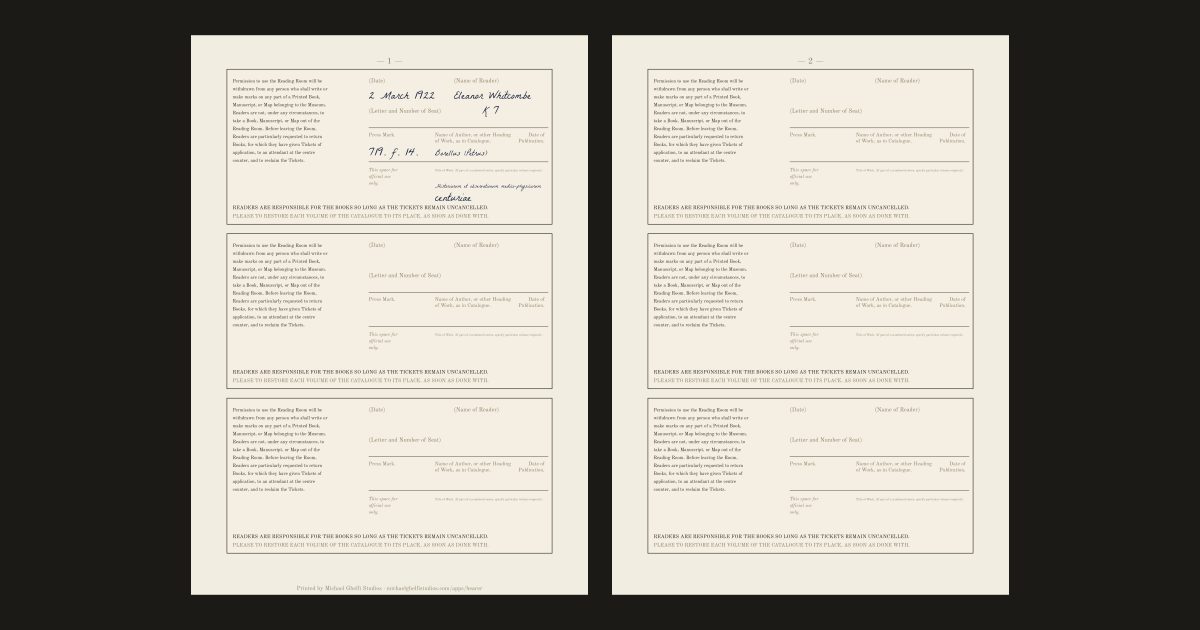
Open this example in the office
The press-mark
| Mark | Meaning |
|---|---|
| 9500. b. 6. | Press 9500, shelf b, sixth book. |
| 09500 … | A sliding press in front of press 9500. |
| … (12.) | The twelfth of several pieces bound together (the tract-mark). |
| Ac. / P.P. | Publications of learned societies; periodicals. R. Ac., R. P. P. in the upper gallery of the Reading Room. |
| C. | The Select Case. |
| G. | The Grenville Library. |
Still to be confirmed
- the wording changed between the Guide of 1919 and that of 1938; the day it changed is not known and is set at 1 January 1938. What would settle it: the editions of the Guide between 1919 and 1938.
- the ticket is read on the sample the Guide prints, not on a ticket itself. What would settle it: a Reading Room ticket for books of the period.
- the Director who signs is the one in office that year (Sir Frederic Kenyon to 1931, Sir George Hill to 1936, Sir John Forsdyke after), from the plain record; the day each took office is set at the middle of the year. What would settle it: the day each Director took office.
- the sample of 1938 adds a line of the Museum's reconstruction work ("During the reconstruction, delay in the supply of books is unavoidable"), left out. What would settle it: nothing: a notice of that year.
- the ticket is read on the sample the Guide prints, not on a ticket itself. What would settle it: a Reading Room ticket for books of the period.
- the Director who signs is the one in office that year (Sir Frederic Kenyon to 1931, Sir George Hill to 1936, Sir John Forsdyke after), from the plain record; the day each took office is set at the middle of the year. What would settle it: the day each Director took office.
Sources
- Trustees of the British Museum; on the Internet Archive, A Guide to the Use of the Reading Room (British Museum), 1919, pp. 7-8: tickets of admission (a written application to the Director stating profession, abode and a definite purpose, with the recommendation of a householder of recognised position, never of a hotel or lodging-house keeper; not transferable; granted for a single day to six months, re-dated on renewal); pp. 18-20: tickets for books, one for each book, the reader's signature, the letter and number of his seat and the press-mark mattering most, a sample ticket filled in, its printed warnings and the five directions on its back. (read directly)
- Trustees of the British Museum; on the Internet Archive (Digital Library of India), A Guide to the Use of the Reading Room (British Museum), 1938, the rules of admission, now also suspendable by the Director and withdrawable by the Trustees at their discretion; the ticket for books as then printed (the name in block capitals, press-marks from the General Catalogue, blue tickets for music and pink for maps), its warnings and the five directions on its back. (read directly)
Open the passport office · MGS Toolbox