The permit to dig
Nobody could dig for antiquities in Egypt, not even on his own land, without an authorisation of the Minister of Public Works, granted on the proposal of the Director General of the Service des Antiquités once the Comité d'Égyptologie had agreed (law no. 14 of 1912 and decree no. 52, in force from 1 January 1913). Every antiquity in Egyptian soil belonged to the State; the excavator was granted a share of what he found.
Bearer prints the authorisation on three sheets: the decision naming the excavator, the site and the season; the articles of the decree he agreed to keep; and the division of the finds, each object set down to the Museum or to him. Page 1 is set in the form the ministry's own decrees take, since no authorisation actually granted has been found.
Bearer makes an investigator's papers for Call of Cthulhu and any 1920s or 1930s tabletop campaign: the passport a consul would have filled in, with the visas and frontier stamps a campaign leaves in it, and the permits, certificates and tickets of the period, to print or to share.
An example
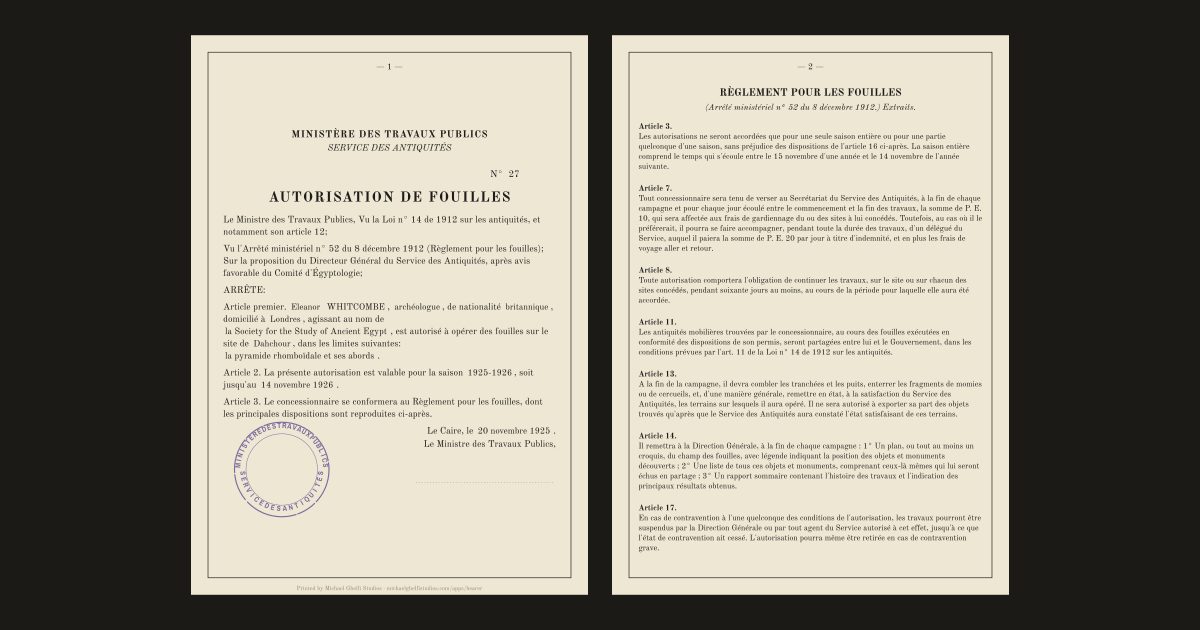
Open this example in the office
What the decree asked of an excavator
| Article | What it says |
|---|---|
| 2 | Only scholars on a mission or officially recommended by a government, a university, an academy or a learned society, or private persons with a reputed scholar to direct the work. |
| 3 | One season at most, from 15 November to 14 November. |
| 4 | Never more than two sites at once for one person, or for the envoys of one government, university, academy or society. |
| 5 | Applied for before 25 October, at the Service in Cairo, with a plan of the site and the programme of the work. |
| 7 | P.E. 10 a day for the guarding of the site, or P.E. 20 a day and the fare for a delegate of the Service at the excavator's side. |
| 8 | Sixty days of work at least on every site granted. |
| 11 | The finds divided between the excavator and the Government, the Service first taking what it means to keep. |
| 13 | Trenches and shafts filled, fragments of mummies and coffins buried, before any share may leave Egypt. |
| 14 | A plan, a list of every object (his share included) and a report, handed in at the end of each season. |
| 17 | Work suspended for any breach, the authorisation withdrawn for a serious one. |
Elsewhere
Palestine under the Mandate had its Antiquities Ordinance of 1920: antiquities belonged to the country, permits went to scientific bodies of recognised standing whatever their nationality, after an international Advisory Board had given its opinion, and "antiquity" meant anything made before 1700. Iraq had its Antiquities Law of 26 June 1924, and Bearer prints its permit to excavate as Permit No. 1 was typed for Ur: in English and in Arabic side by side, granted by the Minister of Communications and Works through the Director of Antiquities, then Gertrude Bell, and accepted on behalf of the British Museum and the University of Pennsylvania under article 9 of the law. Turkey granted a permit by a decree of the Council of Ministers signed by the President of the Republic: the one read let the University of Cincinnati dig at Troy for two years from April 1932. Under the French Mandate the High Commissioner at Beirut granted excavations for Syria and Lebanon under the regulation of 7 November 1933 (arrêté No. 166-LR): only to a learned body, for six years at most, the finds split into two lots of equal importance of which the Service chose one; Bearer prints it in the form of the High Commissioner's arrêtés, since no granted authorisation has been found. Bearer prints the Turkish decree as the one for Troy was typed, the grantee described in Turkish and the site given its locative ending. Peru authorised digs under law 6634 of 13 June 1929: the Government's express permission for every exploration or excavation, granted to national scientific bodies on the Patronato Nacional de Arqueología's report, to foreign societies by diplomatic convention, and to persons who asked; everything found belonged to the State and left the country only by leave. No Peruvian authorisation has been found, so the paper Bearer prints for Peru is a reconstruction, and the office says so above the form. Bearer does not print the Palestinian permit: no licence has been found.
China. The law of 2 June 1930 on the preservation of ancient objects, in force from June 1931, made everything in the ground the State's and let only academic bodies under the central or a provincial government dig, on a licence the Ministries of Education and of the Interior issued together after the Central Commission for the Preservation of Antiquities had reviewed the request; digging without one was punished as theft (art. 8). A foreign learned body or specialist could only help such a body, with the Commission's approval (art. 10), and the Commission sent an inspector to every dig (art. 11). Licence No. 1 was issued on 9 April 1935 to the Institute of History and Philology of the Academia Sinica for Anyang. Before the law, the Commission had already stopped the American Museum's Central Asiatic Expedition: in 1929 it asked for half its members to be Chinese, with two leaders, and for the originals to stay in China; the season was lost, 1930 was the last, and permission was refused in 1931. No licence of the period has been found, so the paper Bearer prints for China is a reconstruction, and the office says so above the form.
Kenya and Australia. Kenya's Ancient Monuments Preservation Ordinance of 1927, modelled on the Indian act of 1904, protected listed monuments; its revision of 1934, written after Louis Leakey's finds, added research and export permits and control of digs at protected sites, so a dig in the Kenya of the thirties asked the colony's leave where the site was listed and for anything taken out of the country. Western Australia passed no law on Aboriginal sites before the Aboriginal Heritage Act of 1972: no permit to dig is known for an expedition into its deserts between the wars.
Mexico. The law published in the Diario Oficial of 19 January 1934 made every immovable archaeological monument, and whatever was found in it, the Nation's, and asked a concession of the Secretaría de Educación Pública for any work that tended to discover one or to explore it; of several identical pieces the Secretaría might give the concessionaire one of each, and nothing left the country without its leave. The Carnegie Institution had dug Chichén Itzá since 1924 under a contract of 3 July 1923. No concession has been found, so the paper Bearer prints for Mexico is a reconstruction, and the office says so above the form.
The same paper elsewhere
Still to be confirmed
- no authorisation actually granted has been found: page 1 is set in the form the ministry's own decrees of 1912 take (Le Ministre des Travaux Publics, Vu…, ARRÊTE, articles), and says what the law and decree no. 52 require an authorisation to say (the person, the site and its limits, the season). What would settle it: an Egyptian autorisation de fouilles of the twenties or thirties.
- the rules printed on page 2 are those of decree no. 52 of 1912; how far the terms granted after 1922 changed them (the division of finds after the discovery of Tutankhamun's tomb) has not been found. What would settle it: the conditions of an Egyptian concession granted after 1922.
- French alone: the law and the decree were published in French and in Arabic, and Bearer has no Arabic face. What would settle it: an Arabic face in the print shop and the Arabic text of the decree (Journal officiel, 19 Safar 1331).
- the page is set at A4. What would settle it: an Egyptian authorisation measured.
- the day and the place of issue are not on the permit read, so Bearer prints neither; the date of issue only chooses who signs. What would settle it: another Iraqi permit to excavate, dated.
- clause (c) speaks of "these mounds" (هذين التلين, two of them), as the permit read does: a permit for one site or for three has not been found. What would settle it: an Iraqi permit for one site or for more than two.
- the Arabic of clause 1 agrees the verb with البعثة (the expedition, feminine: مرخوصة), as on the permit read; a grantee named by a masculine noun would take مرخوص. What would settle it: an Iraqi permit granted to a person or to a masculine body.
- four years when no expiry is typed in: the permit read runs from 1924 to 31 March 1928; what the Antiquities Law itself allows has not been found. What would settle it: the Antiquities Law, 1924.
- the Arabic months other than March (اذار, on the permit read) are the Iraqi names, spelt as the permit spells its words, without hamza. What would settle it: an Iraqi paper of the period dated in those months.
- Gertrude Bell signs until her death on 12 July 1926, a date from secondary sources; after it the title is printed Director of Antiquities (مدير الآثار القديمة, masculine) and the name left to the pen, since her successors' own permits have not been found. What would settle it: a permit to excavate signed after July 1926.
- the Minister of Communications and Works is the minister of the permit read; the ministry's name in later years has not been found. What would settle it: a permit of the thirties.
- the Antiquities Law of 1936 replaced that of 1924; the permits granted under it have not been found, so the type runs on unchanged. What would settle it: a permit to excavate of 1936 or later.
- the sheet is set at A4. What would settle it: the permit measured.
- no authorisation actually granted has been found: page 1 is set in the form of the High Commissioner's own arrêtés (the preamble of No. 166-LR, the closing formula of No. 225 of 1934), and says what articles 58 to 60 require (the learned body, the director of the works, the site, the term). What would settle it: an arrêté of the High Commissioner granting an excavation, or a contrat de concession de fouilles.
- the contract of concession itself (article 59) is not printed: its words have not been found. What would settle it: a contrat de concession de fouilles of the thirties (Mari, Ras Shamra, Dura-Europos, Byblos).
- one year when no expiry is typed in; article 63 allows up to six. What would settle it: a granted authorisation.
- the High Commissioner who signs: D. de Martel is read on an arrêté of 1934; G. Puaux from 1939 is the plain record of his term, the change dated to the turn of the year. What would settle it: acts of the High Commissioner signed in January 1939.
- the type begins with the regulation of 7 November 1933; the regulation of 26 March 1926 (arrêté No. 207) it replaced has not been found. What would settle it: arrêté No. 207 of 1926.
- the sheet is set at A4. What would settle it: an authorisation measured.
- one year when no end of the dig is typed in: licence No. 1 ran four months (March to July 1935), and no other licence has been read. What would settle it: a second licence read, or the Commission's register.
- the ministers' signatures: licence No. 1 is signed in violet by the two ministers of the day; Bearer leaves them out. What would settle it: the ministers of 1935-1939 by date, and a hand that can write them.
- the decree read grants a second campaign at Troy; the words 'vaktiyle hafriyat icra kılınan mevkilerde' (at the places formerly excavated) are left out of the generic text. What would settle it: a kararname granting a first campaign.
- the work begins the month of the day typed as the start (the decree read: April 1932, decided in December 1931); Bearer starts it the month the term begins, the term running from the decree to its expiry. What would settle it: other kararname.
- the ministers' initials are those of December 1931; the cabinets of other years had other ministries. What would settle it: the kararname of other years.
- offered from 1 January 1929, when the Latin alphabet became compulsory in official writing; earlier permits were written in the Arabic script and are not printed. What would settle it: a permit of 1928 or earlier.
- the President of the Republic who signs is the one in office on the day: Gazi M. Kemal read, İsmet İnönü from 11 November 1938 plain record. What would settle it: a kararname of 1938-1939.
- the whole of page 1 and page 3. What would settle it: a supreme resolution of 1929-1939 granting an excavation (El Peruano, or the archive of an expedition: Wendell Bennett's at the American Museum of Natural History).
- the text of law 6634 is read in a modern transcription, not in El Peruano. What would settle it: the Diario Oficial El Peruano of June 1929.
- pages 1 and 3. What would settle it: a concession of the Secretaría de Educación Pública of 1934-1939 (the Carnegie Institution's archive for Chichén Itzá, or the INAH's).
- the type begins with the law of 1934; the law of 30 January 1930 it repealed, and the Carnegie Institution's contract of 3 July 1923 for Chichén Itzá, have not been found. What would settle it: the law of 1930, or the contract of 1923.
Sources
- Gouvernement égyptien, Ministère des Travaux Publics; printed in the Annales du Service des Antiquités de l'Égypte, vol. XII (1912), pp. 245-263, Loi n° 14 de 1912 sur les antiquités, and the arrêtés ministériels n° 50, 51 and 52 of 8 December 1912 (Réglement pour les fouilles), Law no. 14, art. 1: every antiquity on or in the soil of Egypt belongs to the public domain; art. 11: a finder keeps half; art. 12: nobody may dig for antiquities, even on his own land, without an authorisation of the Ministry of Public Works on the proposal of the Director General of the Service des Antiquités, which fixes the place and the period and grants the excavator a share of the finds; art. 14: no export without a special authorisation. Decree no. 52 (in force 1 January 1913): authorisations granted by the Minister after a favourable opinion of the Comité d'Égyptologie (art. 1), only to scholars on a mission or officially recommended, or to private persons with a reputed scholar to direct the work (art. 2), for one season, 15 November to 14 November (art. 3), never more than two sites at once (art. 4), applied for before 25 October (art. 5), P.E. 10 a day for the guarding of the site or P.E. 20 a day for a delegate of the Service travelling with the excavator (art. 7), sixty days' work at least (art. 8), the finds divided between the excavator and the Government under art. 11 of the law (art. 11), transport and export permits on request (art. 12), trenches filled and the ground put back at the end of the season before any share may leave (art. 13), a plan, a list and a report handed in (art. 14), renewal as of right to one who kept to his conditions (art. 16), suspension or withdrawal for breach (art. 17). (read directly)
- Gertrude Bell, Honorary Director of Antiquities, for the Minister of Communications and Works; accepted by C. Leonard Woolley. Original in the British Museum; photograph published by the Penn Museum, Expedition magazine, 'Archaeology in the Digital Age', Antiquities Department of the Government of 'Iraq, Permit to Excavate No. 1: the joint Expedition of the British Museum and the University of Pennsylvania at Tall al Muqaiyir (Ur) and Tall al 'Ubaid, valid until 31 March 1928, typed in English on the left and in Arabic on the right, line for line: the department and the permit's number; clause 1, the expedition permitted to excavate for antiquities at (a) and (b), two mounds, and (c) the area round them defined on a map attached; clause 2, valid until a date and subject to the Antiquities Law, 1924 and to any law or regulations the 'Iraq Government issues meanwhile; the Minister of Communications and Works (a revenue stamp over his line); the Honorary Director of Antiquities, signed in English and in Arabic; accepted on behalf of the two institutions in accordance with article 9 of the Antiquities Law, 1924. The Arabic writes its figures in Arabic-Indic digits and the month as اذار. (read directly)
- Haut-Commissariat de la République française en Syrie et au Liban, Direction du Service des Antiquités; the edition printed at Beyrouth in 1935, with the arrêtés of 1934 and 1943 that amend it. Scan in the UNESCO Database of National Cultural Heritage Laws (Lebanon), Arrêté No. 166-LR du 7 novembre 1933 portant règlement sur les antiquités en Syrie et au Liban (Bulletin officiel des Actes administratifs du Haut-Commissariat, 30 novembre 1933), the preamble (Le Haut-Commissaire de la République Française, Vu…, Sur la proposition du Directeur du Service des Antiquités, Arrête :); title III, Des fouilles, articles 56 to 72: the right to dig belongs to the States represented by the High Commissioner (56), only a learned body for scientific research (57), the request (58), a contract of concession of excavations (59, 60), no more than two authorisations to one applicant and six years at most, renewable (63), an agent of the Service may be delegated (64), every find handed to the State and entered in a register (65), the finds divided in two lots of equal importance, one chosen for the State (68), a photographic dossier and a report (69), the concessionaire's right to publish within three years (70), suspension or withdrawal (71), clandestine digging fined 25 to 500 L.S. (72). The arrêté No. 225 of 28 September 1934 ends 'Beyrouth, le 28 Septembre 1934 / Le Haut-Commissaire / Signé : D. de Martel.' and 'Le Secrétaire Général est chargé de l'exécution du présent arrêté.' (read directly)
- National Government of the Republic of China; text on Chinese Wikisource from the Government Gazette (國民政府公報), 古物保存法 (Law on the Preservation of Ancient Objects), passed 24 May 1930, promulgated 2 June 1930, in force 15 June 1931; re-enacted 10 November 1935, art. 7: everything buried or brought up from the ground belongs to the State; art. 8: only academic bodies under the central or a provincial government may dig, on a licence (採掘執照) the Ministries of Education and of the Interior issue together after review by the Central Commission for the Preservation of Antiquities; digging without it is punished as theft; art. 10: a foreign learned body or specialist may take part only in helping such a body, with the Commission's prior approval; art. 11: the Commission sends an inspector; art. 12: the finds kept for study for a fixed period with the Commission's approval; art. 13: ancient objects circulate only within the country. (read directly)
- Museum of the Institute of History and Philology, Academia Sinica, Taipei (文物館週記 118), 第壹號「採取古物執照」 (Licence to take ancient objects No. 1), the licence itself, photographed: issued on 9 April 1935 by the Ministries of the Interior and of Education to Cai Yuanpei, head of the National Academia Sinica, for a dig from March to July 1935 near Xiaotun and Houjiazhuang and on both banks of the Huan, Anyang, Henan, led by Liang Siyong, Dong Zuobin being sent by the Central Commission to inspect it; the title under a gabled heading, the text in columns with the values written in small, the number on the counterfoil under two seals struck across the cut, the ministries' two seals over the date, the ministers' signatures in violet. (read directly)
- 徐敏 (Xu Min), 中国文物报 (China Cultural Relics News), 5 January 2024, p. 8, 中国考古发掘执照制度的发展 (The development of China's excavation licence system), licence No. 1, 採取古物執照, issued on 9 April 1935 by the Ministries of the Interior and of Education to the Institute of History and Philology of the Academia Sinica for Yinxu (Anyang); it named the excavating body, the period, the place, the leader and the inspectors; applicants filed three copies of a form with the Central Commission and paid two yuan for the licence and two for the stamp. (secondary source)
- Department of State, Washington, Papers Relating to the Foreign Relations of the United States, 1929 vol. II docs. 874-881 and 1930 vol. II docs. 648-649: the Roy Chapman Andrews expedition, May-June 1929: the Chinese society for the preservation of antiquities asks that the American Museum's expedition be half Chinese with two leaders and leave the originals in China; the Museum refuses and the 1929 season is lost; the 1928 collections are released; February 1930: the Foreign Minister says the antiquities law will decide; May 1930: 'everything had been settled' for the season of 1930, the last, permission being refused in 1931. (read directly)
- CRM: The Journal of Heritage Stewardship, U.S. National Park Service, Winter 2007, Gazetting and Historic Preservation in Kenya, the Ancient Monuments Preservation Ordinance of 1927, modelled on the Indian act of 1904, the first of five Kenyan preservation laws; in 1934 it grew to 25 sections, the new ones answering Louis Leakey's discoveries: research and export permits, the ownership and treatment of objects, and control of excavations at protected sites. (secondary source)
- Parliament of Western Australia; Western Australian legislation site, Aboriginal Heritage Act 1972 (Western Australia), Western Australia's first law protecting Aboriginal sites and objects, enacted in 1972. (read directly)
- Congreso del Perú; text transcribed on arqueologia.deperu.com (the Diario Oficial El Peruano of June 1929 not found), Ley N° 6634 (Patronato Nacional de Arqueología), promulgada el 13 de junio de 1929, art. 1: the historical monuments before the Viceroyalty belong to the State; art. 3: so does everything they contain, even found on private land; art. 6: every exploration or excavation not expressly authorised by the Government is fined ten to a hundred Peruvian pounds; art. 7: the Government may grant the permit national scientific bodies ask for, on the report of the Patronato Nacional de Arqueología; art. 8: to foreign scientific societies by stipulations in a diplomatic convention; art. 9: to persons, national or foreign, who ask for it; art. 10: no export without the Government's permission; art. 13: the Patronato (the Minister of Instruction, the Rector of San Marcos, the Director of the National History Museum, the President of the Geographical Society of Lima…); art. 20: finds on private land put at the disposal of the Patronato. (secondary source)
- Estados Unidos Mexicanos; Diario Oficial, Friday 19 January 1934, Tomo LXXXII No. 16, Secretaría de Educación Pública; transcription in UNESCO's Database of National Cultural Heritage Laws, Ley sobre protección y conservación de monumentos arqueológicos e históricos, poblaciones típicas y lugares de belleza natural, promulgated 27 December 1933, art. 3: archaeological monuments are all the remains of the aboriginal civilisations before the Conquest; art. 4: every immovable one belongs to the Nation, and the objects found in it; art. 6: the owner of the land cannot oppose an authorised exploration; art. 8: no one, national or foreign, may remove or restore an archaeological monument or take out what it holds; a concession granted by the Secretaría de Educación Pública is required for every work that tends to discover archaeological monuments, and for exploring those already found; of several identical pieces the Secretaría may give the concessionaire one of each; art. 23: the export of archaeological monuments is forbidden; art. 24: unless the Secretaría authorises it; art. 29: destroying or damaging them, three days to five years in prison and a fine of 100 to 5,000 pesos; art. 30: exporting them against the law is contraband. The law of 30 January 1930 is repealed (transitory art. 1). The decree closes 'Sufragio Efectivo. No Reelección.' (read directly)
- H. C. Luke and E. Keith-Roach (eds.), published under the authority of the Government of Palestine, 1922, The Handbook of Palestine, part V, § 2: Department of Antiquities, the Department of Antiquities formed under the Civil Administration, the Archaeological Advisory Board of the archaeological bodies working in Palestine (British, French, American, Italian, Greek and Jewish) which deals in particular with permits to excavate, and the Antiquities Ordinance: the antiquities of Palestine belong to the country and its people, excavations by scientific bodies of recognised standard are facilitated irrespective of nationality, "antiquity" covers all monuments down to 1700 A.D. (read directly)
- Colonial Office, London, 1928, Report by His Britannic Majesty's Government on the Administration of 'Iraq for the period 1920-1927, the list of the laws of 1924 gives the Antiquities Law, 1924, of 26 June 1924; the reports of the following years name the excavations licensed (Ur, Kish, Nineveh, Nuzi, Warka, Khorsabad) but do not print the law (read directly)
- T.C. Başvekâlet, Muamelât Müdürlüğü; Başbakanlık Cumhuriyet Arşivi; photograph on Wikimedia Commons (CC BY 4.0), Kararname of the Council of Ministers of the Turkish Republic, 12 December 1931, no. 12028: permit to excavate at Troy, on the proposal of the Ministry of Education, the Council of Ministers grants Professor W. T. Semple of the University of Cincinnati leave to excavate, in the name of his university, at the places of Troy formerly excavated, for two years from April 1932; signed by the President of the Republic, Gazi M. Kemal, and by the ministers Read line by line: 'T. C. / BAŞVEKÂLET / MUAMELÂT MÜDÜRLÜĞÜ / Şube: / Sayı: 12028', 'KARARNAME', the text typed ('Amerikanın Cincinati Darülfünunu profesörlerinden M. W. T. Semple, mensup olduğu darülfünun namına Trovada vaktiyle hafriyat icra kılınan mevkilerde 932 senesi nisanından itibaren iki sene müddetle hafriyat icrası için izin verilmesi; Maarif Vekâletinin 12/11/931 tarih ve 85925 numaralı tezkeresiyle yapılan teklifi üzerine İcra Vekilleri Heyetinin 12/12/931 tarihli içtimaında tasvip ve kabul olunmuştur.'), '12/12/931', 'REİSİCÜMHUR' over the President's signature, and the ministers' initials: Bş. V., Ad. V., M. M. V., Da. V., Ha. V., Ma. V., Mf. V., Na. V., İk. V., S. İ. M. V. (read directly)

Open the passport office · MGS Toolbox