The Massachusetts commitment papers
Under chapter 123 of the General Laws of Massachusetts a superintendent could receive a person needing immediate care because of mental derangement for ten days at most, on the written request of a physician, a member of the board of health, a selectman or a police officer (s. 79). Before the ten days ran out, two physicians examined the patient: each swore that he was a graduate of a chartered medical school, three years in practice and registered, and together they certified, within five days of their examination, that the person was insane and a proper subject for treatment in a hospital for the insane, with the facts on which they based it (s. 53). A judge of probate, of the superior court or of a district court then signed the order of commitment, finding the person insane and either an inhabitant of the Commonwealth for six months or dangerous if at large (ss. 50, 51). A licensed private institution could receive the patient as well as a state hospital (s. 10).
The forms were prescribed by the Department of Mental Diseases and have not been found, so the three papers Bearer prints are set on the words of the law, and the office says so above them. They are the road by which an investigator reaches the Arkham Sanitarium, and by which a Keeper takes one there.
Bearer makes an investigator's papers for Call of Cthulhu and any 1920s or 1930s tabletop campaign: the passport a consul would have filled in, with the visas and frontier stamps a campaign leaves in it, and the permits, certificates and tickets of the period, to print or to share.
An example
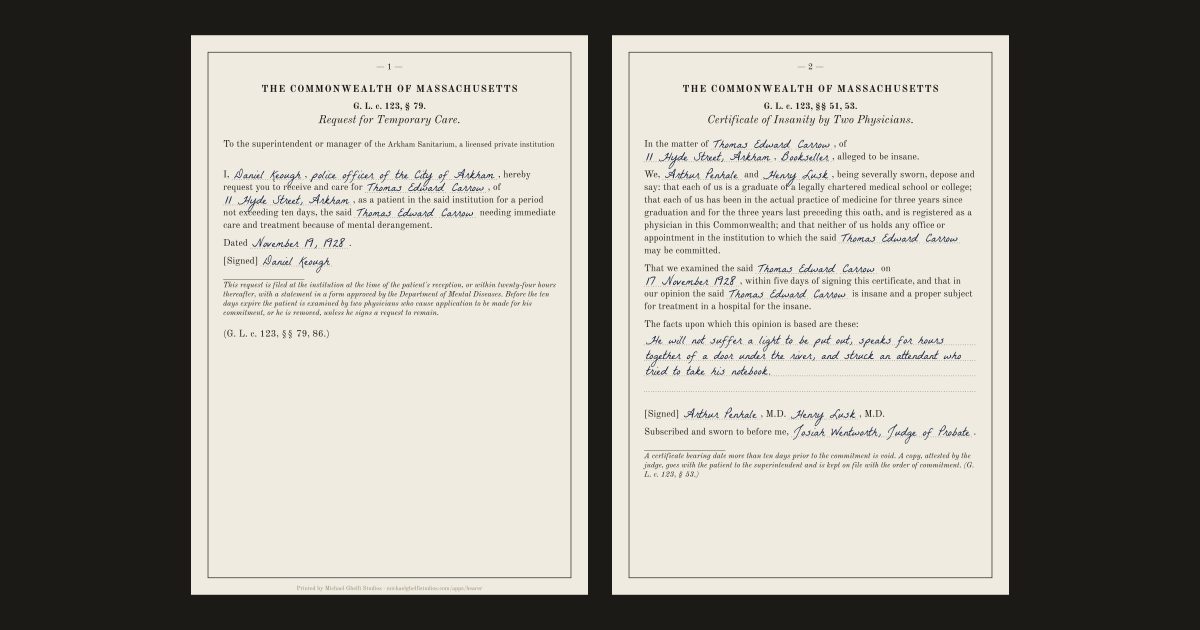
Open this example in the office
The paper
| Offered | from 1 January 1921 |
| Printed in | English |
| Sheets | 3 |
| How it is known | a reconstruction: no document of the period has been found |
A reconstruction
This paper is a reconstruction. Chapter 123 of the General Laws of Massachusetts, read in the edition of 1922, says who could ask for ten days' temporary care (a physician, a selectman, a police officer), what the two physicians swore and certified, and what the judge had to find and order; the forms themselves were prescribed by the Department of Mental Diseases and have not been found. Their words are set on the law's.
The same paper elsewhere
Still to be confirmed
- the three forms. What would settle it: the forms of the Department of Mental Diseases, 1921 to 1939.
Sources
- Department of Mental Diseases, Commonwealth of Massachusetts, The Massachusetts Laws relating to Insane Persons and other classes under the supervision of the Department of Mental Diseases (1922): General Laws, chapter 123, sections 10, 24, 50 to 54, 79, 86, s. 50: a justice of the superior court, a judge of probate, or a justice or special justice of a district court may commit any insane person who is a proper subject for treatment; s. 51: not without a certificate of the insanity of such person by two properly qualified physicians, and an order signed by the judge stating that he finds that the person committed is insane and is a proper subject for treatment in a hospital for the insane, and that he has been an inhabitant of the commonwealth for six months or that by reason of insanity he would be dangerous if at large; s. 53: the physician's oath of qualification, examination within five days, the facts upon which his opinion is based, a certificate dated more than ten days before the commitment void; s. 10: commitment to any licensed private institution; s. 24: the department prescribes the forms; s. 79: temporary care for not more than ten days on the written request of a physician, a member of the board of health, a selectman or a police officer, or a member of the state police; s. 86: a voluntary boarder may leave three days after written notice (read directly)
- Commonwealth of Massachusetts; on the Internet Archive, Tercentenary Edition of the General Laws of Massachusetts (1932), vol. I, chapter 123, sections 50, 51, 53, 79 and 86, s. 51: the order finds the person insane and a proper subject for treatment, and either an inhabitant of the commonwealth for six months, or that provision satisfactory to the department has been made for his maintenance (1925, 293), or dangerous if at large; the judge sees and examines the person or states why not; s. 53 unchanged from 1922 (oath, five days, the facts, a certificate more than ten days old void, none valid from a physician holding office in the institution); s. 79: temporary care for ten days at most on the written request of a physician, member of the board of health, sheriff, deputy sheriff, member of the state police, selectman, police officer or agent of the institutions department of Boston; s. 86: a voluntary patient kept no more than three days after written notice (read directly)
Open the passport office · MGS Toolbox