The Egyptian certificate of export of antiquities
Under law No. 14 of 1912 no antiquity could leave Egypt without a special authorisation of the Service des Antiquités, and anything taken out without it was seized (art. 14). The ministry's arrêté No. 51 set the procedure: a written request naming the applicant, his quality and nationality and the port of exit; the objects shown with a list of their number, nature, dimensions and value; only Egyptian objects of the Pharaonic, Graeco-Roman, Byzantine or Coptic periods; the cases wired and sealed; an exit duty of one and a half per cent of the declared value; and two certificates handed over, one for the State Railways, one in two copies for the Customs.
No certificate of the period has been found, so the paper Bearer prints is a reconstruction on the arrêté, and the office says so above it.
Bearer makes an investigator's papers for Call of Cthulhu and any 1920s or 1930s tabletop campaign: the passport a consul would have filled in, with the visas and frontier stamps a campaign leaves in it, and the permits, certificates and tickets of the period, to print or to share.
An example
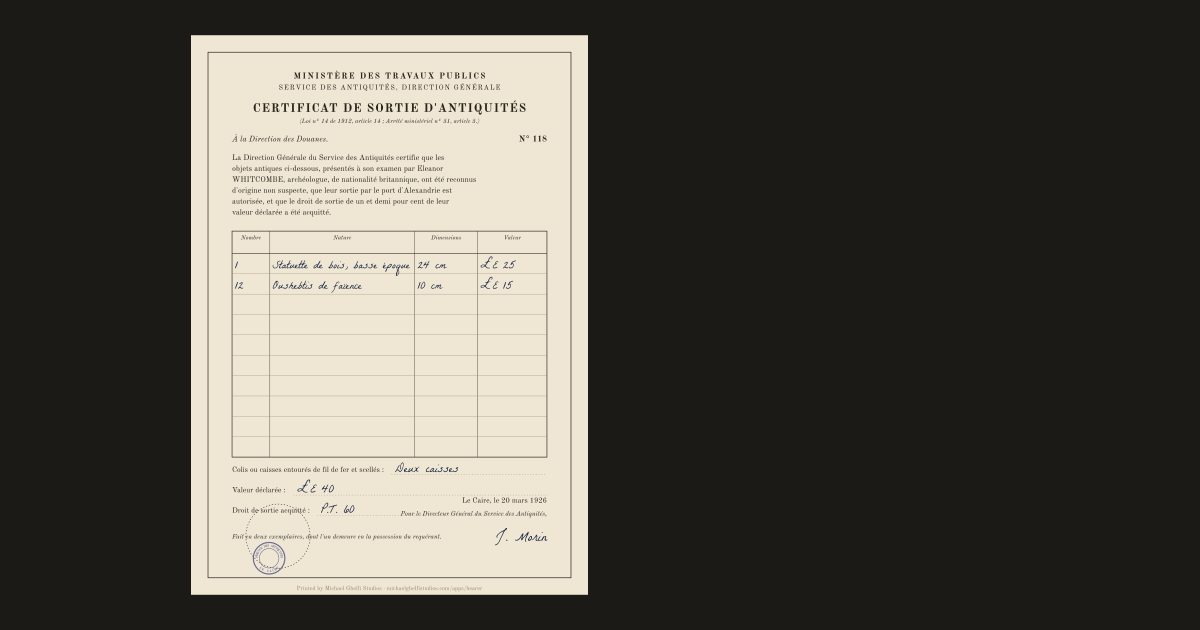
Open this example in the office
The paper
| Offered | from 21 October 1920 |
| Printed in | French |
| Sheets | 1 |
| How it is known | a reconstruction: no document of the period has been found |
A reconstruction
This paper is a reconstruction. No certificate of export of the period has been found: what it certifies and names is the ministry's arrêté No. 51 of 1912 (the applicant's name, quality and nationality, the port of exit, the list of the objects with their number, nature, dimensions and value, the cases wired and sealed, the exit duty of 1 1/2 per cent paid, the certificate in two copies for the Customs); the words and layout are ours.
Still to be confirmed
- the whole certificate. What would settle it: a certificate of export of antiquities of 1920 to 1939.
- the sealing fee per case is not printed: its figure is unreadable in the copy of the arrêté read. What would settle it: a clean copy of arrêté No. 51.
- the certificate for the State Railways, the second paper the arrêté names, is not printed. What would settle it: nothing: one paper is enough at the table.
Sources
- Ministère des Travaux Publics, Égypte; Annales du Service des Antiquités de l'Égypte, vol. XII, archive.org, Loi n° 14 de 1912 sur les antiquités, art. 14, and Arrêté ministériel n° 51, Règlement pour l'exportation des antiquités, 8 December 1912, art. 14: the export of antiquities is prohibited save by a special authorisation of the Administration, anything taken out without it seized; arrêté 51: the written request (name, first names, quality, nationality, port or point of exit), the objects and their cases shown with a list of their number, nature, dimensions and price or value, only Egyptian objects of the Pharaonic, Graeco-Roman, Byzantine or Coptic periods; the cases wired and sealed, a sealing fee per case and an exit duty of 1 1/2 per cent of the declared value; the Direction Générale then hands the applicant a certificate for the State Railways and a certificate in two copies for the Customs stating that the exit duty has been paid (read directly)
Open the passport office · MGS Toolbox