The reception order
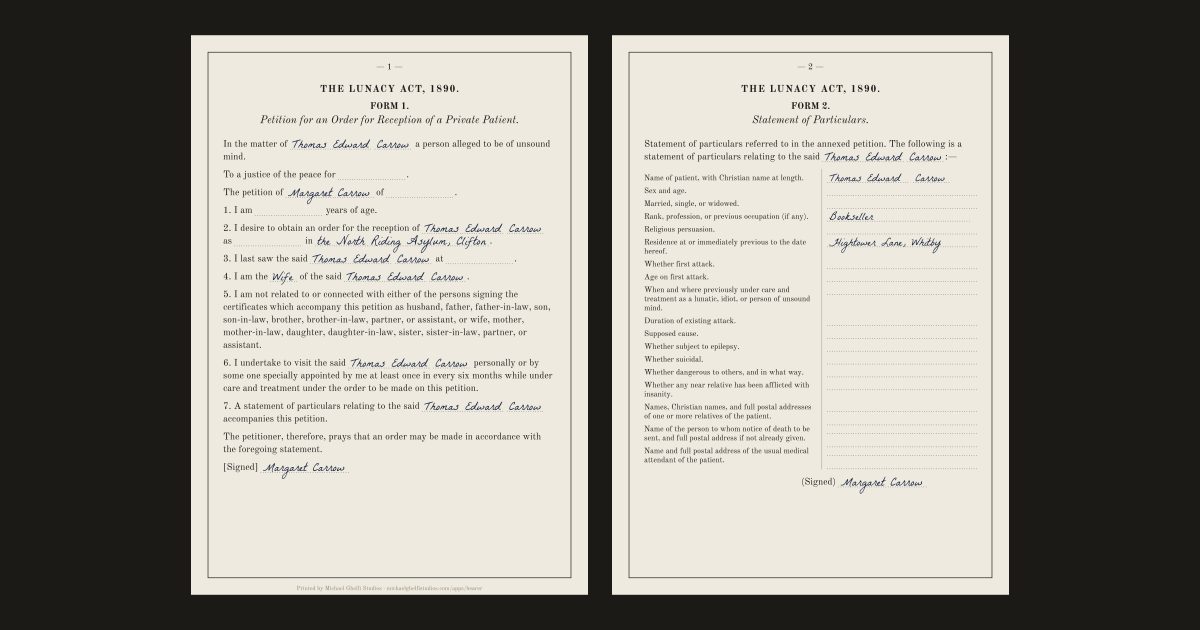
Under the Lunacy Act, 1890 a private patient could be received into an asylum, a hospital or a licensed house on four papers. A petition by a person of at least twenty-one, usually a relative, who had seen the patient within the last fourteen days and undertook to visit him every six months. A statement of particulars. Two certificates by medical practitioners, each examining the patient separately and setting down the facts they saw and those others told them. And an order signed by a justice specially appointed under the Act, a county court judge or a stipendiary magistrate, who might or might not have seen the patient himself.
The certifying doctors could not be the petitioner's husband or wife, parent, child, sibling, in-law, partner or assistant, and a wilful misstatement in a certificate was a misdemeanour. Once received, the patient had the right to ask to be seen by a judge or a justice. Bearer prints the four papers as the Act's schedule sets them out, filled in: a scene for a keeper, and the fear the Call of Cthulhu turns on, as the law of the time wrote it.
From 1 January 1931 the Mental Treatment Act, 1930 kept the order but changed its words: an asylum of a local authority became a mental hospital, and the words "lunatic" and "pauper" were struck from every order and document issued under the Lunacy Acts (s. 20). A paper dated from 1931 prints the forms with those words replaced. The same Act let a person enter as a voluntary patient on his own application, and a patient incapable of saying yes or no be received for up to six months as a temporary patient, without an order.
Bearer makes an investigator's papers for Call of Cthulhu and any 1920s or 1930s tabletop campaign: the passport a consul would have filled in, with the visas and frontier stamps a campaign leaves in it, and the permits, certificates and tickets of the period, to print or to share.
An example
Open this example in the office
The papers
| Form | What it is |
|---|---|
| 1 | Petition for an order for reception of a private patient. |
| 2 | Statement of particulars: age, occupation, religion, the attack, whether suicidal or dangerous, the relatives. |
| 8 | Certificate of medical practitioner, twice: facts observed, facts communicated by others. |
| 3 | Order for reception, addressed to the medical superintendent of the asylum. |
The same paper elsewhere
Still to be confirmed
- the forms are the ones the Act's Second Schedule prints, as read in Archbold's edition of 1895; the papers an asylum actually kept, printed by law stationers, have not been found. What would settle it: a reception order and its certificates of the twenties or thirties.
- the words the forms leave to the one who fills them (a lunatic, an idiot, or a person of unsound mind; asylum, hospital or house) are written as they are filled in, and the bracketed alternatives the Act prints are left out. What would settle it: nothing: the Act prints the alternatives for the one who fills the form.
- England and Wales: Scotland and Ireland had laws of their own. What would settle it: the Scottish and Irish forms.
- the Mental Treatment Act, 1930, read, kept the reception order of 1890 and struck the words "lunatic", "asylum" and "pauper" from every order and document issued under the Lunacy Acts from 1 January 1931 (s. 20): the forms are the ones of 1890 with its substitutions, and where the Act says "such other expression as the context may require" the words chosen are ours. What would settle it: a reception order printed after 1930.
- the three forms. What would settle it: a request, a certificate and a prefect's order of 1920 to 1939.
- the voluntary request is drawn only when someone asks, and the prefect's order only when its circumstances are given. What would settle it: nothing: the law made them two ways of placing a patient.
- the forms are read as the Board of Lunacy printed them in 1859; the Act was amended in 1862 and 1866 and governed until 1960, and the forms of the twenties and thirties are taken to be the same. What would settle it: a Scottish petition, certificate or Sheriff's order of 1920 to 1939.
- the dates are written as the day of the Petition; the forms read print “one thousand eight hundred and”. What would settle it: a form printed after 1900.
Sources
- Parliament of the United Kingdom; printed in J. F. Archbold, Lunacy (4th ed., 1895), pp. 476-481, on the Internet Archive (Wellcome Collection), The Lunacy Act, 1890 (53 & 54 Vict. c. 5), Second Schedule, Forms 1, 2, 3 and 8, Form 1: Petition for an Order for Reception of a Private Patient (the petitioner at least twenty-one, having seen the patient within fourteen days, related or saying why not, unrelated to the certifying doctors, undertaking to visit every six months); Form 2: Statement of Particulars; Form 3: Order for reception of a private patient by a Justice appointed under the Act, a Judge of County Courts or a Stipendiary Magistrate; Form 8: Certificate of Medical Practitioner (registered under the Medical Act, 1858; facts observed, facts communicated by others; the extract of section 317 on wilful misstatement). Checked against the Lunacy Acts Amendment Act, 1889, whose forms the Act of 1890 consolidated. (read directly)
- Parliament of the United Kingdom; the King's Printer's copy at legislation.gov.uk, Mental Treatment Act, 1930 (20 & 21 Geo. 5 c. 23), as enacted: sections 5, 20 and 22 and the First Schedule, s. 20(1): asylums provided by local authorities to be called mental hospitals, and in any order or other document issued under the Lunacy Acts a reference to a mental hospital substituted; s. 20(4): "pauper" to cease, "rate-aided" instead; s. 20(5): the word "lunatic" (save "criminal lunatic") to cease in any enactment, order or other document, "person of unsound mind", "patient" or such other expression as the context may require substituted; s. 22(3): the Act does not apply to Scotland or Northern Ireland; s. 22(4): in operation on 1 January 1931, save as otherwise provided; First Schedule: the forms of application for the reception of a temporary patient and of the recommendation for temporary treatment (two practitioners, one approved by the Board of Control; suffering from mental illness, likely to benefit, for the time being incapable of expressing himself as willing or unwilling; a period not exceeding six months) (read directly)
Open the passport office · MGS Toolbox