Austria
The Republic of Austria issued a booklet of 32 pages in German and French, the League's model almost line for line, and the Geneva conference of 1926 named it among the four to recommend. It was issued by the district authorities, and it ends with Austria on 13 March 1938.
Page 1 carries the number, the name, the wife and the number of children, the nationality and the revenue stamps; page 2 the description, with a column for the wife and a table of the children; page 3 the photographs, the embossed stamp and the signatures; page 4 the countries it is good for, the expiry, the place and date of issue and three renewals. The visas begin on page 5, on pages with no heading.
Read on the passport issued to Hugo von Hofmannsthal at Vienna in 1927, all 32 pages, with the Italian, Hungarian and Swiss visas and stamps it gathered. Austrian law allows the federal arms to be pictured where the use cannot pass for official, so they may be drawn.
Bearer makes an investigator's papers for Call of Cthulhu and any 1920s or 1930s tabletop campaign: the passport a consul would have filled in, with the visas and frontier stamps a campaign leaves in it, and the permits, certificates and tickets of the period, to print or to share.
An example
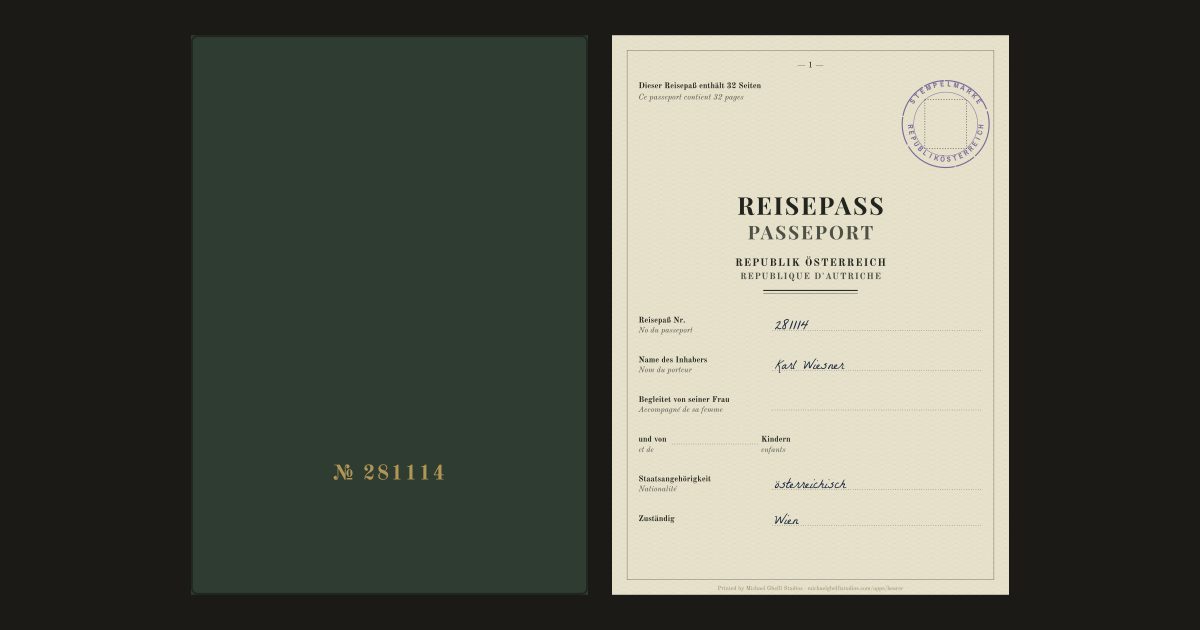
Open this example in the office
The passport
| Issued | from 21 October 1920, until 12 March 1938 |
| Form | a booklet of 32 pages |
| Languages | German + French |
| Validity | 2 years |
| Renewals allowed | 3 |
| Countries | listed on page 4 |
| Wife and children | a joint passport is possible; the children are written in |
| Coat of arms | allowed, not drawn yet. The Austrian law on the arms allows pictures of the federal arms unless the use can pass for a public authorisation or harm the standing of the Republic (Wappengesetz, § 7); a prop dated 1927 on its face, which says what it is, does neither. Page 1 carries the eagle of the First Republic until 1934 and the double-headed eagle of 1934 after it; either may be drawn from a period rendering. |
The description of the bearer
- Profession
- Lieu et date de naissance
- Domicile
- Visage
- Couleur des yeux
- Couleur des cheveux
- Signes particuliers
The same paper elsewhere
Still to be confirmed
- the booklet read was issued in 1927; the stateless document of 1936 shows the same layout under the double-headed eagle of 1934, but a passport of the years 1934 to 1938 has not been found, and it may name the state otherwise than REPUBLIK ÖSTERREICH. What would settle it: an Austrian passport issued between May 1934 and March 1938.
- "Zuständig" (the commune the bearer had his right of home in) is a rubber stamp struck on page 1 of the booklet read, not a printed line. What would settle it: other Austrian booklets, to say whether every office struck it.
- the countries it is good for are struck with a rubber stamp on the booklet read (Germany, England, France, Italy, Poland, Romania, Switzerland, the Kingdom of the Serbs, Croats and Slovenes, Czechoslovakia and Hungary); Bearer writes the list in. What would settle it: nothing: the list is the bearer's choice.
- validity of two years, read on the one booklet. What would settle it: other Austrian booklets.
- the size of the booklet: the League's 15.5 by 10.5 cm is used. What would settle it: an Austrian booklet measured.
Sources
- Republik Österreich, Bezirkshauptmannschaft Hietzing-Umgebung; Freies Deutsches Hochstift, Frankfurter Goethe-Museum (Hs-Foto-1497), through museum-digital:hessen and Europeana (CC BY-NC-SA 4.0), Reisepass of the Republic of Austria no. 1197 (booklet no. 199,830), issued at Vienna on 8 July 1927 to Hugo von Hofmannsthal, valid until 7 July 1929, read page by page, cover (orange card, the printed number, R.Ö. perforated through every leaf), page 1 (Dieser Reisepaß enthält 32 Seiten / Ce passeport contient 32 pages, the eagle, REISEPASS / PASSEPORT, REPUBLIK ÖSTERREICH / REPUBLIQUE D'AUTRICHE, number, name, wife, children, nationality, the revenue stamps, a rubber stamp "Zuständig"), page 2 (Personsbeschreibung / Signalement, a column for the wife, Kinder / Enfants), page 3 (the photographs, Trockenstempel / Timbre sec, the signatures, Für die Paßbehörde), page 4 (the countries it is valid for, struck with a rubber stamp; the expiry; place and date of issue; three renewals), pages 5 to 32 (visas, no heading); an Italian consular visa of 15 July 1927 dated in the Fascist era, stamps of the Italian posts at the Brenner, Coccau and Passo Drava, a Hungarian visa and a stamp of Hegyeshalom, a Swiss stamp of Buchs (read directly)
- Nationalrat, Republik Österreich, Bundesgesetz vom 28. März 1984 über das Wappen und andere Hoheitszeichen der Republik Österreich (Wappengesetz), BGBl. Nr. 159/1984, § 4: who carries the federal arms in the exercise of state functions; § 7: pictures of the federal arms may be used unless the use can pass for a public authorisation or harm the standing of the Republic; § 8: the penalties. Read in the version in force on 21 September 2026. (read directly)
- Bundesstaat Österreich, Polizeidirektion Wien; photograph on Wikimedia Commons (public domain), Identitäts- und Reiseausweis / Titre d'identité et de voyage no. 010,673, Austria, 1936, page 1, the document Austria issued to a stateless resident, on the passport's own layout (32 pages, German and French), with the double-headed eagle of 1934 and ÖSTERREICH perforated through the leaves; "Der Inhaber des vorliegenden Ausweises hat keinen Anspruch auf einen österreichischen Heimatpaß" (read directly)

Open the passport office · MGS Toolbox