The pass for the interior of China
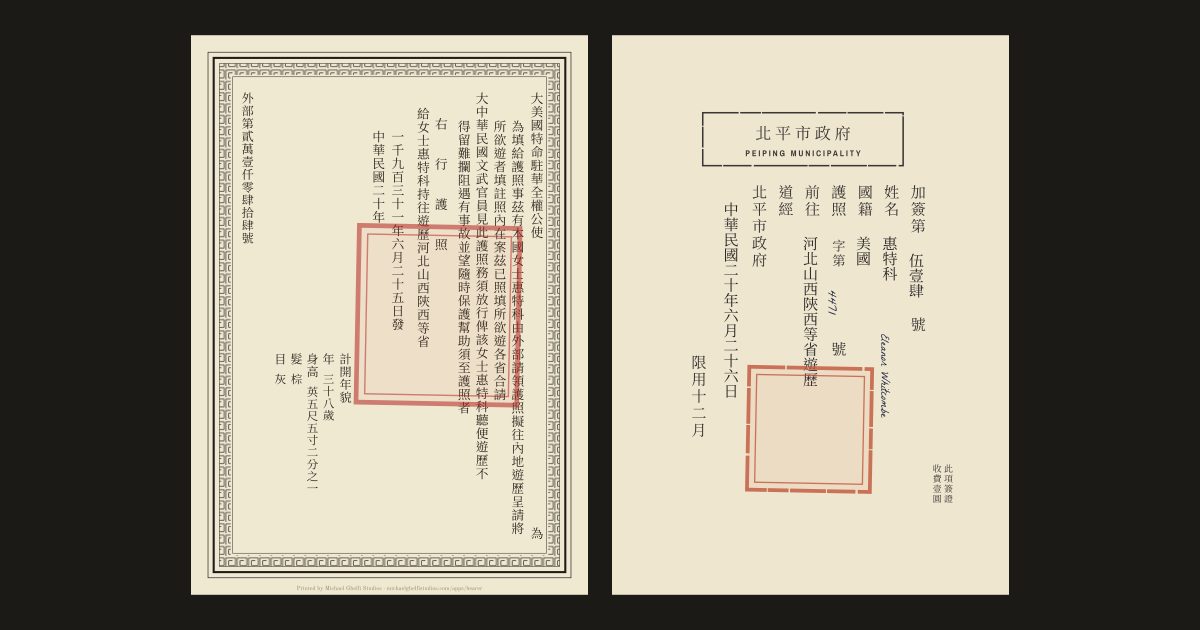
Since the Treaty of Tientsin of 1858 (art. IX) a British subject, and after him the subjects of every treaty power, could travel to all parts of the interior of China under a passport issued by his consul and countersigned by the Chinese authorities, to be shown wherever he passed. Between the wars the pass was still written in Chinese, in columns, in the name of the legation at Peking: the Minister asked the civil and military officials of the Republic to let the bearer pass, not to detain or obstruct him, and to protect and help him in case of trouble. The Ministry of Foreign Affairs numbered it; the provinces the bearer meant to visit were written in; the particulars gave age, height in English feet, hair and eyes. In Peiping the Municipal Government then endorsed it with its own stamp, for twelve months.
Bearer prints the pass and the endorsement given to an American traveller in June 1931, sewn into her passport. The British and French passes use the same words with their own Minister, and say so; the red seal is drawn empty, its seal script being illegible on the pass read.
Bearer makes an investigator's papers for Call of Cthulhu and any 1920s or 1930s tabletop campaign: the passport a consul would have filled in, with the visas and frontier stamps a campaign leaves in it, and the permits, certificates and tickets of the period, to print or to share.
An example
Open this example in the office
The paper
| Offered | from 1 January 1920 |
| Printed in | Chinese |
| Sheets | 2 |
| How it is known | read off a document of the period |
The same paper elsewhere
Still to be confirmed
- the pass read was given by the American Minister in 1931; its words are used for every year from 1920 and for every treaty power. What would settle it: passes of other legations and other years.
- from the raising of the legations to embassies in 1935 the head names an Ambassador (特命全權大使); that wording is ours. What would settle it: a pass of 1935 to 1939.
- the column after the body (右 行 護 照) is read as it stands, its second character uncertain. What would settle it: a clearer pass.
- the red square seal is drawn empty: its seal script is not legible on the pass read. What would settle it: a pass with a clear seal.
- the Peiping Municipal Government's endorsement is drawn only while the city was named Peiping (28 June 1928 to 1937) and dated the day after the pass; the words of the seal's upper legend are ours. What would settle it: endorsements of other cities (Shanghai, Tientsin) and a clear seal.
Sources
- Wikimedia Commons (CC BY 2.0), Pass for travel in the interior of China given to Isabel Ingram by the American Minister and numbered by the Ministry of Foreign Affairs (25 June 1931), sewn into her passport, and the Peiping Municipal Government's endorsement (26 June 1931), pass, in columns: 大美國特命駐華全權公使詹 為填給護照事茲有本國女士梅愛德由外部請領護照擬往內地遊歷呈請將所欲遊者填註照內在案茲已照填所欲遊各省合請大中華民國文武官員見此護照務須放行俾該女士梅愛德聽便遊歷不得留難攔阻遇有事故並望隨時保護幫助須至護照者 / 右 行 護 照 / 給女士梅愛德持往遊歷河北遼寧吉林黑龍江等省 / 一千九百三十一年六月二十五日發 / 中華民國二十年 / 計開年貌: 年二十九歲, 身高英五尺三寸二分之一, 髮棕, 目棕 / 外部第貳萬壹仟零肆拾肆號, a large red square seal; endorsement, in a blue frame: 加簽第伍壹肆號 / 姓名 / 國籍 / 護照 字第 號 / 前往 / 道經 / 北平市政府 / 中華民國二十年六月二十六日 / 限用十二月, an oval seal PEIPING MUNICIPALITY, 此項簽證收費壹圓 (read directly)
- Wikisource, Treaty of Tien-Tsin between the Queen of Great Britain and the Emperor of China, 26 June 1858, Article IX, British subjects are hereby authorized to travel, for their pleasure or for purposes of trade, to all parts of the interior, under passports which will be issued by their Consuls, and countersigned by the local authorities; the passport to be produced for examination in the localities passed through (read directly)

Open the passport office · MGS Toolbox