Egypt
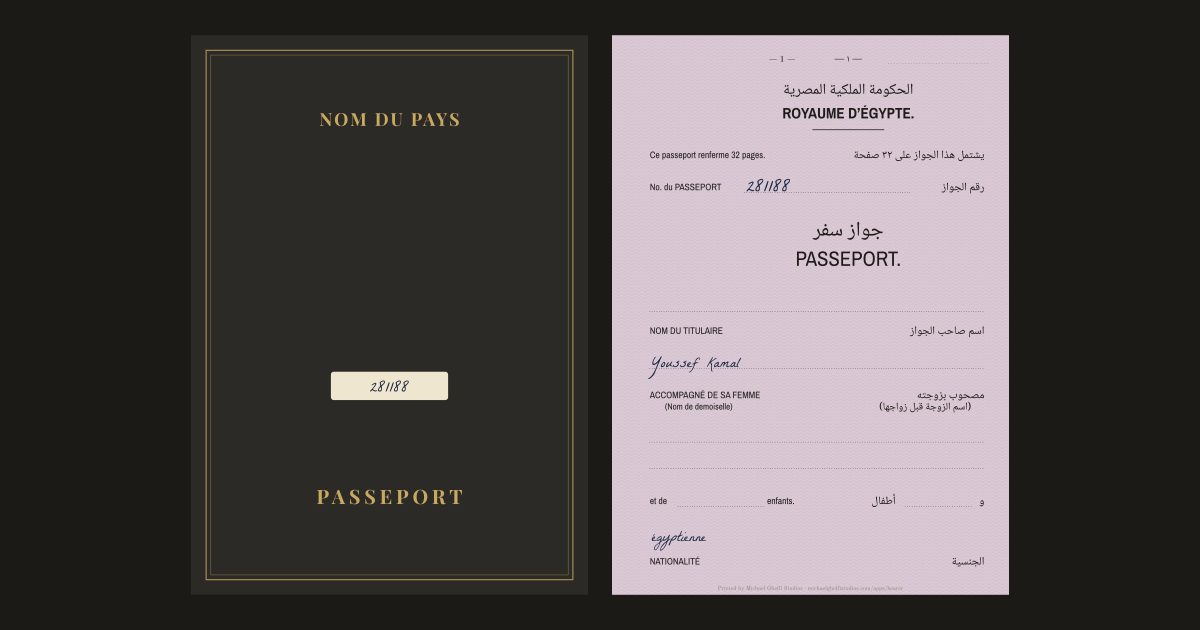
The Kingdom of Egypt issued a booklet of 32 pages in French and Arabic, French on the left of every line and Arabic on the right, each page numbered in both scripts. It is offered from the proclamation of the Kingdom on 15 March 1922.
A leaf before page 1 carries the form number (Modèle No. 117), the Ministry of the Interior and the Directorate General of Public Security, and the request to Egypt's officials and consuls in both languages, signed by the Governor of the town. Page 1 names the bearer, a wife with her maiden name, the children and the nationality; the clerk wrote the values in both scripts.
Read on the booklet issued at Cairo on 12 July 1938 (Modèle No. 117). The pages after the first have not been found: Bearer prints them in the League's French, the Arabic labels taken from the Palestinian booklet, and says so on the paper.
Bearer makes an investigator's papers for Call of Cthulhu and any 1920s or 1930s tabletop campaign: the passport a consul would have filled in, with the visas and frontier stamps a campaign leaves in it, and the permits, certificates and tickets of the period, to print or to share.
An example
Open this example in the office
The passport
| Issued | from 15 March 1922 |
| Form | a booklet of 32 pages |
| Languages | French + Arabic |
| Validity | 2 years, or a single journey |
| Renewals allowed | 4 |
| Countries | listed on page 4 |
| Wife and children | a joint passport is possible; the children are written in |
| Coat of arms | allowed, not drawn yet. The booklet read carries the royal arms as a watermark on page 1; they are left to the design pass. |
The description of the bearer
- Profession
- Lieu et date de naissance
- Domicile
- Visage
- Couleur des yeux
- Couleur des cheveux
- Signes particuliers
- Nom du titulaire, en arabe
- Ville, en arabe
Its ports and cities in Passage
The same paper elsewhere
Still to be confirmed
- the booklet read was issued in 1938; the type is offered from the Kingdom's proclamation on 15 March 1922, its earlier forms not found. What would settle it: Egyptian passports of the twenties.
- the Arabic months other than July (يوليه, on the booklet read) are the Egyptian names, spelt as the booklet spells its words. What would settle it: Egyptian passports issued in other months.
- pages 2 to 4 (the description, the photographs, the validity) have not been found; they are printed in the League's French, which page 1 follows line for line. What would settle it: pages 2 to 4 of an Egyptian passport.
- the term of validity and the number of renewals are the League's. What would settle it: page 4 of an Egyptian passport.
Sources
- Gouvernement égyptien, Ministère des Travaux Publics; printed in the Annales du Service des Antiquités de l'Égypte, vol. XII (1912), pp. 245-263, Loi n° 14 de 1912 sur les antiquités, and the arrêtés ministériels n° 50, 51 and 52 of 8 December 1912 (Réglement pour les fouilles), Law no. 14, art. 1: every antiquity on or in the soil of Egypt belongs to the public domain; art. 11: a finder keeps half; art. 12: nobody may dig for antiquities, even on his own land, without an authorisation of the Ministry of Public Works on the proposal of the Director General of the Service des Antiquités, which fixes the place and the period and grants the excavator a share of the finds; art. 14: no export without a special authorisation. Decree no. 52 (in force 1 January 1913): authorisations granted by the Minister after a favourable opinion of the Comité d'Égyptologie (art. 1), only to scholars on a mission or officially recommended, or to private persons with a reputed scholar to direct the work (art. 2), for one season, 15 November to 14 November (art. 3), never more than two sites at once (art. 4), applied for before 25 October (art. 5), P.E. 10 a day for the guarding of the site or P.E. 20 a day for a delegate of the Service travelling with the excavator (art. 7), sixty days' work at least (art. 8), the finds divided between the excavator and the Government under art. 11 of the law (art. 11), transport and export permits on request (art. 12), trenches filled and the ground put back at the end of the season before any share may leave (art. 13), a plan, a list and a report handed in (art. 14), renewal as of right to one who kept to his conditions (art. 16), suspension or withdrawal for breach (art. 17). (read directly)
- Royaume d'Égypte, Ministère de l'Intérieur, Direction Générale de la Sécurité Publique; photograph on Wikimedia Commons ('1938 Egyptian passport used for travelling to Germany', CC BY-SA 4.0), Passport of the Kingdom of Egypt, Modèle No. 117, no. 56826, issued at Cairo on 12 July 1938 to Mohamed Hosni Bey, the leaf before page 1: the form number, the Kingdom, the Ministry of the Interior and the Directorate General of Public Security, PASSEPORT, the town, the request to Egypt's officials and consuls in French and Arabic side by side, made at … on the … day of the month of … 19.., the Governor's signature; page 1: the Kingdom, the count of 32 pages, the number, PASSEPORT, the bearer's name, accompanied by his wife (maiden name), and … children, nationality; French on the left, Arabic on the right, the page numbered in both scripts. (read directly)
- League of Nations, Advisory and Technical Committee for Communications and Transit, Resolution adopted by the Conference on Passports, Customs Formalities and Through Tickets in Paris on October 21st, 1920 (Passport Conference, Preparatory Documents II), C.641.M.230.1925.VIII (read directly)

Open the passport office · MGS Toolbox