Switzerland
The Swiss Confederation printed its booklet in French, German and Italian, all three on every page, the only passport in Bearer to do so. A federal model replaced the booklets each canton printed for itself in December 1915; the cantons and the legations abroad went on issuing it.
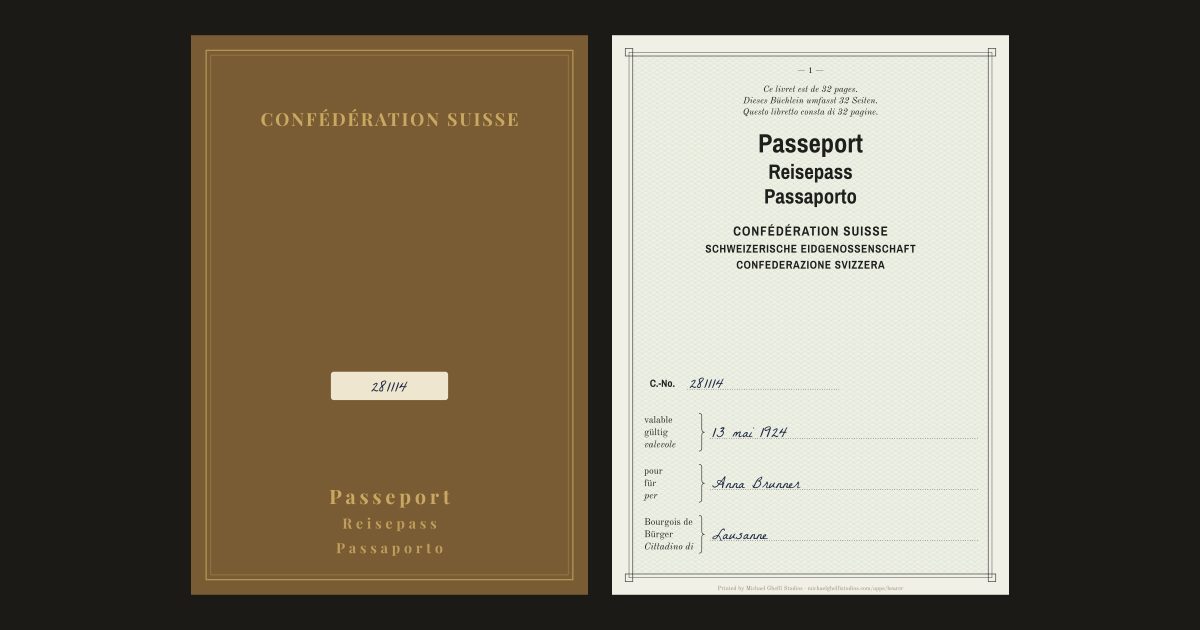
Page 1 carries the Confederation's name in its three languages, the word passport, the number, how long it is valid, the bearer's name and the commune he is a citizen of, which is how a Swiss held his nationality; page 4 the description in twelve lines, the height in centimetres, and the bearer's signature under it; page 5 the photograph, sealed by the office. Pages 2 and 3 have not been seen and are printed empty.
Page 1 is read on a cantonal booklet of 1915 and pages 4 and 5 on the booklet the Swiss legation in Berlin issued to Albert Einstein in 1923. A Swiss consul wrote his visas in French, at Warsaw in 1931 as at Jaffa in 1938. The arms of the Confederation and of the cantons are reserved by Swiss law to the bodies they belong to, and Bearer does not draw them.
Bearer makes an investigator's papers for Call of Cthulhu and any 1920s or 1930s tabletop campaign: the passport a consul would have filled in, with the visas and frontier stamps a campaign leaves in it, and the permits, certificates and tickets of the period, to print or to share.
An example
Open this example in the office
The passport
| Issued | from 21 October 1920 |
| Form | a booklet of 32 pages |
| Languages | French + German + Italian |
| Validity | 2 years |
| Renewals allowed | 0 |
| Countries | all countries |
| Wife and children | no |
| Coat of arms | withheld. Swiss law reserves the arms of the Confederation, of the cantons and of the communes, and any sign that can be confused with them, to the body they belong to (federal law on the protection of arms, LPAP, art. 8), and a prop passport is none of the exceptions the law lists. Page 1 of the Swiss booklet carried the arms of the canton that issued it; they are left out, and so is the white cross the visas and seals carry. |
The description of the bearer
- Bourgois de
- Autorité
- Age: Né le
- Stature
- Taille
- Cheveux
- Front
- Sourcils
- Yeux
- Nez
- Bouche
- Menton
- Visage
- Signes particuliers
Its ports and cities in Passage
The same paper elsewhere
Still to be confirmed
- page 1 is read on a cantonal booklet valid until March 1916, of the model the federal booklet replaced in December 1915; the federal booklet read shows only its pages 4 and 5. What would settle it: page 1 of a Swiss booklet of the twenties.
- the eyes and the nose, the mouth and the chin share a line on page 4; each has a line of its own here. What would settle it: a decision of the design pass.
- validity of two years, the League's recommendation, not found on a Swiss booklet. What would settle it: a Swiss booklet with its date of issue and its expiry both legible.
- whether the booklet took in a wife and children, as the League's model did: not shown on the pages read, so it does not. What would settle it: a Swiss booklet issued to a married man.
- the certificate of the office under the photograph on page 5 is a rubber stamp in the language of the office that issued it (German at Berlin), not a printed text, and is not drawn. What would settle it: Swiss booklets issued at home and at other legations.
- the register number (Reg.) printed beside the booklet's number on page 1 is not asked for. What would settle it: a decision on whether the office's register belongs on the page.
- the size of the booklet: the League's 15.5 by 10.5 cm is used. What would settle it: a Swiss booklet measured.
Sources
- Confédération suisse, Légation de Suisse à Berlin; photograph on Wikimedia Commons, Swiss passport issued by the Swiss legation in Berlin, 1923, pages 4 and 5, page 4 (one heading, "Signalement." then "Connotati.": Age: Né le / Alter: geb. den / Età: nato il; Stature / Gestalt / Corporatura; Taille / Höhe / Statura, in centimetres; Cheveux, Front, Sourcils, Yeux, Nez, Bouche, Menton, Visage, Signes particuliers, each in French, German and Italian; Signature du porteur / Unterschrift des Inhabers / Firma del titolare), page 5 (the photograph, the legation's seal, its certificate struck in German with a rubber stamp); every page headed and footed "Ce livret est de 32 pages / Dieses Büchlein umfasst 32 Seiten / Questo libretto consta di 32 pagine" and numbered in the three languages (Page quatrième / Vierte Seite / Pagina quarta) (read directly)
- Assemblée fédérale de la Confédération suisse, Loi fédérale sur la protection des armoiries de la Suisse et des autres signes publics (LPAP), du 21 juin 2013, RS 232.21, art. 2: the arms of the Confederation are a Swiss cross in a triangular shield. Art. 8 al. 1: the arms of the Confederation, of the cantons, of the communes and of other public bodies, the characteristic elements of cantonal arms with a shield, and signs that can be confused with them may be used only by the body concerned; al. 3: no licence, no transfer; al. 4: the exceptions (illustration in a dictionary, reference or scientific work; decoration at a festival or event; decoration of objects of applied art; the Swiss patent sign; a collective or guarantee mark; a use continued under art. 35). Art. 9 and 10: the official designations and the flags may be used by others where the use is neither misleading nor contrary to public order, morals or the law. Read in the version in force on 1 January 2017. (read directly)
- Kanton Graubünden; Semadeni family archive, on Wikimedia Commons, Swiss passport issued by the Canton of Graubünden, valid until 13 March 1916: inside cover and page 1, page 1: C.-No., Reg., "Schweizerische Eidgenossenschaft / Confederazione svizzera / Confédération Suisse", the canton in its three names with its arms, "Reisepass", "Passaporto" and "Passeport", gültig / valevole / valable, für / per / pour, Bürger / Cittadino di / Bourgois de (so printed); the inside cover carries the photograph and the police stamps (read directly)
- League of Nations, Advisory and Technical Committee for Communications and Transit, Resolution adopted by the Conference on Passports, Customs Formalities and Through Tickets in Paris on October 21st, 1920 (Passport Conference, Preparatory Documents II), C.641.M.230.1925.VIII (read directly)


Open the passport office · MGS Toolbox