The German Kennkarte
From 1938 the German police issued an inland identity card, the Kennkarte, on form A 104: on the left the place and number of the card and its term of five years, then the name and forenames, the date and place of birth, the profession, the permanent and changeable marks and remarks; on the right the photograph under the office's stamp, the prints of the right and left index fingers, the holder's signature, the place and date, and the official's signature for the police headquarters.
The card Bearer prints it off was issued at Munich on 9 March 1939 to a Jewish man: the office struck a large J across his particulars and wrote the forename Israel after his own, as the Reich then forced on Jewish men, and Sara on Jewish women. Bearer prints both when you write them in as marks of the state, each on its own. The eagle and swastika of the office's stamps are never drawn; the rings stay empty.
Bearer makes an investigator's papers for Call of Cthulhu and any 1920s or 1930s tabletop campaign: the passport a consul would have filled in, with the visas and frontier stamps a campaign leaves in it, and the permits, certificates and tickets of the period, to print or to share.
An example
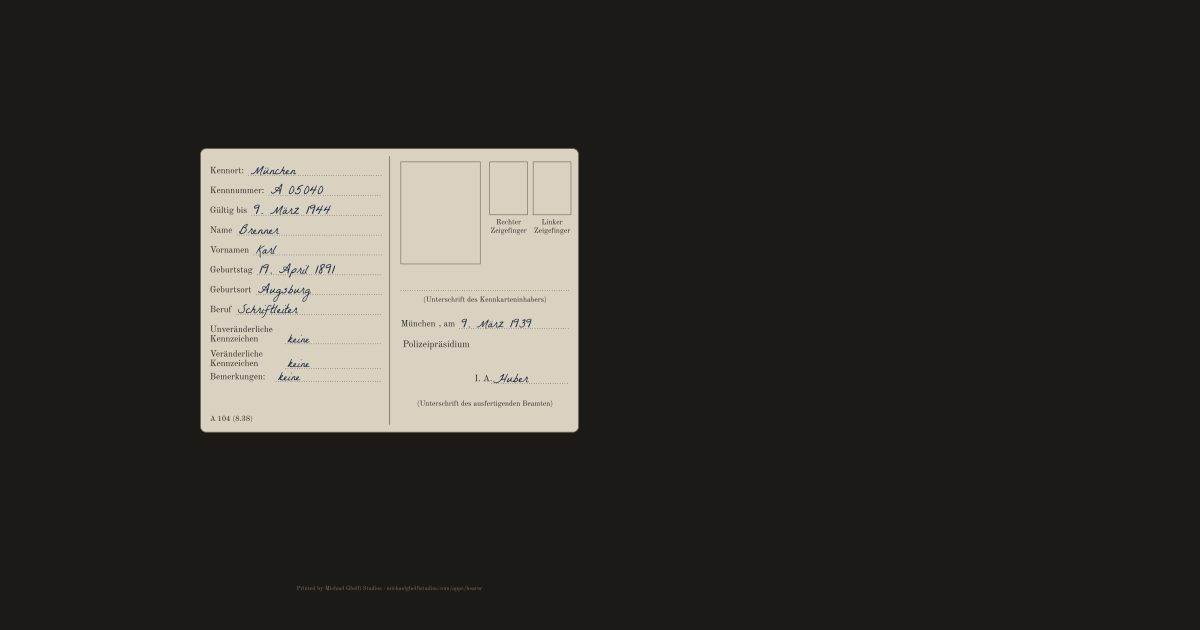
Open this example in the office
The paper
| Offered | from 1 October 1938 |
| Printed in | German |
| Sheets | 1 |
| How it is known | read off a document of the period |
The same paper elsewhere
Still to be confirmed
- the office's round stamps carry the Reich's eagle with the swastika, which Bearer never draws: the rings stay empty. What would settle it: nothing: those emblems are not drawn.
- the fingerprints are drawn as a pattern, not a person's. What would settle it: nothing.
Sources
- Wikimedia Commons (public domain), Kennkarte, form A 104 (8.38), issued by the Polizeipräsidium München on 9 March 1939 to Hugo Erlanger, with the J and the forename Israel, left: Kennort, Kennnummer, Gültig bis (five years), Name, Vornamen, Geburtstag, Geburtsort, Beruf, Unveränderliche Kennzeichen, Veränderliche Kennzeichen, Bemerkungen, the large J across the table; right: the photograph, Rechter Zeigefinger and Linker Zeigefinger (the prints), (Unterschrift des Kennkarteninhabers), München, am … 19.., Polizeipräsidium, I. A., (Unterschrift des ausfertigenden Beamten), the office's round stamps; foot: A 104 (8.38) (read directly)
- Reichsgesetzblatt 1938 I, p. 913 (Wikisource transcription), Verordnung über Kennkarten, 22 July 1938, § 1 (a general police identity card for German nationals from their fifteenth year, compulsory for the groups the Minister names), § 2 (applied for at the local police, issued by the Paßbehörde), § 3 (photographs, fingerprints, signature), § 5 (the Minister’s model, no alteration), § 6 (five years, no extension), § 7 (three Reichsmark, one for a new card after a change of name or profession), § 14 (in force on 1 October 1938) (read directly)

Open the passport office · MGS Toolbox