Committal papers by country
The papers that put a patient in an asylum against his will: the request of a relative or an official, the doctors' certificates, and the order of a judge, a sheriff or a prefect. The road to the sanitarium.
Bearer prints it for 4 offices: Commonwealth of Massachusetts, France, Scotland, United Kingdom. Each is read off a document of the time or reconstructed on the country's law, and says which.
Bearer makes an investigator's papers for Call of Cthulhu and any 1920s or 1930s tabletop campaign: the passport a consul would have filled in, with the visas and frontier stamps a campaign leaves in it, and the permits, certificates and tickets of the period, to print or to share.
An example
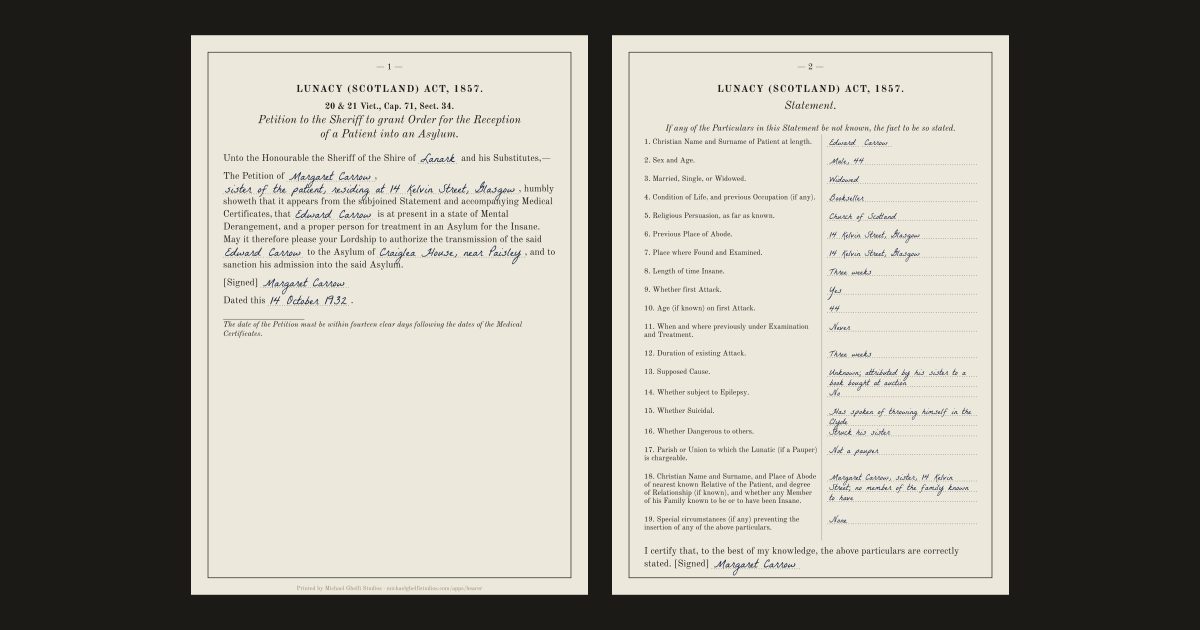
Open this example in the office
Every office Bearer prints it for
| Office | Offered from | Until | How it is known | Printed in |
|---|---|---|---|---|
| Commonwealth of Massachusetts | 1 January 1921 | reconstructed on the law | English | |
| France | 1 January 1920 | reconstructed on the law | French | |
| Scotland | 1 January 1920 | read off a document of the period | English | |
| United Kingdom | 21 October 1920 | 31 December 1930 | read off a document of the period | English |
| United Kingdom | 1 January 1931 | read off a document of the period | English |
Each version in full
- The Massachusetts commitment papers
- The French committal papers of 1838
- The Scottish committal papers
- The reception order
Sources
- Department of Mental Diseases, Commonwealth of Massachusetts, The Massachusetts Laws relating to Insane Persons and other classes under the supervision of the Department of Mental Diseases (1922): General Laws, chapter 123, sections 10, 24, 50 to 54, 79, 86, s. 50: a justice of the superior court, a judge of probate, or a justice or special justice of a district court may commit any insane person who is a proper subject for treatment; s. 51: not without a certificate of the insanity of such person by two properly qualified physicians, and an order signed by the judge stating that he finds that the person committed is insane and is a proper subject for treatment in a hospital for the insane, and that he has been an inhabitant of the commonwealth for six months or that by reason of insanity he would be dangerous if at large; s. 53: the physician's oath of qualification, examination within five days, the facts upon which his opinion is based, a certificate dated more than ten days before the commitment void; s. 10: commitment to any licensed private institution; s. 24: the department prescribes the forms; s. 79: temporary care for not more than ten days on the written request of a physician, a member of the board of health, a selectman or a police officer, or a member of the state police; s. 86: a voluntary boarder may leave three days after written notice (read directly)
- Commonwealth of Massachusetts; on the Internet Archive, Tercentenary Edition of the General Laws of Massachusetts (1932), vol. I, chapter 123, sections 50, 51, 53, 79 and 86, s. 51: the order finds the person insane and a proper subject for treatment, and either an inhabitant of the commonwealth for six months, or that provision satisfactory to the department has been made for his maintenance (1925, 293), or dangerous if at large; the judge sees and examines the person or states why not; s. 53 unchanged from 1922 (oath, five days, the facts, a certificate more than ten days old void, none valid from a physician holding office in the institution); s. 79: temporary care for ten days at most on the written request of a physician, member of the board of health, sheriff, deputy sheriff, member of the state police, selectman, police officer or agent of the institutions department of Boston; s. 86: a voluntary patient kept no more than three days after written notice (read directly)
- Royaume de France (texte en vigueur jusqu'en 1990); texte reproduit par le CRPA, référence Légifrance JORFTEXT000000882534, Loi du 30 juin 1838 sur les aliénés, articles 8, 10, 11, 18 et 19, art. 8: une demande d'admission contenant les noms, profession, âge et domicile, tant de la personne qui la formera que de celle dont le placement sera réclamé, et l'indication du degré de parenté ou, à défaut, de la nature des relations qui existent entre elles, écrite et signée, ou reçue par le maire ou le commissaire de police; un certificat de médecin constatant l'état mental de la personne à placer, et indiquant les particularités de sa maladie et la nécessité de faire traiter la personne désignée dans un établissement d'aliénés, et de l'y tenir renfermée, non admis s'il a été délivré plus de quinze jours avant sa remise, s'il est signé d'un médecin attaché à l'établissement ou parent ou allié au second degré; le passeport ou toute autre pièce propre à constater l'individualité; art. 18: à Paris le préfet de police, dans les départements les préfets ordonneront d'office le placement de toute personne dont l'état d'aliénation compromettrait l'ordre public ou la sûreté des personnes, par des ordres motivés énonçant les circonstances; art. 19: en cas de danger imminent, les commissaires de police à Paris et les maires ailleurs ordonnent les mesures provisoires, à la charge d'en référer dans les vingt-quatre heures au préfet (read directly)
- General Board of Commissioners in Lunacy for Scotland, First Annual Report of the General Board of Commissioners in Lunacy for Scotland (1859), Appendix E, Schedule 3: the forms of the Lunacy (Scotland) Act, 1857 (20 & 21 Vict. c. 71, s. 34) for placing a patient in an asylum, Petition to the Sheriff to grant order for the reception of a patient into an asylum (… is at present in a state of Mental Derangement, and a proper person for treatment in an Asylum for the Insane; the petition within fourteen clear days of the medical certificates); Statement of nineteen particulars; Form of Medical Certificate (I, the undersigned …, hereby certify, on soul and conscience, that I have this day, at …, separately from any other Medical Practitioner, visited and personally examined …, and that the said … is (a Lunatic …) and a proper Person to be detained under Care and Treatment …: 1. Facts indicating Insanity observed by myself; 2. Other facts … communicated to me by others); Certificate of Emergency; Order to be granted by the Sheriff for the transmission and reception of the lunatic (read directly)
- Parliament of the United Kingdom; printed in J. F. Archbold, Lunacy (4th ed., 1895), pp. 476-481, on the Internet Archive (Wellcome Collection), The Lunacy Act, 1890 (53 & 54 Vict. c. 5), Second Schedule, Forms 1, 2, 3 and 8, Form 1: Petition for an Order for Reception of a Private Patient (the petitioner at least twenty-one, having seen the patient within fourteen days, related or saying why not, unrelated to the certifying doctors, undertaking to visit every six months); Form 2: Statement of Particulars; Form 3: Order for reception of a private patient by a Justice appointed under the Act, a Judge of County Courts or a Stipendiary Magistrate; Form 8: Certificate of Medical Practitioner (registered under the Medical Act, 1858; facts observed, facts communicated by others; the extract of section 317 on wilful misstatement). Checked against the Lunacy Acts Amendment Act, 1889, whose forms the Act of 1890 consolidated. (read directly)
- Parliament of the United Kingdom; the King's Printer's copy at legislation.gov.uk, Mental Treatment Act, 1930 (20 & 21 Geo. 5 c. 23), as enacted: sections 5, 20 and 22 and the First Schedule, s. 20(1): asylums provided by local authorities to be called mental hospitals, and in any order or other document issued under the Lunacy Acts a reference to a mental hospital substituted; s. 20(4): "pauper" to cease, "rate-aided" instead; s. 20(5): the word "lunatic" (save "criminal lunatic") to cease in any enactment, order or other document, "person of unsound mind", "patient" or such other expression as the context may require substituted; s. 22(3): the Act does not apply to Scotland or Northern Ireland; s. 22(4): in operation on 1 January 1931, save as otherwise provided; First Schedule: the forms of application for the reception of a temporary patient and of the recommendation for temporary treatment (two practitioners, one approved by the Board of Control; suffering from mental illness, likely to benefit, for the time being incapable of expressing himself as willing or unwilling; a period not exceeding six months) (read directly)
Open the passport office · MGS Toolbox