The firearm certificate
From the Firearms Act, 1920 nobody in the United Kingdom could buy, keep, use or carry a firearm or its ammunition without a firearm certificate, granted by the chief officer of police of his district if he had "a good reason" and was no danger to the public safety or the peace. A smooth-bore shot-gun, an air-gun and an air-rifle were not firearms under it in Great Britain.
The certificate named every firearm, its maker and its number, and the ammunition the holder might buy and keep at any one time; it ran three years in Great Britain and one in Ireland, cost five shillings and half a crown to renew. Every seller filled in one of the forms at its back, and any constable could ask to see it.
Bearer makes an investigator's papers for Call of Cthulhu and any 1920s or 1930s tabletop campaign: the passport a consul would have filled in, with the visas and frontier stamps a campaign leaves in it, and the permits, certificates and tickets of the period, to print or to share.
An example
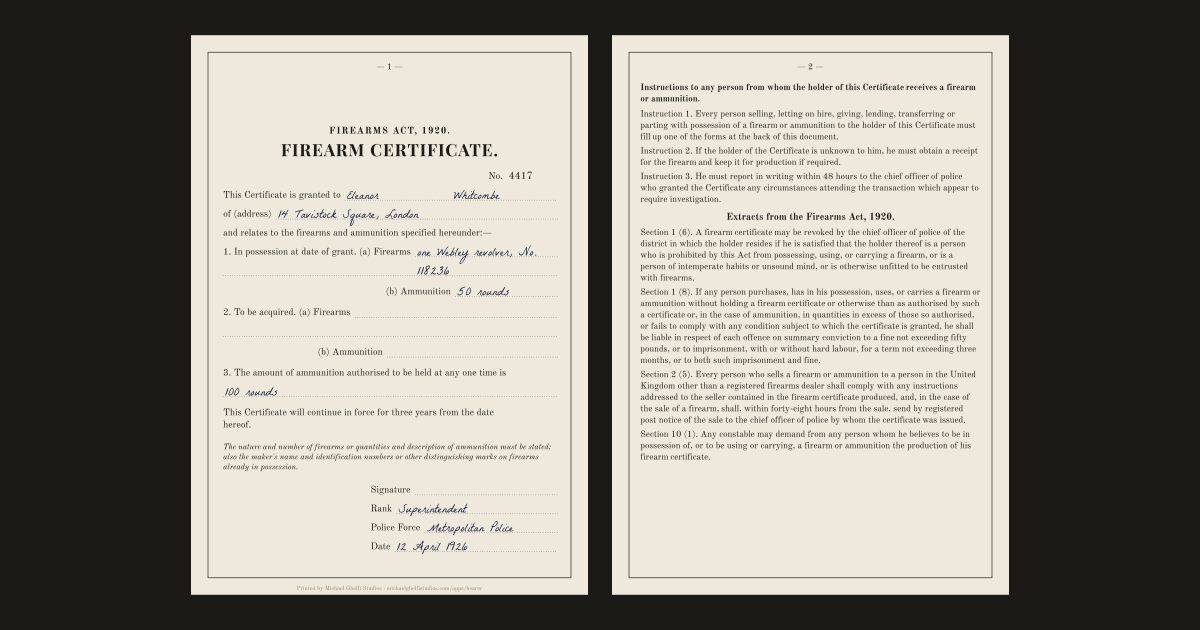
Open this example in the office
What the Act asked
| Section | What it says |
|---|---|
| 1 (2) | Granted by the chief officer of police of the district the applicant lives in, if he has a good reason and can be trusted with it. |
| 1 (3) | In the prescribed form, naming the nature and number of the firearms and the ammunition to be bought and held at any one time. |
| 1 (5) | Three years, renewable for three; one year in Ireland (s. 18). |
| 1 (6) | Revoked from a person of intemperate habits or unsound mind, or otherwise unfitted to be trusted with firearms. |
| 2 (5) | A seller follows the certificate's instructions and reports a sale to the police within forty-eight hours. |
| 10 | Any constable may ask to see it, and seize the firearm if it is not shown. |
| First Schedule | Five shillings; half a crown on renewal. |
Elsewhere
New York's Sullivan Act of 1911 made a pistol permit a matter for the police, and most American states and European countries had their own rules; none of their permits has been found, so Bearer prints only the British certificate.
The same paper elsewhere
Still to be confirmed
- the form is the one the Minister for Home Affairs of Northern Ireland prescribed on 12 February 1922 under the Act; the form the Home Secretary prescribed for Great Britain has not been found, and Bearer takes the words to be the same. What would settle it: a British firearm certificate of the twenties or the rules of 1920-21 for Great Britain.
- three years, the Act's term for Great Britain (s. 1(5)); the Northern Irish form says one year, the term the Act gave Ireland (s. 18(4)). What would settle it: a British firearm certificate.
- the Firearms Act, 1937 consolidated the law from 1 May 1937 and kept the rules and certificates made under the Act of 1920 in force until replaced (s. 33); Bearer keeps the form of 1922 after it. What would settle it: a firearm certificate issued after 1937.
- the notice prints four of the sections the rules name (1(6), 1(8), 2(5), 10(1)); the rules allow "the essential portions thereof". What would settle it: a certificate of the period, to see which portions the police printed.
- the size of the sheet. What would settle it: a firearm certificate measured.
Sources
- Parliament of the United Kingdom; the Act as printed, on Wikimedia Commons, Firearms Act, 1920 (10 & 11 Geo. 5, c. 43), s. 1: no one may purchase, possess, use or carry a firearm or ammunition without a firearm certificate, granted by the chief officer of police of the district the applicant lives in if he has a good reason for it and is no danger to the public safety or the peace (s. 1(2)), in the prescribed form, naming the nature and number of the firearms and the quantities of ammunition to be purchased and held at any one time (s. 1(3)), in force for three years and renewable for three (s. 1(5)), revocable (s. 1(6)); fees in the First Schedule: five shillings, half a crown on renewal; s. 2(5): a seller follows the certificate's instructions and reports a sale to the police within forty-eight hours; s. 10: any constable may demand the certificate; s. 18(4): in Ireland one year instead of three; s. 19(3): in operation from 1 September 1920, or a later day not after 1 December 1920. (read directly)
- Ministry of Home Affairs for Northern Ireland; Statutory Rules and Orders issued in 1922, pp. 2-6, on the Internet Archive, Rules of the Minister for Home Affairs, dated 12th February, 1922, for carrying into effect the Firearms Act, 1920 (S.R. & O. of Northern Ireland, 1922, No. 19), rule 1: the form of a firearm certificate ("This Certificate is granted to … of … and relates to the firearms and ammunition specified hereunder: 1. In possession at date of grant. (a) Firearms. (b) Ammunition. 2. To be acquired. (a) Firearms. (b) Ammunition. 3. The amount of ammunition authorised to be held at any one time is … This Certificate will continue in force for one year from the date hereof. Signature. Rank. Police Force. Date."), the maker's name and numbers to be stated, the three instructions to a seller, the forms attached at the back for every transfer, a notice of sections 1(6), (8), (9), 2(3), (5), (7), 10, 12(2) and 13(3), and spaces for variations and renewals. (read directly)
- Parliament of the United Kingdom; on Wikimedia Commons, Firearms Act, 1937 (1 Edw. 8 & 1 Geo. 6, c. 12), s. 2: grant, renewal, variation and revocation, three years; s. 3: five shillings, half a crown on renewal; s. 33: rules and certificates under the Act of 1920 continue in force; s. 34: not extending to Northern Ireland, in operation from 1 May 1937. (read directly)
Open the passport office · MGS Toolbox