The Kenya game licence
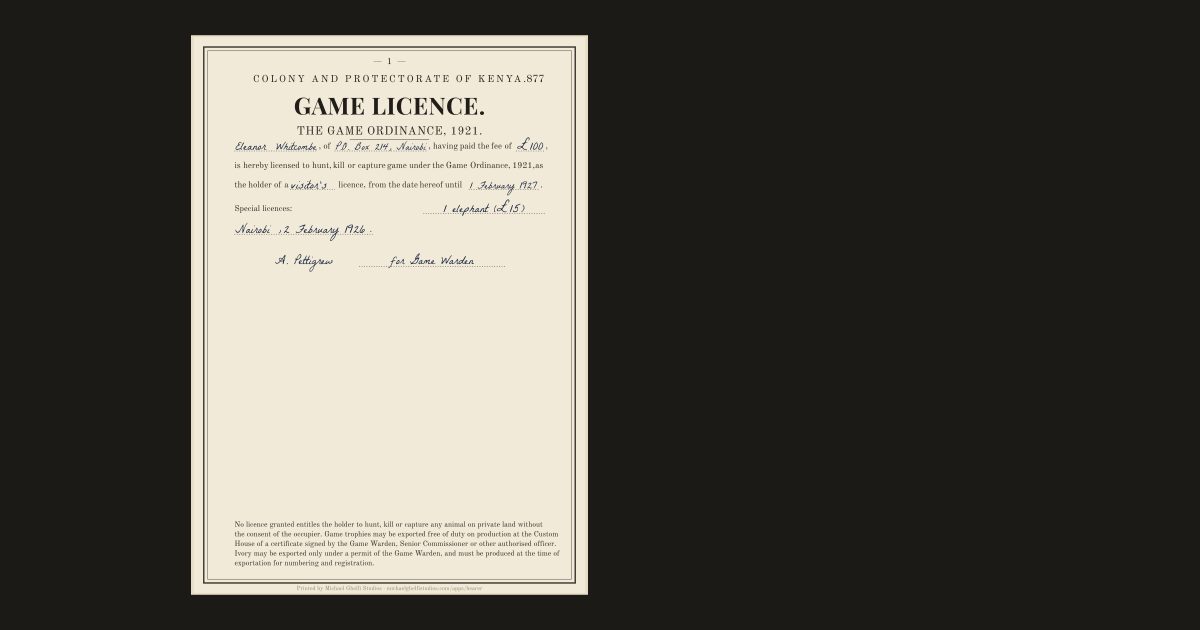
In Kenya game was fairly strictly preserved: shooting was allowed only on a licence, taken out from the Game Warden at Nairobi or from an Administrative Officer on the fees the Game Ordinance, 1921 prescribed. In 1924 a visitor's licence cost £100, a resident's full licence £10, a resident's licence for fourteen days £3, a resident's on private land £2, a visitor's on private land £10, a native employee's £2, a game dealer's and a trophy dealer's £1 each. Big game needed a special licence besides: one elephant £15, two £45; one rhinoceros £5, two £15; one bull giraffe £15; one cock ostrich £5. No licence entitled the holder to hunt on private land without the occupier's consent. Trophies left the Colony free of duty on a certificate of the Game Warden, the Senior Commissioner or another authorised officer, and ivory under a permit of the Game Warden, produced for numbering and registration.
No licence of the period has been found, so the paper Bearer prints is set on the handbook's words, and the office says so above it. For the safari out of Nairobi, and the investigator who shoots something the licence does not cover.
Bearer makes an investigator's papers for Call of Cthulhu and any 1920s or 1930s tabletop campaign: the passport a consul would have filled in, with the visas and frontier stamps a campaign leaves in it, and the permits, certificates and tickets of the period, to print or to share.
An example
Open this example in the office
The paper
| Offered | from 1 January 1921 |
| Printed in | English |
| Sheets | 1 |
| How it is known | a reconstruction: no document of the period has been found |
A reconstruction
This paper is a reconstruction. The Oversea Settlement Office's handbook on Kenya of February 1924, read, says who granted a game licence (the Game Warden at Nairobi, or an Administrative Officer), the kinds of licence and their fees under the Game Ordinance, 1921, and the rules on private land, trophies and ivory printed at the foot. No licence of the period has been found: the words and the layout are ours.
The same paper elsewhere
Still to be confirmed
- the day the Game Ordinance, 1921 came into force is not read: 1 January 1921 is taken. What would settle it: the Game Ordinance, 1921, in the Kenya Gazette or the Ordinances of 1921.
- the term: the handbook gives none; a year is taken for a full licence (the 14-day licence is given its own expiry by hand), and the fees are the handbook's of 1924, not followed after. What would settle it: the Game Ordinance, 1921 and its later amendments, or a Kenya game licence of 1920 to 1939.
Sources
- Oversea Settlement Office; H.M. Stationery Office, London, General information as to Kenya Colony and Protectorate, revised edition, February 1924, pp. 22-23: Arms and Ammunition (registration on introduction, 6s. a firearm, 1s. a consignment of ammunition, the warehouse and the permit, the declaration for personal use or sale, no firearm or ammunition to a native without an officer's written permission); Game (licences from the Game Warden, Nairobi, or Administrative Officers under the Game Ordinance, 1921; the eight licences and the special licences with their fees; private land; trophies and ivory); Immigration Regulations (the law of 1906 amended 1910 and 1919, the Immigration Officer boarding every ship, the prohibited classes, the deposit of £37 10s.) (read directly)
Open the passport office · MGS Toolbox