The Chinese licence to excavate, 1935 to 1939
The law of 2 June 1930 on the preservation of ancient objects made everything in the ground the State's and let only academic bodies under the central or a provincial government dig, on a licence the Ministries of Education and of the Interior issued together; a foreign learned body could only help such a body, and the Commission sent an inspector to every dig. Licence No. 1 went to the Academia Sinica for Anyang on 9 April 1935.
Bearer prints it off licence No. 1 itself, kept by the museum of the Institute of History and Philology in Taipei: the title under a gable, one sentence in columns (the Academia Sinica, through its head Cai Yuanpei, may dig near Anyang from March to July 1935, Liang Siyong leading, Dong Zuobin sent to inspect), the number on the counterfoil under two seals struck across the cut. Licence No. 1 has no foreign helper, so the words that name one are ours, and the office says so above the form.
Bearer makes an investigator's papers for Call of Cthulhu and any 1920s or 1930s tabletop campaign: the passport a consul would have filled in, with the visas and frontier stamps a campaign leaves in it, and the permits, certificates and tickets of the period, to print or to share.
An example
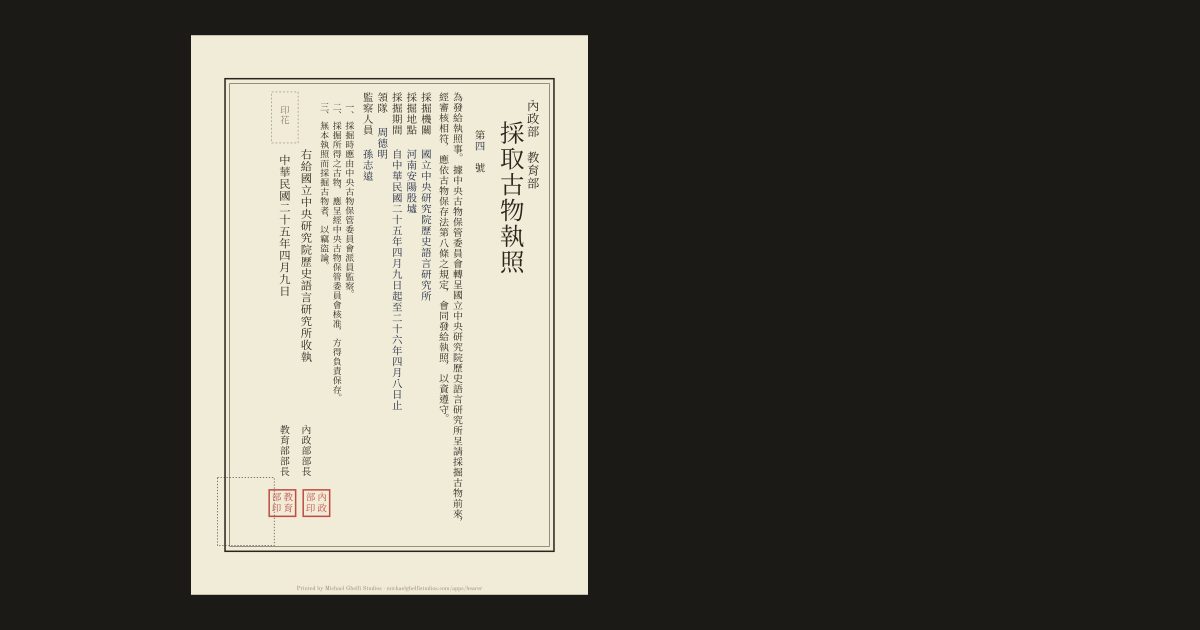
Open this example in the office
The paper
| Offered | from 9 April 1935 |
| Printed in | Chinese |
| Sheets | 1 |
| How it is known | read off a document of the period |
Parts reconstructed
- the foreign helpers: licence No. 1 has none, so the words that name them ("… 協助", helped by …, after the leader) are ours, built on article 10 of the law of 1930
- the four seals: the licence's own cannot be read on the photograph, so Bearer strikes the seals the two ministries use today (教育部印, 內政部印), as vectorized by ReneeWrites on Wikimedia Commons (CC BY 4.0), lighter
The same paper elsewhere
Still to be confirmed
- one year when no end of the dig is typed in: licence No. 1 ran four months (March to July 1935), and no other licence has been read. What would settle it: a second licence read, or the Commission's register.
- the ministers' signatures: licence No. 1 is signed in violet by the two ministers of the day; Bearer leaves them out. What would settle it: the ministers of 1935-1939 by date, and a hand that can write them.
Sources
- Museum of the Institute of History and Philology, Academia Sinica, Taipei (文物館週記 118), 第壹號「採取古物執照」 (Licence to take ancient objects No. 1), the licence itself, photographed: issued on 9 April 1935 by the Ministries of the Interior and of Education to Cai Yuanpei, head of the National Academia Sinica, for a dig from March to July 1935 near Xiaotun and Houjiazhuang and on both banks of the Huan, Anyang, Henan, led by Liang Siyong, Dong Zuobin being sent by the Central Commission to inspect it; the title under a gabled heading, the text in columns with the values written in small, the number on the counterfoil under two seals struck across the cut, the ministries' two seals over the date, the ministers' signatures in violet. (read directly)
- National Government of the Republic of China; text on Chinese Wikisource from the Government Gazette (國民政府公報), 古物保存法 (Law on the Preservation of Ancient Objects), passed 24 May 1930, promulgated 2 June 1930, in force 15 June 1931; re-enacted 10 November 1935, art. 7: everything buried or brought up from the ground belongs to the State; art. 8: only academic bodies under the central or a provincial government may dig, on a licence (採掘執照) the Ministries of Education and of the Interior issue together after review by the Central Commission for the Preservation of Antiquities; digging without it is punished as theft; art. 10: a foreign learned body or specialist may take part only in helping such a body, with the Commission's prior approval; art. 11: the Commission sends an inspector; art. 12: the finds kept for study for a fixed period with the Commission's approval; art. 13: ancient objects circulate only within the country. (read directly)
- 徐敏 (Xu Min), 中国文物报 (China Cultural Relics News), 5 January 2024, p. 8, 中国考古发掘执照制度的发展 (The development of China's excavation licence system), licence No. 1, 採取古物執照, issued on 9 April 1935 by the Ministries of the Interior and of Education to the Institute of History and Philology of the Academia Sinica for Yinxu (Anyang); it named the excavating body, the period, the place, the leader and the inspectors; applicants filed three copies of a form with the Central Commission and paid two yuan for the licence and two for the stamp. (secondary source)
- Department of State, Washington, Papers Relating to the Foreign Relations of the United States, 1929 vol. II docs. 874-881 and 1930 vol. II docs. 648-649: the Roy Chapman Andrews expedition, May-June 1929: the Chinese society for the preservation of antiquities asks that the American Museum's expedition be half Chinese with two leaders and leave the originals in China; the Museum refuses and the 1929 season is lost; the 1928 collections are released; February 1930: the Foreign Minister says the antiquities law will decide; May 1930: 'everything had been settled' for the season of 1930, the last, permission being refused in 1931. (read directly)
- ReneeWrites, on Wikimedia Commons (2023), after the seals in use in 2016 and 2021; the vectorization CC BY 4.0, the seals public domain (PD-ROC-official), 教育部印 (中華民國) and 內政部印 (中華民國): the seals of the Ministries of Education and of the Interior of the Republic of China, vectorized, the two seals Bearer strikes on the Chinese licence to dig, the licence's own being illegible on its photograph; drawn unmodified, lighter. (secondary source)
.svg)
Open the passport office · MGS Toolbox