The voluntary patient of 1930
The Mental Treatment Act, 1930 let a person who wished to be treated for mental illness be received as a voluntary patient, without a reception order, on a written application to the person in charge of an institution, hospital or approved home; a child under sixteen only on his parent's application with a medical recommendation. A voluntary patient could leave on giving seventy-two hours' notice in writing, and one who became unable to say whether he wished to stay could not be kept as such beyond twenty-eight days.
The forms have not been found, so the application and the notice Bearer prints are reconstructions on the Act, and the office says so above them. The committal papers of the Lunacy Act, 1890, read, have their own page.
Bearer makes an investigator's papers for Call of Cthulhu and any 1920s or 1930s tabletop campaign: the passport a consul would have filled in, with the visas and frontier stamps a campaign leaves in it, and the permits, certificates and tickets of the period, to print or to share.
An example
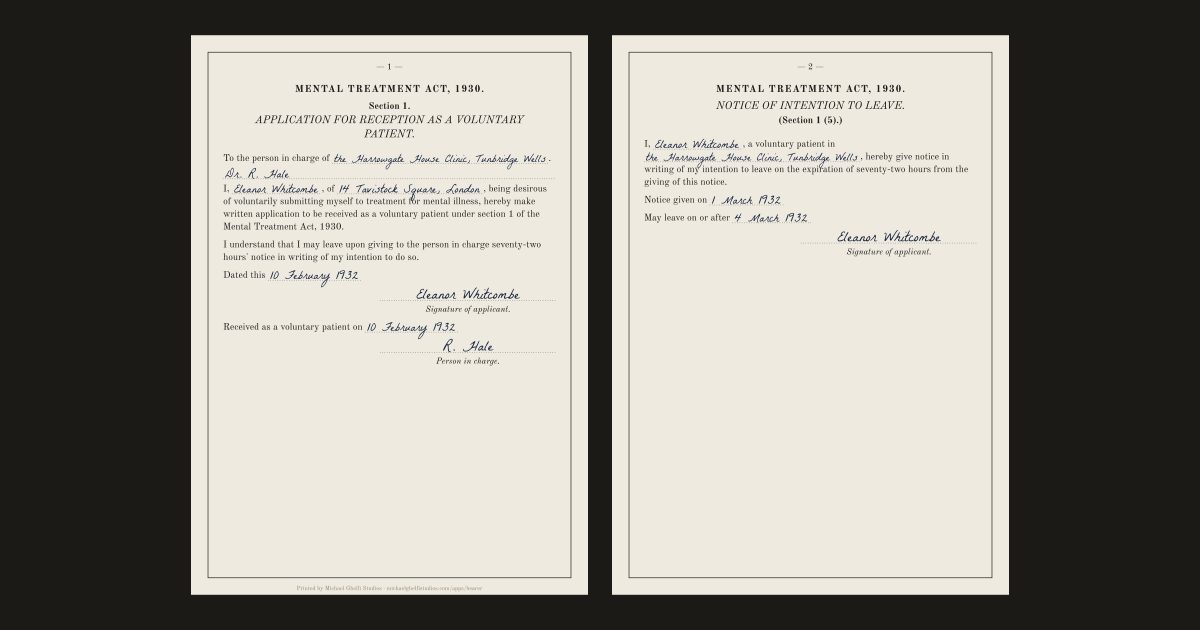
Open this example in the office
The paper
| Offered | from 1 January 1931 |
| Printed in | English |
| Sheets | 2 |
| How it is known | a reconstruction: no document of the period has been found |
A reconstruction
This paper is a reconstruction. The Mental Treatment Act, 1930 let a person be received as a voluntary patient on his own written application to the person in charge, without a reception order, and leave on seventy-two hours' notice in writing (s. 1); the forms that carried both have not been found, and their words and layout are ours.
Still to be confirmed
- the whole paper. What would settle it: the forms of the Mental Treatment Rules, 1930.
Sources
- Parliament of the United Kingdom; text at legislation.gov.uk, Mental Treatment Act, 1930 (20 & 21 Geo. 5 c. 23), sections 1 and 2, s. 1: any person desirous of voluntarily submitting himself to treatment for mental illness who makes a written application to the person in charge may be received as a voluntary patient without a reception order; under sixteen, on the written application of a parent or guardian with a medical recommendation; a voluntary patient may leave on giving the person in charge seventy-two hours' notice in writing of his intention to do so; s. 2: notice of his reception sent to the Board of Control before the end of the second day; a patient become incapable of expressing himself willing or unwilling kept no longer than twenty-eight days (read directly)
- Parliament of the United Kingdom; the King's Printer's copy at legislation.gov.uk, Mental Treatment Act, 1930 (20 & 21 Geo. 5 c. 23), as enacted: sections 5, 20 and 22 and the First Schedule, s. 20(1): asylums provided by local authorities to be called mental hospitals, and in any order or other document issued under the Lunacy Acts a reference to a mental hospital substituted; s. 20(4): "pauper" to cease, "rate-aided" instead; s. 20(5): the word "lunatic" (save "criminal lunatic") to cease in any enactment, order or other document, "person of unsound mind", "patient" or such other expression as the context may require substituted; s. 22(3): the Act does not apply to Scotland or Northern Ireland; s. 22(4): in operation on 1 January 1931, save as otherwise provided; First Schedule: the forms of application for the reception of a temporary patient and of the recommendation for temporary treatment (two practitioners, one approved by the Board of Control; suffering from mental illness, likely to benefit, for the time being incapable of expressing himself as willing or unwilling; a period not exceeding six months) (read directly)
Open the passport office · MGS Toolbox