Poland
The Republic of Poland issued a booklet of 40 pages, every line in Polish above French, delivered by the county office (starostwo powiatowe) in the Ministry of the Interior's name. Page 1 carries the series and number, the office's own register number and, in red, the fee paid; page 2 the description with a column for the wife; page 3 the photographs, sealed at the corners; page 4 the countries, the request to foreign and Polish authorities and the expiry, under the office's red stamp.
Pages 5 and 6 keep four renewals, page 7 the remarks (the red stamp of a passport good for one journey out goes there), page 8 the booklet's own rules, pages 9 to 14 the Polish frontier control, 15 and 16 the registrations, and the visas begin on page 17. Officials wrote the month in Roman numerals: 8 IV 1931.
Read on a booklet issued at Chrzanów on 8 April 1931. A booklet of 1926, on a form printed in January 1925, has the same words in another order; the eagle is not drawn.
Bearer makes an investigator's papers for Call of Cthulhu and any 1920s or 1930s tabletop campaign: the passport a consul would have filled in, with the visas and frontier stamps a campaign leaves in it, and the permits, certificates and tickets of the period, to print or to share.
An example
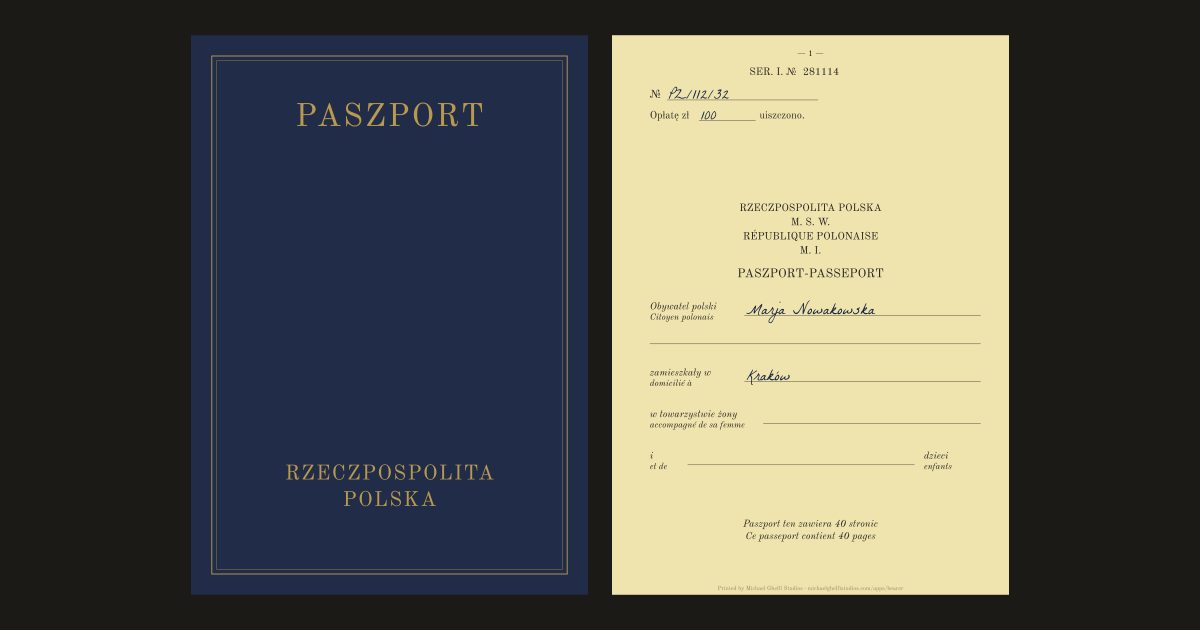
Open this example in the office
The passport
| Issued | from 21 October 1920 |
| Form | a booklet of 40 pages |
| Languages | Polish + French |
| Validity | 1 year, or a single journey |
| Renewals allowed | 4 |
| Countries | listed on page 4 |
| Wife and children | a joint passport is possible; the children are written in |
| Coat of arms | withheld. The white eagle of the cover and page 1 is the model of the emblem the Polish law protects today: the law on the emblem forbids the Republic's symbols on articles intended for trade, save in a stylised or artistically transformed form (art. 16), and asks that they be treated with respect (art. 1). Bearer does not draw the eagle as the booklet printed it; a stylised rendering may be drawn by the design pass, and whoever wants the eagle on their own prop uploads it. |
The description of the bearer
- domicilié à
- Date de naissance
- Lieu de naissance
- Etat civil
- Profession
- Taille
- Visage
- Cheveux
- Yeux
- Signes particuliers
The same paper elsewhere
Still to be confirmed
- the booklet read was issued in 1931; the form of the twenties, read in part on a booklet printed on 12 January 1925 (plPassport1926), has the same words in another order (the destination on page 3, the photographs on page 4) and is not printed. What would settle it: a Polish booklet of the twenties photographed page by page.
- validity of one year: the booklet read was issued on 8 April 1931 and ran to 8 November 1931, for a single journey. The law of 1924, read, sets only fees; the passport Act of 14 July 1936, read, allows up to three years, extendable to five in all, for several journeys (art. 10), and Bearer keeps one year for every date. What would settle it: the fee rules of the Minister of the Treasury, which set the months a passport ran before 1936, and a booklet issued after 1936.
- the series letter printed before the number (SER. I. on the booklet read, Ser. E. on the one of 1926) is printed as SER. I. for every date. What would settle it: the series of the Polish booklets, year by year.
- the endings the clerk wrote by hand in the request of page 4 (osob… wymienion…) are printed as for one person (osobie wymienionej). What would settle it: nothing: a choice of layout.
- the Polish frontier stamps are laid on the visa pages like every other, not on pages 9 to 14 which the booklet keeps for them. What would settle it: nothing: a limit of the layout.
- page 15 is not shown on the booklet read; it is taken to carry the registrations like page 16. What would settle it: page 15 of a Polish booklet.
- the size of the booklet: the League's 15.5 by 10.5 cm is used. What would settle it: a Polish booklet measured.
Sources
- Rzeczpospolita Polska, Ministerstwo Spraw Wewnętrznych; photograph on Wikimedia Commons ('PaszportRzeczpospolitaPolska.1931.jpg', CC BY-SA 2.5), Paszport / Passeport of the Republic of Poland, Ser. I. No. 115509, issued by the county office (Starostwo Powiatowe) of Chrzanów on 8 April 1931, read page by page, cover (dark blue cloth, PASZPORT, the eagle in a ring, RZECZPOSPOLITA POLSKA, in gold), page 1 (series and number, the office's register number, the red stamp of the fee paid, the eagle, RZECZPOSPOLITA POLSKA / M.S.W. / RÉPUBLIQUE POLONAISE / M.I., PASZPORT-PASSEPORT, Obywatel polski / Citoyen polonais, zamieszkały w / domicilié à, w towarzystwie żony / accompagné de sa femme, i … dzieci / et de … enfants, Paszport ten zawiera 40 stronic / Ce passeport contient 40 pages), page 2 (Rysopis - Signalement, a column Żona - Femme, Dzieci - Enfants), page 3 (Fotografje - Photographies, four round seals of the county office over the corners, Podpis posiadacza / Signature du porteur), page 4 (the countries, the request to foreign and Polish authorities, the expiry, the red stamp Za Starostę powiatowego, Pieczęć / Sceau, Podpis / Signature, Data / Date, Chrzanów, dnia …), pages 5 and 6 (Wznowienia - Renouvellements, two blocks a page), page 7 (Uwagi - Observations, a red stamp: PASZPORT WAŻNY NA JEDNORAZOWY WYJAZD ZA GRANICĘ), page 8 (the booklet's rules), page 9 (Stemple polskiej kontroli granicznej, Wyjazd - Sortie, Wjazd - Entrée), page 16 (Meldunki), page 17 onwards (Wizy - Visas); Swiss, Italian, Austrian and Czechoslovak visas of 1931 (read directly)
- Sejm Rzeczypospolitej Polskiej, via the Sejm's ELI service, Ustawa z dnia 31 stycznia 1980 r. o godle, barwach i hymnie Rzeczypospolitej Polskiej oraz o pieczęciach państwowych, consolidated text Dz. U. 2025 poz. 299, art. 1 (the white eagle is a symbol of the Republic, to be treated with respect, under the special protection of the law); art. 2 and annex 1 (the emblem's image); art. 3 ust. 2 (the emblem may be placed elsewhere with due respect); art. 16 (symbols may not be placed on articles intended for trade, save the emblem or colours in a stylised or artistically transformed form) (read directly)
- Rzeczpospolita Polska; the Dziennik Ustaw page in ISAP, the Sejm's database, Ustawa z dnia 14 lipca 1936 r. o paszportach (Dz. U. 1936 nr 56 poz. 404), art. 8: ordinary passports are for one person, the wife may be written in the husband's, children under 13 in a parent's; art. 10(1): ordinary passports may be issued for up to three years, extensions allowed but the whole term from the day of issue may not pass five years; art. 10(2): good for several journeys out and back unless the office limits their number; art. 11: good for every foreign country unless the office limits it; art. 12: the fee set by the Minister of the Interior on monthly periods of validity; art. 23: passports issued before keep their validity to the end of their term; art. 27: in force thirty days after publication (read directly)
- Rzeczpospolita Polska; the Dziennik Ustaw page in ISAP, Ustawa z dnia 17 lipca 1924 r. w sprawie opłat za paszporty na wyjazd zagranicę (Dz. U. 1924 nr 69 poz. 672), art. 1: passports for going abroad pay the fee the Minister of the Treasury sets with the Minister of the Interior; diplomatic passports and those of workers and emigrants free; art. 2: 25 zloty for business travel; art. 3: 20 zloty for study, research, treatment, congresses, sport or social purposes (read directly)
- Rzeczpospolita Polska; photographs on Wikimedia Commons ('Harry Lender's Passport', Flickr), Paszport / Passeport of the Republic of Poland, Ser. E. No. 037942, issued by the county office of Lublin in 1926, on a form printed by the State Printing Office on 12 January 1925, page 1 (the same words as the form of 1931, set in roman type on a guilloche ground), page 2 (the description), page 3 (the destination, udaje się do / se rend en, the request and the expiry), page 4 (the photographs), the renewals, visa pages headed Wizy i adnotacje polskich przedstawicielstw konsularnych za granicą and Wizy i adnotacje urzędów i przedstawicielstw cudzoziemskich (read directly)

.jpg)
Open the passport office · MGS Toolbox