The Mexican concession to excavate, 1934 to 1939
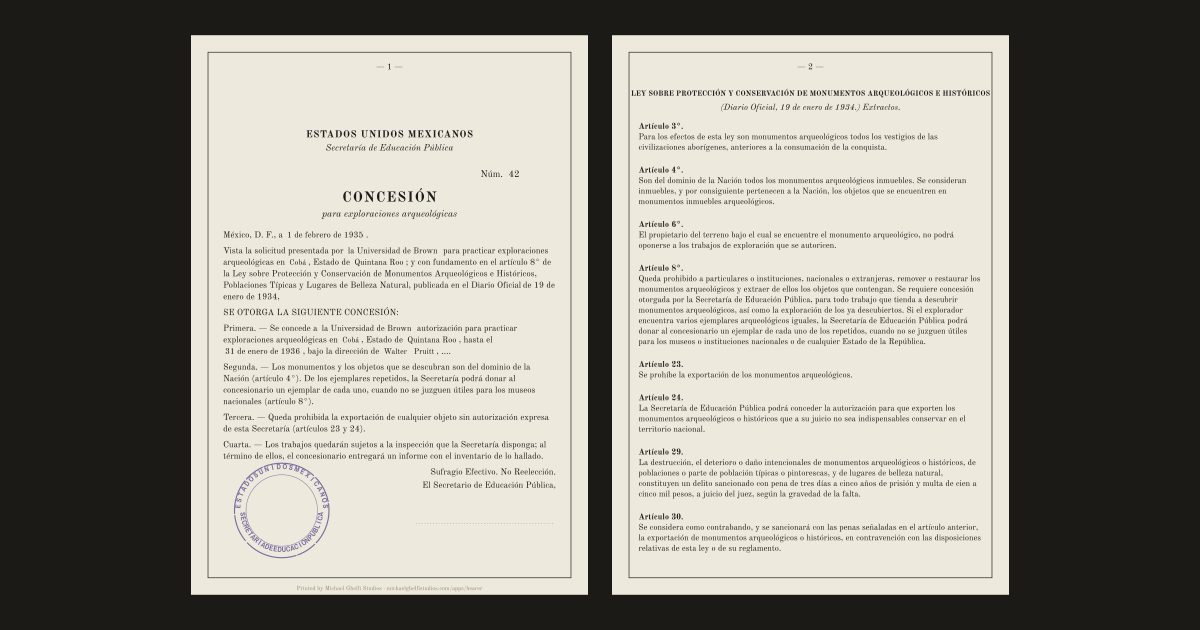
The law published in the Diario Oficial of 19 January 1934 made every immovable archaeological monument, and whatever was found in it, the Nation's, and asked a concession of the Secretaría de Educación Pública for any work that tended to discover one or to explore it; nothing left the country without its leave.
No concession has been found, so the paper Bearer prints for Mexico is a reconstruction built on the law, and the office says so above the form.
Bearer makes an investigator's papers for Call of Cthulhu and any 1920s or 1930s tabletop campaign: the passport a consul would have filled in, with the visas and frontier stamps a campaign leaves in it, and the permits, certificates and tickets of the period, to print or to share.
An example
Open this example in the office
The paper
| Offered | from 19 January 1934 |
| Printed in | Spanish |
| Sheets | 3 |
| How it is known | a reconstruction: no document of the period has been found |
A reconstruction
This paper is a reconstruction. No Mexican concession of the period has been found: page 1 is written in the form of an official grant from the law of 1934 (articles 4, 8, 23 and 24), printed on page 2 as the Diario Oficial published it; the grant's words, the inventory's columns and the layout are ours. The law is real; the paper is not a copy of one.
The same paper elsewhere
Still to be confirmed
- pages 1 and 3. What would settle it: a concession of the Secretaría de Educación Pública of 1934-1939 (the Carnegie Institution's archive for Chichén Itzá, or the INAH's).
- the type begins with the law of 1934; the law of 30 January 1930 it repealed, and the Carnegie Institution's contract of 3 July 1923 for Chichén Itzá, have not been found. What would settle it: the law of 1930, or the contract of 1923.
Sources
- Estados Unidos Mexicanos; Diario Oficial, Friday 19 January 1934, Tomo LXXXII No. 16, Secretaría de Educación Pública; transcription in UNESCO's Database of National Cultural Heritage Laws, Ley sobre protección y conservación de monumentos arqueológicos e históricos, poblaciones típicas y lugares de belleza natural, promulgated 27 December 1933, art. 3: archaeological monuments are all the remains of the aboriginal civilisations before the Conquest; art. 4: every immovable one belongs to the Nation, and the objects found in it; art. 6: the owner of the land cannot oppose an authorised exploration; art. 8: no one, national or foreign, may remove or restore an archaeological monument or take out what it holds; a concession granted by the Secretaría de Educación Pública is required for every work that tends to discover archaeological monuments, and for exploring those already found; of several identical pieces the Secretaría may give the concessionaire one of each; art. 23: the export of archaeological monuments is forbidden; art. 24: unless the Secretaría authorises it; art. 29: destroying or damaging them, three days to five years in prison and a fine of 100 to 5,000 pesos; art. 30: exporting them against the law is contraband. The law of 30 January 1930 is repealed (transitory art. 1). The decree closes 'Sufragio Efectivo. No Reelección.' (read directly)
Open the passport office · MGS Toolbox