The American customs declaration
A passenger landing in New York declared what he had bought abroad, then watched his trunks carried to the customs examination area to be opened by an inspector. For the investigators it is where the crate from Peru either passes as pottery, or does not.
The Tariff Act of 1922 is read: the collector examined the baggage whatever the declaration, an article left out was forfeited with a penalty equal to its value, and a returning resident brought a hundred dollars of purchases in free of duty. The Tariff Act of 1930, read, kept all three from 18 June 1930, adding that the hundred dollars could be claimed only once in thirty days. The form the Treasury prescribed has not been found, so the paper Bearer prints is set on the law, and the office says so above it.
Bearer makes an investigator's papers for Call of Cthulhu and any 1920s or 1930s tabletop campaign: the passport a consul would have filled in, with the visas and frontier stamps a campaign leaves in it, and the permits, certificates and tickets of the period, to print or to share.
An example
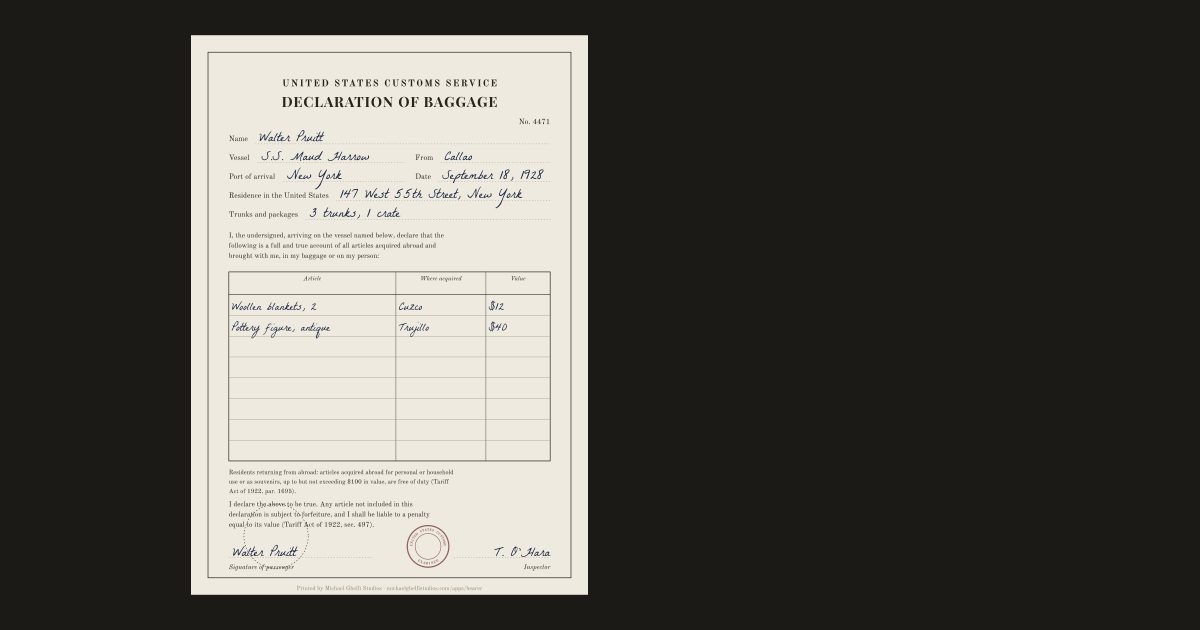
Open this example in the office
The paper
| Offered | from 21 September 1922 |
| Printed in | English |
| Sheets | 1 |
| How it is known | a reconstruction: no document of the period has been found |
A reconstruction
This paper is a reconstruction on the law. The Tariff Act of 1922, read, says what the passenger declared and what befell an article left out: the baggage examined whatever the declaration (sec. 496), an article not declared forfeited and a penalty equal to its value (sec. 497), the declaration on the Treasury's rules (sec. 498), and the returning resident's hundred dollars of purchases free of duty (par. 1695), and the Tariff Act of 1930, read, the same from 18 June 1930 with the free list's paragraph 1798 and a limit of one exemption in thirty days. The form the Treasury prescribed has not been found: its layout and the words that are not the law's are ours.
Still to be confirmed
- the form prescribed by the Secretary of the Treasury. What would settle it: a United States baggage declaration of 1922 to 1939.
Sources
- South Street Seaport Museum, Arriving in the Port of New York, the baggage of arriving passengers unloaded and taken to the customs examination area, 1920s to 1960s; the declaration itself not shown (secondary source)
- United States, Customs Tariff Act of 21 September 1922, with administrative provisions: sections 496 to 498 and paragraph 1695 of the free list, Sec. 496: the collector may cause an examination to be made of the baggage of any person arriving in the United States, notwithstanding a declaration and entry has been made; Sec. 497: any article not included in the declaration and entry, and not mentioned before the examination was begun, shall be subject to forfeiture and such person liable to a penalty equal to the value of the article; Sec. 498: the Secretary of the Treasury prescribes the declaration and entry of articles contained in the baggage of a person arriving in the United States; par. 1695: residents returning from abroad bring in free of duty the effects they took out, and up to but not exceeding $100 in value of articles acquired abroad for personal or household use or as souvenirs or curios, not for sale (read directly)
- United States; U.S. Statutes at Large, vol. 46, Library of Congress, Tariff Act of 1930 (Act of 17 June 1930, c. 497, 46 Stat. 590): sections 496 to 498 and 653, and paragraph 1798 of the free list, sec. 496: the collector may cause an examination of the baggage of any person arriving, notwithstanding a declaration and entry has been made; sec. 497: any article not included in the declaration and entry, and before the examination was begun not mentioned in writing (or orally if written declaration was not required), subject to forfeiture and a penalty equal to its value; sec. 498(a)(6): the Secretary of the Treasury prescribes the declaration and entry of articles carried on the person or in the baggage; par. 1798: residents returning from abroad bring in free the effects they took out, and up to but not exceeding $100 in value of articles acquired abroad for personal or household use or as souvenirs or curios, not bought on commission or for sale, but not within thirty days of the last exemption claimed; sec. 653: in effect on the day following enactment (approved 17 June 1930) (read directly)
Open the passport office · MGS Toolbox