The chemist's poisons book
Under the Pharmacy Act, 1868 a chemist could not sell a poison of the first part of its schedule to anyone he did not know unless someone he knew introduced him, and before handing it over he entered in a book, in the form of Schedule F, the date, the name and address of the purchaser, the name and quantity sold and the purpose it was required for, signed by the purchaser and by whoever introduced him. From 1 May 1936 the Pharmacy and Poisons Act, 1933 and its rules governed the book.
The columns are Schedule F's, read in the edition of 1909; the heading and layout of the page are ours. It is where investigators find who bought arsenic the week before the funeral.
Bearer makes an investigator's papers for Call of Cthulhu and any 1920s or 1930s tabletop campaign: the passport a consul would have filled in, with the visas and frontier stamps a campaign leaves in it, and the permits, certificates and tickets of the period, to print or to share.
An example
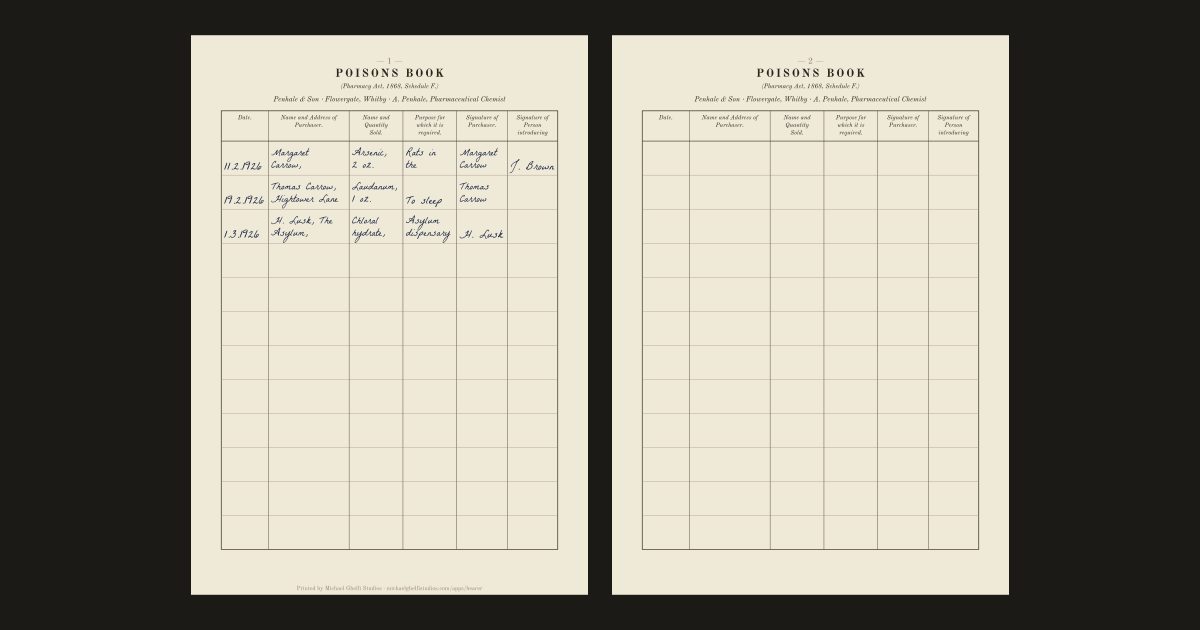
Open this example in the office
The paper
| Offered | from 21 October 1920 |
| Printed in | English |
| Sheets | 2 |
| How it is known | read off a document of the period |
Parts reconstructed
- the heading and the layout of the page: the columns are those of Schedule F, read, but no poisons book of the period has been seen
Still to be confirmed
- from 1 May 1936 the Pharmacy and Poisons Act, 1933 and its Poisons Rules governed the book (the prescribed particulars, a card index allowed, orders in writing in place of a signature); the page after that date still prints the columns of 1868. What would settle it: the form of the Poisons Rules, 1935.
- the purchaser's signature is written as his name. What would settle it: nothing: a choice of layout.
Sources
- Parliament of the United Kingdom; Wellcome Collection copy on archive.org (b28102046), The Pharmacy Act, 1868, s. 17 and Schedule F, Form of Poisons Book, as printed in The Poisons and Pharmacy Act, 1908 (Pharmaceutical Society, 1909), s. 17: no poison of Part 1 of Schedule A sold to a person unknown to the seller unless introduced by a person known to him; the seller, before delivery, enters in a book in the form of Schedule F the date of the sale, the name and address of the purchaser, the name and quantity of the article sold and the purpose for which it is stated to be required, signed by the purchaser and by the person who introduced him; Schedule F: Date, Name and Address of Purchaser, Name and Quantity Sold, Purpose for which it is required, Signature of Purchaser, Signature of Person introducing Purchaser (read directly)
- Home Office; Wellcome Collection copy on archive.org (b32176387), Memorandum on the Provisions of the Pharmacy and Poisons Act, 1933, affecting Shops other than Chemists' Shops (HMSO, 1936), paragraphs 19 and 20: the Poisons Book, the prescribed particulars entered before delivery, the book (or a card index or loose leaves) kept two years, orders in writing in place of the purchaser's signature (read directly)
Open the passport office · MGS Toolbox