Italy
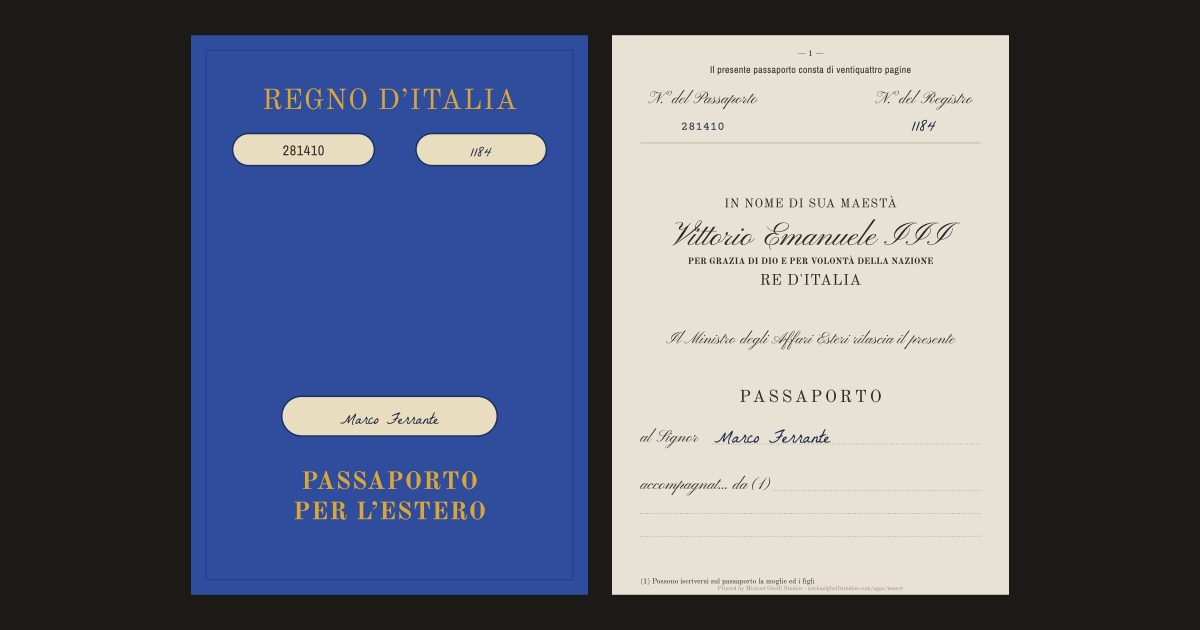
The Kingdom of Italy issued a booklet of 24 pages in Italian alone, in the King's name: page 1 names Victor Emmanuel III in his titles of the day, "King of Italy" and, from May 1936, "Emperor of Ethiopia", and says that the Minister of Foreign Affairs issues it. The questure issued it at home and the consulates abroad.
Page 1 carries the number and the register number, the sovereign, the bearer and the wife who travels with him; page 2 the description in fourteen lines, the names of father and mother among them, with a column for the wife and a table of the children; page 3 the photographs of both, their signatures and the authority that vouches for them. Page 4 has not been seen and is printed empty.
The cover was a red card in 1921 and blue cloth with three windows in 1928, the royal arms beside the fasces. The arms of the House of Savoy may be drawn; the fasces, like the swastika, never is. Italian officials dated in the Fascist era from 1927 at the latest, and Bearer adds its year after the date.
Bearer makes an investigator's papers for Call of Cthulhu and any 1920s or 1930s tabletop campaign: the passport a consul would have filled in, with the visas and frontier stamps a campaign leaves in it, and the permits, certificates and tickets of the period, to print or to share.
An example
Open this example in the office
The passport, from 21 October 1920
| Issued | from 21 October 1920, until 31 December 1927 |
| Form | a booklet of 24 pages |
| Languages | Italian |
| Validity | 2 years |
| Renewals allowed | 4 |
| Countries | all countries |
| Wife and children | a joint passport is possible; the children are written in |
| Coat of arms | allowed, not drawn yet. Page 1 and the cover carry the arms of the House of Savoy, the arms of a kingdom that ended in 1946 and that the law of the Italian Republic does not protect as its own; they may be drawn from a period rendering. From 1928 the cover sets the fasces beside them, the emblem of the Fascist regime: like the swastika of the German seals, it is never drawn, and whoever wants it on their own prop draws it themselves. |
| Seals struck in it | withheld. The cover of 1928 sets the fasces, the emblem of the Fascist regime, beside the royal arms. It is never drawn: the studio's rule for the emblems of the regimes of the time, the same as for the swastika. |
The description of the bearer
The passport, from 1 January 1928
| Issued | from 1 January 1928 |
| Form | a booklet of 24 pages |
| Languages | Italian |
| Validity | 2 years |
| Renewals allowed | 4 |
| Countries | all countries |
| Wife and children | a joint passport is possible; the children are written in |
| Coat of arms | allowed, not drawn yet. Page 1 and the cover carry the arms of the House of Savoy, the arms of a kingdom that ended in 1946 and that the law of the Italian Republic does not protect as its own; they may be drawn from a period rendering. From 1928 the cover sets the fasces beside them, the emblem of the Fascist regime: like the swastika of the German seals, it is never drawn, and whoever wants it on their own prop draws it themselves. |
| Seals struck in it | withheld. The cover of 1928 sets the fasces, the emblem of the Fascist regime, beside the royal arms. It is never drawn: the studio's rule for the emblems of the regimes of the time, the same as for the swastika. |
The description of the bearer
Its ports and cities in Passage
The same paper elsewhere
Still to be confirmed
- the pages are read on booklets of the model printed from 1936 (page 1 of one issued in 1942, pages 2 and 3 of one issued at Rome in 1937); the booklets of the twenties, whose covers are read, have not been seen inside. What would settle it: the inside of an Italian booklet of the twenties.
- page 1 before May 1936 names the King as King of Italy alone: his titles are the plain record, the page itself is not found. What would settle it: page 1 of an Italian booklet issued before May 1936.
- from 16 April 1939 the King was also King of the Albanians; the booklet read, issued in 1942, does not print it, so neither does Bearer. What would settle it: an Italian booklet printed after April 1939.
- validity of two years, the League's recommendation, not found on an Italian booklet. What would settle it: an Italian booklet with its date of issue and its expiry both legible.
- the words the form leaves for the clerk to end (figli…, nat…, domiciliat…, accompagnat…) are printed as the form prints them, the ending left open. What would settle it: nothing: the clerk wrote the ending by hand.
- the size of the booklet: the League's 15.5 by 10.5 cm is used. What would settle it: an Italian booklet measured.
- the red card of the cover is read on a booklet of 1921 and the blue cloth on one of 1928; the day one replaced the other is not known and is set at 1 January 1928. What would settle it: Italian booklets issued between 1922 and 1928.
- the pages are read on booklets of the model printed from 1936 (page 1 of one issued in 1942, pages 2 and 3 of one issued at Rome in 1937); the booklets of the twenties, whose covers are read, have not been seen inside. What would settle it: the inside of an Italian booklet of the twenties.
- page 1 before May 1936 names the King as King of Italy alone: his titles are the plain record, the page itself is not found. What would settle it: page 1 of an Italian booklet issued before May 1936.
- from 16 April 1939 the King was also King of the Albanians; the booklet read, issued in 1942, does not print it, so neither does Bearer. What would settle it: an Italian booklet printed after April 1939.
- validity of two years, the League's recommendation, not found on an Italian booklet. What would settle it: an Italian booklet with its date of issue and its expiry both legible.
- the words the form leaves for the clerk to end (figli…, nat…, domiciliat…, accompagnat…) are printed as the form prints them, the ending left open. What would settle it: nothing: the clerk wrote the ending by hand.
- the size of the booklet: the League's 15.5 by 10.5 cm is used. What would settle it: an Italian booklet measured.
- the blue cloth cover with its three windows is read on a booklet of 1928 and taken to run to 1939. What would settle it: an Italian cover of the late thirties.
Sources
- Regno d'Italia, Ministero degli Affari Esteri; photograph on Wikimedia Commons (public domain), Passaporto of the Kingdom of Italy no. 738226, the inside of the cover and page 1, stamped REGIO SERVIZIO by a consulate in 1942, inside of the cover: the windows of the cover seen from inside, "Non si passa la frontiera senza aver redatto completamente e consegnata la cedola statistica"; page 1: "Il presente passaporto consta di ventiquattro pagine", N.° del Passaporto, N.° del Registro, the arms, IN NOME DI SUA MAESTÀ Vittorio Emanuele III PER GRAZIA DI DIO E PER VOLONTÀ DELLA NAZIONE RE D'ITALIA IMPERATORE D'ETIOPIA, Il Ministro degli Affari Esteri rilascia il presente PASSAPORTO al Signor … accompagnat… da (1), "(1) Possono iscriversi sul passaporto la moglie ed i figli" (read directly)
- Regno d'Italia; photograph by Giovanni Di Felice on Wikimedia Commons (CC BY-SA 4.0), Passaporto per l'estero of the Kingdom of Italy, 1928, the cover, blue cloth: REGNO D'ITALIA in gold, two windows for the number and the register, the royal arms beside a shield with the fasces, a window for the bearer's name, PASSAPORTO PER L'ESTERO (read directly)
- Regno d'Italia, Regia Questura di Roma; Malpassuti family archive, on Wikimedia Commons (CC BY 2.5), Passaporto of the Kingdom of Italy issued by the Questura of Rome on 4 November 1937 (Anno XVI), pages 2 and 3, page 2: Dati e Connotati del Titolare (Professione, figli… di, e di, nat…, il, domiciliat…, Prov. di, statura, occhi, capelli, barba, baffi, colorito, segni particolari), "(1) Colonna riservata ai connotati della moglie", Figli (Nome, Data di nascita, Visto); page 3: Fotografie, "(1) Spazio riservato alla fotografia della moglie", Firma del Titolare, Autentificazione della firma e fotografia, Firma dell'Autorità, Dato, "(2) Firma della moglie", a revenue stamp of six lire (read directly)
- Wikipedia, Victor Emmanuel III of Italy: his titles, King of Italy from 29 July 1900; proclaimed Emperor of Ethiopia on 9 May 1936; King of the Albanians from 16 April 1939. A plain record of the titles, not the words a passport printed. (secondary source)
- League of Nations, Advisory and Technical Committee for Communications and Transit, Resolution adopted by the Conference on Passports, Customs Formalities and Through Tickets in Paris on October 21st, 1920 (Passport Conference, Preparatory Documents II), C.641.M.230.1925.VIII (read directly)
- Regno d'Italia; photograph by Giovanni Di Felice on Wikimedia Commons (CC BY-SA 4.0), Passaporto per l'estero of the Kingdom of Italy, 1921, the cover, a red card: the small royal arms, REGNO D'ITALIA, PASSAPORTO PER L'ESTERO in a ruled box (read directly)


Open the passport office · MGS Toolbox