Permits to dig by country
The authority a state gave an expedition to dig: the site, the term, the rules the excavator agreed to, and what became of the finds.
Bearer prints it for 7 offices: China (Republic), Egypt, Iraq, Mexico, Peru, Syria and Lebanon (French High Commission), Turkey. Each is read off a document of the time or reconstructed on the country's law, and says which.
Bearer makes an investigator's papers for Call of Cthulhu and any 1920s or 1930s tabletop campaign: the passport a consul would have filled in, with the visas and frontier stamps a campaign leaves in it, and the permits, certificates and tickets of the period, to print or to share.
An example
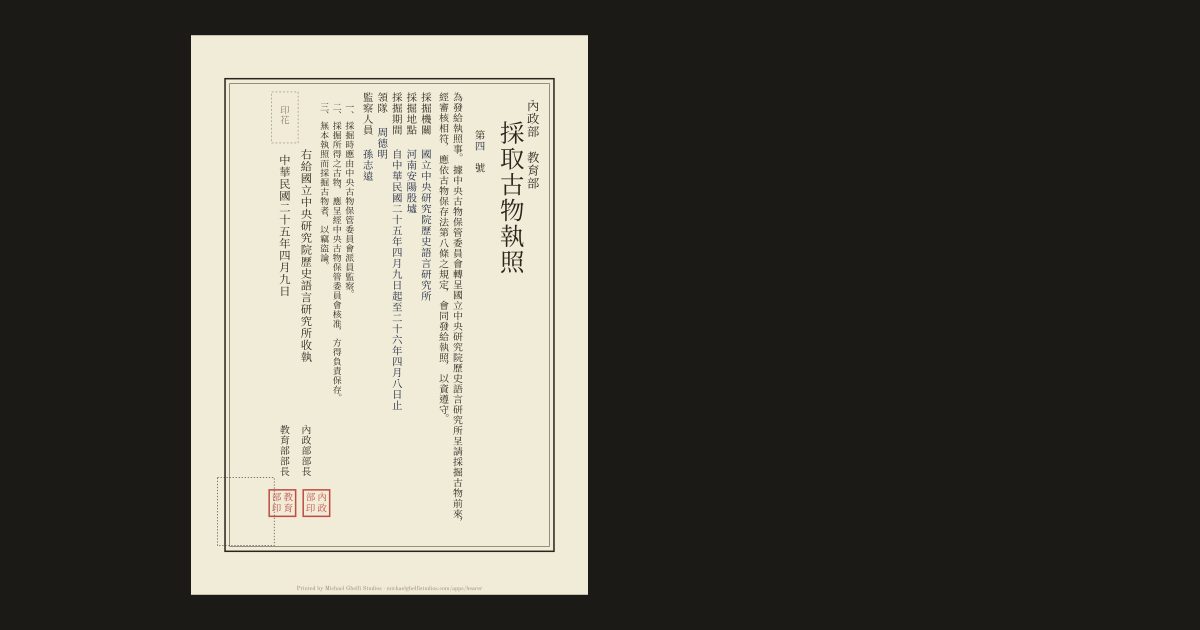
Open this example in the office
Every office Bearer prints it for
| Office | Offered from | Until | How it is known | Printed in |
|---|---|---|---|---|
| China (Republic) | 9 April 1935 | read, some parts ours | Chinese | |
| Egypt | 21 October 1920 | read off a document of the period | French | |
| Iraq | 26 June 1924 | read, some parts ours | English + Arabic | |
| Mexico | 19 January 1934 | reconstructed on the law | Spanish | |
| Peru | 13 June 1929 | reconstructed on the law | Spanish | |
| Syria and Lebanon (French High Commission) | 7 November 1933 | read off a document of the period | French | |
| Turkey | 1 January 1929 | read off a document of the period | Turkish |
Each version in full
- The Chinese licence to excavate, 1935 to 1939
- The Egyptian permit to dig, 1912 to 1939
- The Iraqi permit to excavate, 1924 to 1939
- The Mexican concession to excavate, 1934 to 1939
- The Peruvian authorisation to excavate, 1929 to 1939
- The permit to dig in Syria and Lebanon, 1933 to 1939
- The Turkish permit to dig, 1929 to 1939
Sources
- Museum of the Institute of History and Philology, Academia Sinica, Taipei (文物館週記 118), 第壹號「採取古物執照」 (Licence to take ancient objects No. 1), the licence itself, photographed: issued on 9 April 1935 by the Ministries of the Interior and of Education to Cai Yuanpei, head of the National Academia Sinica, for a dig from March to July 1935 near Xiaotun and Houjiazhuang and on both banks of the Huan, Anyang, Henan, led by Liang Siyong, Dong Zuobin being sent by the Central Commission to inspect it; the title under a gabled heading, the text in columns with the values written in small, the number on the counterfoil under two seals struck across the cut, the ministries' two seals over the date, the ministers' signatures in violet. (read directly)
- Gouvernement égyptien, Ministère des Travaux Publics; printed in the Annales du Service des Antiquités de l'Égypte, vol. XII (1912), pp. 245-263, Loi n° 14 de 1912 sur les antiquités, and the arrêtés ministériels n° 50, 51 and 52 of 8 December 1912 (Réglement pour les fouilles), Law no. 14, art. 1: every antiquity on or in the soil of Egypt belongs to the public domain; art. 11: a finder keeps half; art. 12: nobody may dig for antiquities, even on his own land, without an authorisation of the Ministry of Public Works on the proposal of the Director General of the Service des Antiquités, which fixes the place and the period and grants the excavator a share of the finds; art. 14: no export without a special authorisation. Decree no. 52 (in force 1 January 1913): authorisations granted by the Minister after a favourable opinion of the Comité d'Égyptologie (art. 1), only to scholars on a mission or officially recommended, or to private persons with a reputed scholar to direct the work (art. 2), for one season, 15 November to 14 November (art. 3), never more than two sites at once (art. 4), applied for before 25 October (art. 5), P.E. 10 a day for the guarding of the site or P.E. 20 a day for a delegate of the Service travelling with the excavator (art. 7), sixty days' work at least (art. 8), the finds divided between the excavator and the Government under art. 11 of the law (art. 11), transport and export permits on request (art. 12), trenches filled and the ground put back at the end of the season before any share may leave (art. 13), a plan, a list and a report handed in (art. 14), renewal as of right to one who kept to his conditions (art. 16), suspension or withdrawal for breach (art. 17). (read directly)
- Gertrude Bell, Honorary Director of Antiquities, for the Minister of Communications and Works; accepted by C. Leonard Woolley. Original in the British Museum; photograph published by the Penn Museum, Expedition magazine, 'Archaeology in the Digital Age', Antiquities Department of the Government of 'Iraq, Permit to Excavate No. 1: the joint Expedition of the British Museum and the University of Pennsylvania at Tall al Muqaiyir (Ur) and Tall al 'Ubaid, valid until 31 March 1928, typed in English on the left and in Arabic on the right, line for line: the department and the permit's number; clause 1, the expedition permitted to excavate for antiquities at (a) and (b), two mounds, and (c) the area round them defined on a map attached; clause 2, valid until a date and subject to the Antiquities Law, 1924 and to any law or regulations the 'Iraq Government issues meanwhile; the Minister of Communications and Works (a revenue stamp over his line); the Honorary Director of Antiquities, signed in English and in Arabic; accepted on behalf of the two institutions in accordance with article 9 of the Antiquities Law, 1924. The Arabic writes its figures in Arabic-Indic digits and the month as اذار. (read directly)
- Estados Unidos Mexicanos; Diario Oficial, Friday 19 January 1934, Tomo LXXXII No. 16, Secretaría de Educación Pública; transcription in UNESCO's Database of National Cultural Heritage Laws, Ley sobre protección y conservación de monumentos arqueológicos e históricos, poblaciones típicas y lugares de belleza natural, promulgated 27 December 1933, art. 3: archaeological monuments are all the remains of the aboriginal civilisations before the Conquest; art. 4: every immovable one belongs to the Nation, and the objects found in it; art. 6: the owner of the land cannot oppose an authorised exploration; art. 8: no one, national or foreign, may remove or restore an archaeological monument or take out what it holds; a concession granted by the Secretaría de Educación Pública is required for every work that tends to discover archaeological monuments, and for exploring those already found; of several identical pieces the Secretaría may give the concessionaire one of each; art. 23: the export of archaeological monuments is forbidden; art. 24: unless the Secretaría authorises it; art. 29: destroying or damaging them, three days to five years in prison and a fine of 100 to 5,000 pesos; art. 30: exporting them against the law is contraband. The law of 30 January 1930 is repealed (transitory art. 1). The decree closes 'Sufragio Efectivo. No Reelección.' (read directly)
- Congreso del Perú; text transcribed on arqueologia.deperu.com (the Diario Oficial El Peruano of June 1929 not found), Ley N° 6634 (Patronato Nacional de Arqueología), promulgada el 13 de junio de 1929, art. 1: the historical monuments before the Viceroyalty belong to the State; art. 3: so does everything they contain, even found on private land; art. 6: every exploration or excavation not expressly authorised by the Government is fined ten to a hundred Peruvian pounds; art. 7: the Government may grant the permit national scientific bodies ask for, on the report of the Patronato Nacional de Arqueología; art. 8: to foreign scientific societies by stipulations in a diplomatic convention; art. 9: to persons, national or foreign, who ask for it; art. 10: no export without the Government's permission; art. 13: the Patronato (the Minister of Instruction, the Rector of San Marcos, the Director of the National History Museum, the President of the Geographical Society of Lima…); art. 20: finds on private land put at the disposal of the Patronato. (secondary source)
- Haut-Commissariat de la République française en Syrie et au Liban, Direction du Service des Antiquités; the edition printed at Beyrouth in 1935, with the arrêtés of 1934 and 1943 that amend it. Scan in the UNESCO Database of National Cultural Heritage Laws (Lebanon), Arrêté No. 166-LR du 7 novembre 1933 portant règlement sur les antiquités en Syrie et au Liban (Bulletin officiel des Actes administratifs du Haut-Commissariat, 30 novembre 1933), the preamble (Le Haut-Commissaire de la République Française, Vu…, Sur la proposition du Directeur du Service des Antiquités, Arrête :); title III, Des fouilles, articles 56 to 72: the right to dig belongs to the States represented by the High Commissioner (56), only a learned body for scientific research (57), the request (58), a contract of concession of excavations (59, 60), no more than two authorisations to one applicant and six years at most, renewable (63), an agent of the Service may be delegated (64), every find handed to the State and entered in a register (65), the finds divided in two lots of equal importance, one chosen for the State (68), a photographic dossier and a report (69), the concessionaire's right to publish within three years (70), suspension or withdrawal (71), clandestine digging fined 25 to 500 L.S. (72). The arrêté No. 225 of 28 September 1934 ends 'Beyrouth, le 28 Septembre 1934 / Le Haut-Commissaire / Signé : D. de Martel.' and 'Le Secrétaire Général est chargé de l'exécution du présent arrêté.' (read directly)
- T.C. Başvekâlet, Muamelât Müdürlüğü; Başbakanlık Cumhuriyet Arşivi; photograph on Wikimedia Commons (CC BY 4.0), Kararname of the Council of Ministers of the Turkish Republic, 12 December 1931, no. 12028: permit to excavate at Troy, on the proposal of the Ministry of Education, the Council of Ministers grants Professor W. T. Semple of the University of Cincinnati leave to excavate, in the name of his university, at the places of Troy formerly excavated, for two years from April 1932; signed by the President of the Republic, Gazi M. Kemal, and by the ministers Read line by line: 'T. C. / BAŞVEKÂLET / MUAMELÂT MÜDÜRLÜĞÜ / Şube: / Sayı: 12028', 'KARARNAME', the text typed ('Amerikanın Cincinati Darülfünunu profesörlerinden M. W. T. Semple, mensup olduğu darülfünun namına Trovada vaktiyle hafriyat icra kılınan mevkilerde 932 senesi nisanından itibaren iki sene müddetle hafriyat icrası için izin verilmesi; Maarif Vekâletinin 12/11/931 tarih ve 85925 numaralı tezkeresiyle yapılan teklifi üzerine İcra Vekilleri Heyetinin 12/12/931 tarihli içtimaında tasvip ve kabul olunmuştur.'), '12/12/931', 'REİSİCÜMHUR' over the President's signature, and the ministers' initials: Bş. V., Ad. V., M. M. V., Da. V., Ha. V., Ma. V., Mf. V., Na. V., İk. V., S. İ. M. V. (read directly)

Open the passport office · MGS Toolbox