The permit to dig in Syria and Lebanon, 1933 to 1939
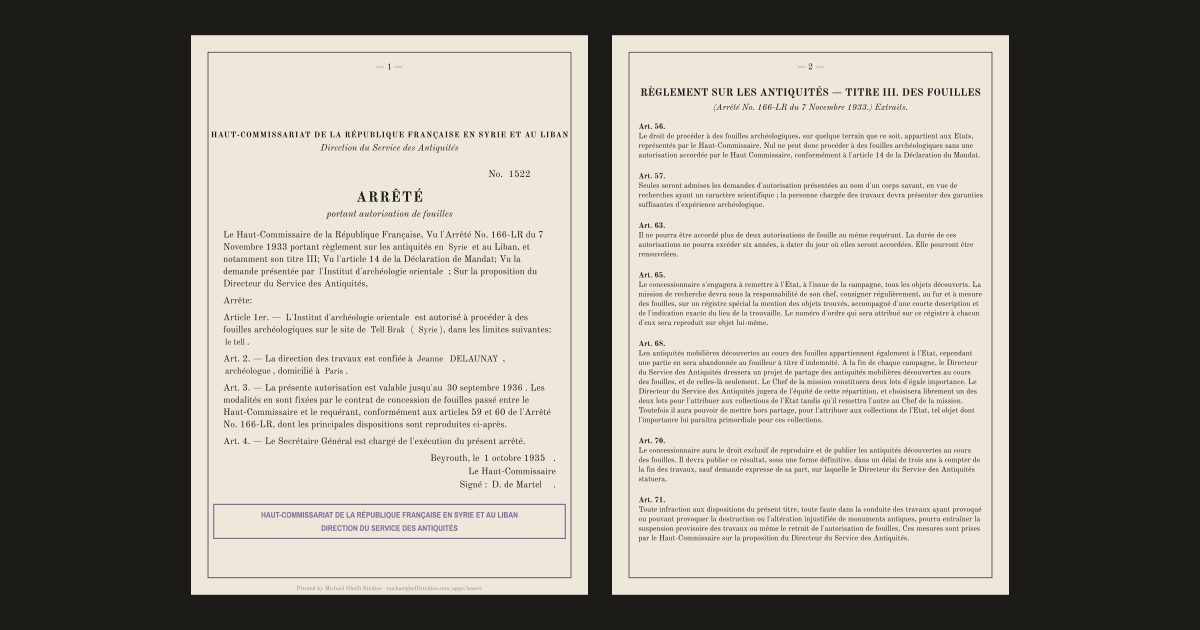
Under the French Mandate the High Commissioner at Beirut granted excavations for Syria and Lebanon under the regulation of 7 November 1933 (arrêté No. 166-LR): only to a learned body, for six years at most, the finds split into two lots of equal importance of which the Service chose one.
Bearer prints it in the form of the High Commissioner's own arrêtés, since no authorisation actually granted has been found, and says so above the paper.
Bearer makes an investigator's papers for Call of Cthulhu and any 1920s or 1930s tabletop campaign: the passport a consul would have filled in, with the visas and frontier stamps a campaign leaves in it, and the permits, certificates and tickets of the period, to print or to share.
An example
Open this example in the office
The paper
| Offered | from 7 November 1933 |
| Printed in | French |
| Sheets | 3 |
| How it is known | read off a document of the period |
The same paper elsewhere
Still to be confirmed
- no authorisation actually granted has been found: page 1 is set in the form of the High Commissioner's own arrêtés (the preamble of No. 166-LR, the closing formula of No. 225 of 1934), and says what articles 58 to 60 require (the learned body, the director of the works, the site, the term). What would settle it: an arrêté of the High Commissioner granting an excavation, or a contrat de concession de fouilles.
- the contract of concession itself (article 59) is not printed: its words have not been found. What would settle it: a contrat de concession de fouilles of the thirties (Mari, Ras Shamra, Dura-Europos, Byblos).
- one year when no expiry is typed in; article 63 allows up to six. What would settle it: a granted authorisation.
- the High Commissioner who signs: D. de Martel is read on an arrêté of 1934; G. Puaux from 1939 is the plain record of his term, the change dated to the turn of the year. What would settle it: acts of the High Commissioner signed in January 1939.
- the type begins with the regulation of 7 November 1933; the regulation of 26 March 1926 (arrêté No. 207) it replaced has not been found. What would settle it: arrêté No. 207 of 1926.
- the sheet is set at A4. What would settle it: an authorisation measured.
Sources
- Haut-Commissariat de la République française en Syrie et au Liban, Direction du Service des Antiquités; the edition printed at Beyrouth in 1935, with the arrêtés of 1934 and 1943 that amend it. Scan in the UNESCO Database of National Cultural Heritage Laws (Lebanon), Arrêté No. 166-LR du 7 novembre 1933 portant règlement sur les antiquités en Syrie et au Liban (Bulletin officiel des Actes administratifs du Haut-Commissariat, 30 novembre 1933), the preamble (Le Haut-Commissaire de la République Française, Vu…, Sur la proposition du Directeur du Service des Antiquités, Arrête :); title III, Des fouilles, articles 56 to 72: the right to dig belongs to the States represented by the High Commissioner (56), only a learned body for scientific research (57), the request (58), a contract of concession of excavations (59, 60), no more than two authorisations to one applicant and six years at most, renewable (63), an agent of the Service may be delegated (64), every find handed to the State and entered in a register (65), the finds divided in two lots of equal importance, one chosen for the State (68), a photographic dossier and a report (69), the concessionaire's right to publish within three years (70), suspension or withdrawal (71), clandestine digging fined 25 to 500 L.S. (72). The arrêté No. 225 of 28 September 1934 ends 'Beyrouth, le 28 Septembre 1934 / Le Haut-Commissaire / Signé : D. de Martel.' and 'Le Secrétaire Général est chargé de l'exécution du présent arrêté.' (read directly)
Open the passport office · MGS Toolbox