The police warrant card
A British police officer out of uniform proved his office with a warrant card: his name, rank and force, and the authority of the chief officer who granted it. For the investigators it is the card the plain-clothes man flashes at the door, or the one a cultist has stolen.
No card of the period has been found, nor any rule that prescribed its words: the card Bearer prints is a placeholder, every word of it ours, and the office says so above it.
Bearer makes an investigator's papers for Call of Cthulhu and any 1920s or 1930s tabletop campaign: the passport a consul would have filled in, with the visas and frontier stamps a campaign leaves in it, and the permits, certificates and tickets of the period, to print or to share.
An example
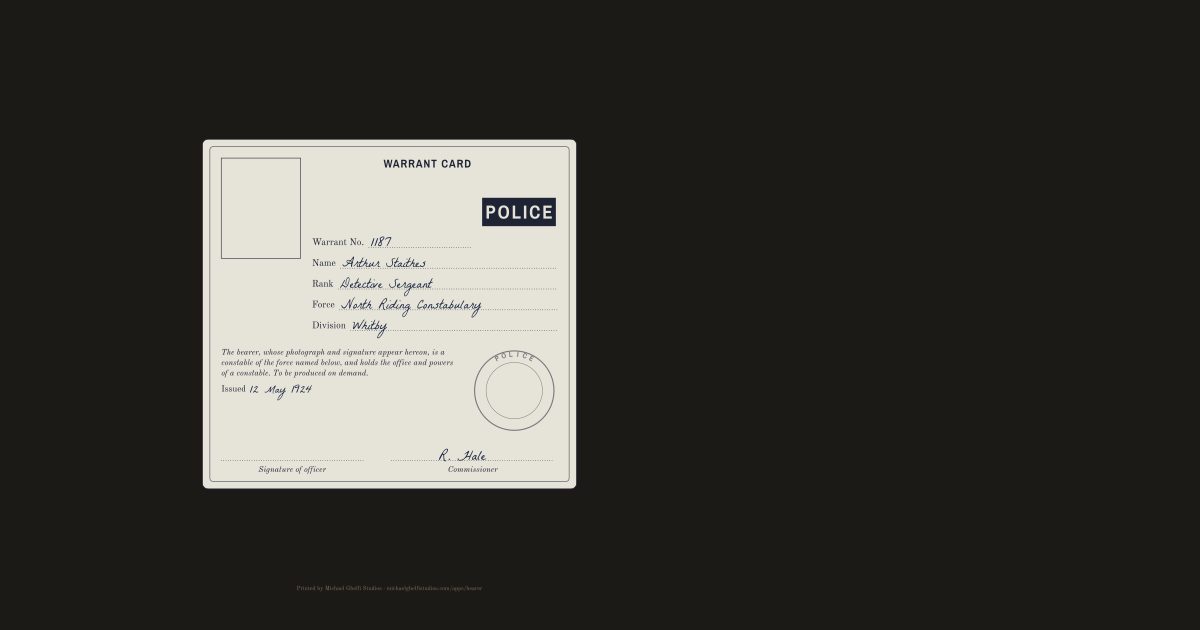
Open this example in the office
The paper
| Offered | from 21 October 1920 |
| Printed in | English |
| Sheets | 1 |
| How it is known | a reconstruction: no document of the period has been found |
A reconstruction
This paper is a reconstruction. British police officers carried a warrant card showing who they were and what force they served, but no card of the period has been found, nor any rule that prescribed its words: everything on it is ours. It is a placeholder for the table, not a copy.
The same paper elsewhere
Still to be confirmed
- the whole card. What would settle it: a British police warrant card of 1920 to 1939.
Sources
- Wikipedia, Warrant card, that a warrant card is proof of identification and authority carried by police constables, its text saying that the holder is granted authority by a named official; nothing about the cards before 1940 (secondary source)
Open the passport office · MGS Toolbox