Corrupted Marsh
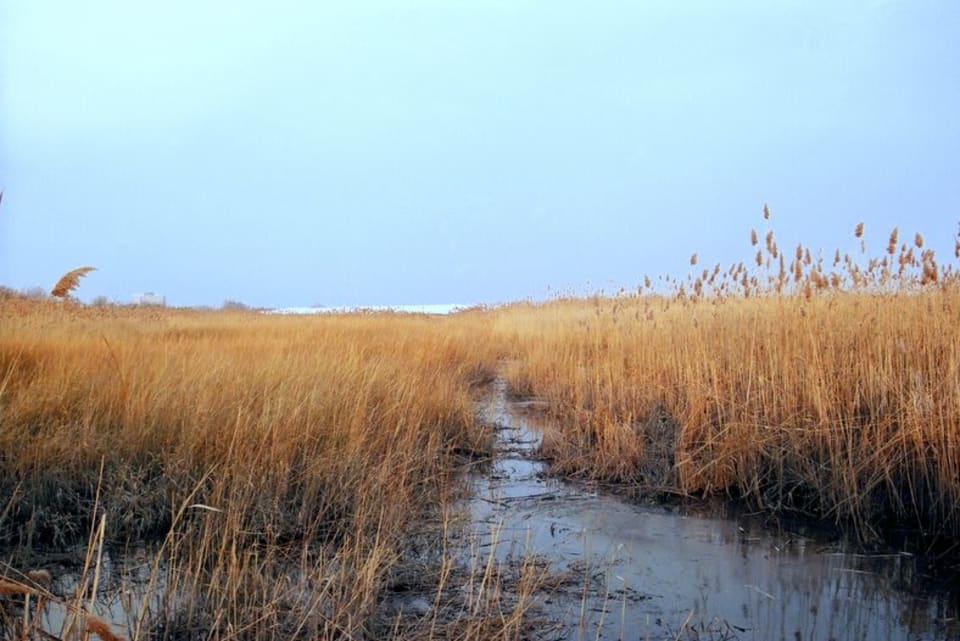

Nature here has gone sick. Water runs tainted, plants grow in wrong shapes, and the animals are diseased or worse. Whatever lives here eats what it should not. Open wetland of reeds, rushes and shallow pools, without trees. Rich in birds, fish and thatch, hard to cross on foot, and loud with frogs on summer nights.
Hear it
- Corrupted: Corrupted Shrine (On Patreon, Raven tier)
- Water: Toxic River (On Patreon, Raven tier)
- By boat: Sailing Barge in Marshlands (On Patreon, Raven tier)
- Insects: Swamp with Insect Swarm (On Patreon, Raven tier)
- In a storm: Thunder in Swamp (On Patreon, Guardian tier)
- Sucking mud: Thorny Swamp (In the album RPG Ambiences Vol. 7)
For the table
- Ground
- hard going, about 10 km a day on foot
- Water
- plentiful
- Foraging
- fair
Hazards
- Sucking mud. Firm-looking ground opens onto deep mud or peat. Alone and laden, a traveller can be held until the water rises or the cold comes.
- Biting insects. In the warm season, clouds of mosquitoes and flies bite day and night. Sleep and tempers wear thin.
- Tainted water. The water has a film on it and a sweet smell. Boiling does not make it safe; only clean water carried in does.
- Grasping growth. Roots and vines that move when nobody looks. They close around an ankle while the party rests.
- Wound rot. Here even a scratch goes black at the edges in a day. Clean cloth and strong drink are worth more than gold.
D&D 5e
- Plays as
- swamp, slow pace at most
- Checks
- forage: Survival DC 10 · find the way: DC 15 · search: DC 20
- Creatures are spotted at
- 2d8 × 10 ft
- Tainted water. (House rule) Whoever drinks it makes a DC 13 Constitution save: on a failure, the Poisoned condition until the next long rest and 1 Exhaustion. Purify Food and Drink makes it safe.
- Grasping growth. (House rule) A creature resting on the ground makes a DC 12 Dexterity save or has the Restrained condition; escaping takes a DC 12 Strength (Athletics) check or 10 slashing damage dealt to the growth.
- Wound rot. (House rule) A creature that took piercing or slashing damage today makes a DC 12 Constitution save at the end of the day, or regains only half the hit points from its next long rest. A healer's kit used on it gives Advantage.
This work includes material from the System Reference Document 5.2.1 ("SRD 5.2.1") by Wizards of the Coast LLC, available at https://www.dndbeyond.com/srd. The SRD 5.2.1 is licensed under the Creative Commons Attribution 4.0 International License, available at https://creativecommons.org/licenses/by/4.0/legalcode.
Pathfinder Second Edition
- Plays as (Pathfinder Second Edition)
- swamp, greater difficult terrain, about 11 km a day at Speed 25
- Checks
- Subsist: Survival DC 15 · Sense Direction: Survival DC 15
- Random encounters
- flat check DC 14 each day
- Sucking mud. Quicksand (GM Core p. 107): a hidden patch about 5 m wide (Stealth +12; Survival DC 18 to spot by disturbing it). Stepping in sinks a traveller to the waist, then one step each round (neck, then under); Athletics DC 20 climbs back a step, and allies can pull with Athletics DC 20.
This product is licensed under the ORC License located at the Library of Congress at TX 9-307-067 and available online at various locations including paizo.com/orclicense, azoralaw.com/orclicense, and others. All warranties are disclaimed as set forth therein. Attribution: this rules layer is based on the following Licensed Material: Pathfinder Player Core © 2023 Paizo Inc., Designed by Logan Bonner, Jason Bulmahn, Stephen Radney-MacFarland, and Mark Seifter. Authors: Alexander Augunas, Kate Baker, Logan Bonner, Jason Bulmahn, Carlos Cabrera, Calder CaDavid, James Case, Eleanor Ferron, Steven Hammond, Joan Hong, Vanessa Hoskins, James Jacobs, Jenny Jarzabski, Erik Keith, Dustin Knight, Lyz Liddell, Luis Loza, Patchen Mortimer, Dennis Muldoon, Stephen Radney-MacFarland, Mikhail Rekun, David N. Ross, Michael Sayre, Mark Seifter, Kendra Leigh Speedling, Mark Thompson, Clark Valentine, Andrew White, Landon Winkler, and Linda Zayas-Palmer; Pathfinder GM Core © 2023 Paizo Inc., Designed by Logan Bonner and Mark Seifter. Authors: Amirali Attar Olyaee, Logan Bonner, Creighton Broadhurst, Jason Bulmahn, James Case, Jesse Decker, Eleanor Ferron, Fabby Garza Marroquín, Jaym Gates, Matthew Goetz, James Jacobs, Brian R. James, Jenny Jarzabski, Dustin Knight, Jason LeMaitre, Lyz Liddell, Luis Loza, Ron Lundeen, Stephen Radney-MacFarland, David N. Ross, Michael Sayre, Mark Seifter, Owen K.C. Stephens, Amber Stewart, Clark Valentine, Landon Winkler, and Linda Zayas-Palmer; Pathfinder Monster Core © 2024 Paizo Inc., Authors: Alexander Augunas, Dennis Baker, Kate Baker, Joshua Birdsong, Joseph Blomquist, Logan Bonner, Jason Bulmahn, James Case, John Compton, Paris Crenshaw, Adam Daigle, Darrin Drader, Brian Duckwitz, Robert N. Emerson, Scott Fernandez, Eleanor Ferron, Leo Glass, Matthew Goodall, BJ Hensley, Thurston Hillman, Vanessa Hoskins, James Jacobs, Jenny Jarzabski, Miko Kallio, Jason Keeley, Jeff Lee, Lyz Liddell, Luis Loza, Ron Lundeen, Robert G. McCreary, Philippe-Antoine Menard, Jacob W. Michaels, Dave Nelson, Jason Nelson, Tim Nightengale, Stephen Radney-MacFarland, Mikhail Rekun, Patrick Renie, Alex Riggs, David N. Ross, Michael Sayre, Mark Seifter, Chris S. Sims, Amber Stewart, Jeffrey Swank, William Thompson, Jason Tondro, Clark Valentine, Landon Winkler, Tonya Woldridge, and Linda Zayas-Palmer. If you use our Licensed Material in your own published work, please credit us as follows: Biomes, Pathfinder Second Edition rules layer © 2026 Michael Ghelfi. Reserved Material: the names of Biomes and its catalogues, its descriptions, sounds, art and code. Pathfinder is a registered trademark of Paizo Inc.; this site is not published, endorsed, or specifically approved by Paizo Inc.
Crossing it
Besides walking, depending on the era and the season (Biomes estimates of a day’s distance):
- On horseback: about 12 km a day
- By river boat: about 35 km a day
- By airship: about 900 km a day
- By bush plane: about 800 km a day
- By rover: about 20 km a day
- By hover sled: about 80 km a day
- By elephant: about 20 km a day
- On a flying mount: about 150 km a day
- By flying carpet: about 100 km a day
- By armoured buggy: about 40 km a day
Adventure hooks
- A herbalist wants a sample of the sick plants to find a cure. Every sample taken out of the land rots within the hour, unless it is carried by someone who is already sick.
- The corruption started at a single spring, and a local lord has paid a priest to say it started elsewhere. The priest is dying of it, and wants to confess before he goes.
- A beast of the land has gone strange: a deer with too many legs that is gentle, follows travellers and seems to want help. Following it leads toward the heart of the sickness.
- A family that lives on the edge of the corrupted land has learned to eat its plants without falling ill. They will not share the secret, which is that they are no longer entirely human.
- Reed cutters have found a body in the peat at the edge of the reed beds, centuries old, a rope still around its neck. The village wants it buried at once; a scholar from the city wants to buy it, and so does somebody else, secretly.
- On a summer night every frog in the marsh fell silent at once. The causeway watchman says that is when the thing that booms in the reeds goes walking; the old folk laugh about it, and bar their doors.
- A wildfowler’s decoys are so good that the ducks fly into his nets by the hundred, and the lord’s falconers accuse him of stealing their game. A contest is set for Sunday, falcon against decoy, and both men need a second.
- An eel catcher needs help to set his wicker traps along a channel before the autumn run. He pays well and asks only one thing: that nobody whistles on the water.
What grows here
- Bog myrtle (shrub). An aromatic shrub up to 2 m tall with grey-green leaves, forming dense thickets in the peat bogs and marshes of northern Europe and North America. From the Middle Ages to the 16th century it went into gruit, the herb mix that flavoured beer before hops. Its sweet resinous leaves keep midges and mosquitoes away, its roots and bark dye wool and calfskin, and its waxy fruits were once made into candles. Not for pregnant women: it is listed as an abortifacient. Gives: Bog Myrtle Leaves, Bog Myrtle Bark.
- Cranberry (shrub). A tiny creeping evergreen with trailing stems that root as they go, small leathery leaves and pink flowers, crawling over the sphagnum hummocks of bogs, fens and conifer swamps across the cool north of Europe, Asia and America. Its red berries stay on the plant for months. Native American peoples ate them and used them as medicine, and some Iñupiat cook them with fish eggs and blubber. Food of: Black grouse. Gives: Cranberry.
- Bogbean (herb). A water-loving herb with three-part leaves and fringed white star flowers, its thick creeping rootstock building treacherous quaking mats in the fens, bogs and shallow waters of Europe, Asia and North America. Swedish peasants put its very bitter leaves in their beer instead of hops, and the bitterness also goes into schnapps. In a famine the rootstock can be ground into a poor flour. Gives: Bogbean Leaves, Bogbean Rootstock.
- Broadleaf Cattail (herb). A wetland plant of 1.5 to 3 m with broad strap leaves and a brown sausage-shaped seed head, always in or beside shallow water. It grows across Eurasia and North America and more locally in Africa and South America, from sea level to 2,300 m. Nearly every part is edible, and its leaves thatch roofs and seat chairs. Food of: Horse. Gives: Cattail Rhizome, Cattail Leaf, Cattail Pollen.
- Brooklime (herb). A fleshy, low perennial with smooth, often reddish stems, paired blunt leaves and small bright blue flowers (May to September), growing at the edge of brooks, ditches, ponds and marshes across Europe, North Africa and western Asia, up to 2,500 m. Leaves and stems are eaten raw in salad or cooked, and it was taken against scurvy with watercress. It can carry the liver fluke: do not eat it raw near pastures. Gives: Brooklime Leaves.
- Cloudberry (herb). A low herb of 10 to 25 cm with palmate leaves and white flowers, growing on acid bogs, wet meadows and tundra around the North Pole. Its amber berries, rich in vitamin C, kept scurvy away from Arctic peoples and are made into jams and liqueurs in the Nordic countries. Gives: Cloudberry.
- Fool's Watercress (herb). A low, often sprawling perennial of western Europe with a hollow stem rooting at the nodes and glossy leaves of paired, toothed leaflets that smell of carrot when crushed. It often grows with watercress in ditches, springs, fens and ponds, and in brackish marshes too. It is not poisonous, but is easily confused with the lesser water parsnip, said to be. Its young leaves and shoots are gathered wild in Spain, Italy, Portugal and Morocco. Gives: Fool's Watercress Shoots.
- Glasswort (herb). A small succulent annual, 20 to 30 cm, with jointed stems so full of water they look almost translucent, which gave it the name glasswort, and leaves reduced to scales; it grows in salt marshes, on beaches and among mangroves on most coasts of Europe. Eaten as marsh samphire: young shoots raw in May and June, later boiled in plenty of unsalted water; it tastes of young spinach stems, asparagus or artichoke. Its ash long gave the alkali of glassmakers and soapmakers, and the word alkali comes from the Arabic al-qalyah, 'glasswort ash'. Gives: Marsh Samphire.
- Mangrove Fern (herb). A big leathery fern with fronds up to 2 m (4 m in Malaysian swamps), found across the tropics in mangroves, salt marshes, swamps and on riverbanks; it is the only fern that can grow in, and even be flooded by, the sea. Its very young fronds are eaten raw or cooked: in salads in Cambodia, in a spicy coconut gravy in Goa. Dried fronds are strung on rods and used instead of straw to thatch roofs. Gives: Mangrove Fern Fronds.
- Marsh Mallow (herb). A soft, velvety perennial of 1 to 1.8 m with pale pink flowers around July, growing in marshes, salt marshes and on riverbanks of Europe, western Asia and North Africa. Its genus name comes from the Greek for "to heal", and Charlemagne listed it among the plants to grow in the royal gardens. Its root gave the first marshmallow sweet. Gives: Marsh Mallow Root.
- Meadowsweet (herb). A perennial of 1 to 2 m with creamy-white flowers of a strong, sweet smell, dominating damp meadows, fens, wet woods, ditches, stream banks and the edges of alder woods in Europe and western Asia. Its English name comes from flavouring mead. In 1838 salicylic acid was drawn from its buds, and aspirin is named after its old name, Spiraea. Gives: Meadowsweet Flowers, Meadowsweet Root.
- Round-leaved sundew (herb). A small carnivorous rosette 3 to 5 cm across, its round leaves covered in red hairs that bead with sticky glue to trap and digest insects. It grows in sunny acid bogs, fens and wet sphagnum under black spruce, all around the northern hemisphere. Healers gave it against coughs and inflammation, but it irritates in strong doses; it is strictly protected in France. Gives: Round-leaved Sundew.
- Sacred Lotus (herb). An aquatic plant of calm water 30 cm to 2.5 m deep, in ponds, lakes, marshes and the floodplains and deltas of slow rivers, native from East Asia to India and spread by people across Southeast Asia and northern Australia. Its round leaves reach 80 to 100 cm across and its flowers 35 cm, warming themselves to 30 to 35 °C. Almost every part is eaten, and it is holy to Buddhists and Hindus. Its seeds keep for centuries: 1,300-year-old seeds from a dry lakebed in China have sprouted. Gives: Lotus Root, Sacred Lotus Seed.
- Sea Beet (herb). A perennial 30 to 80 cm high with dark green, fleshy leaves, growing on sand and pebble beaches, along the drift line of salt marshes, on sea walls, rocks and cliffs, from western Europe to North Africa and southern Asia. Its leaves are good raw or cooked like spinach, hence the name wild spinach. It is the wild ancestor of beetroot, sugar beet and Swiss chard, and Pliny already described it. Gives: Sea Beet Leaves.
- Southern Cattail (herb). A cattail of 2 to 2.5 m found throughout the tropics and subtropics, in marshes and wet ground; it is one of the main plants of the Sudd and grows as an understorey in some mangroves, for it stands much saltier water than its relatives. Around some lake villages of Michoacán, in Mexico, it spreads so fast that it is cut back every month to keep it out of the fields. Gives: Southern Cattail Pollen, Southern Cattail Leaves.
- Sweet Flag (herb). A wetland herb up to 2 m tall with sword-shaped leaves with crimped edges, spreading by rhizomes in marshes, swamps and pond edges. Native to the Irtysh valley of Kazakhstan, it was brought to Europe in the 13th century and is now found across Europe, Asia, Australia and North America. Its fragrant rhizome is a medicine and a flavouring, but its oil holds beta-asarone, which can cause long vomiting and is suspected of causing cancer; the US banned it from food in 1968. Gives: Calamus Root.
- Taro (herb). A tropical perennial with big heart-shaped leaves and a starchy corm, thought native to southern India and Southeast Asia, growing in wetlands, marshes and low ground along streams and rivers. It is one of the oldest crops: traces of taro about 10,000 years old have been found at Kuk Swamp in New Guinea. Raw, the plant is full of needle-like oxalate crystals that burn the mouth and throat: it must be cooked. Food of: Cattle. Gives: Taro Corm, Taro Leaves.
- Water Mint (herb). A strongly minty perennial up to 90 cm, with square stems, toothed leaves and round heads of tiny purple flowers in summer, growing in the shallow edges of streams, rivers, pools, ditches, marshes and fens of Europe, North Africa and western Asia. It is used as a kitchen herb like spearmint and for herbal tea, though peppermint (its hybrid) tastes better. Folk medicine took mints as a tonic and for digestion, and rubbed them on against colds and headaches. Gives: Water Mint Leaves.
- Longstamen Rice (grass). A perennial wild rice with creeping rhizomes, native to most of Africa south of the Sahara and Madagascar, growing in swamps, ponds, lake and river sides and flooded grasslands, it can blanket flooded meadows and grows in water up to 4 m deep, though usually less than 1 m. The grain is cooked and tastes good, but it falls from the ear at a touch, so people reap it unripe or shake the ripe heads over baskets; it is a famine food. The tall straw makes thatch. Gives: African Wild Rice, Wild Rice Straw.
- Bourgou (grass). A floating water grass of tropical Africa and Asia whose spongy stems trail up to 2 m and form nearly pure mats in swamps and standing water. The Fulani once grew it widely in the Inner Niger Delta: they ate the seeds and brewed drinks from it, and the sweet stems are chewed for their juice or boiled down to brown sugar. It still gives hay for animals and holds flood banks against erosion. Gives: Bourgou Stem, Bourgou Seeds.
- Common Reed (grass). A tall wetland grass of 1.5 to 4 m, found worldwide, that forms vast reed beds in shallow fresh or brackish water, like the 1,700 km² of the Danube Delta. Its purple plumes turn grey and silky in autumn and the stems stand through the winter. It is the classic thatch of Europe. Food of: Goat. Food of: Cattle. Gives: Reed Stem, Reed Rhizome.
- Common cottongrass (sedge). A sedge up to 1 m tall whose white cotton tufts, out from June to September, whiten the bogs, fens, wet moors and snowmelt hollows of the whole north, up to 83° N in Greenland. A dense stand can hide wet bog and marks ground to avoid. The down is too brittle to spin, but it made pillow stuffing in Sweden and England, paper and candle wicks in Germany, and the wicks of the kudlik, the Inuit oil lamp. Native peoples eat its seeds and stems. Gives: Cottongrass Down, Cottongrass Stems.
- Lake Clubrush (sedge). A sedge 0.8 to 3.5 m tall with round green stems 5 to 15 mm thick and almost no leaves, forming the waterward edge of reed beds in still and slow fresh water, from Europe to Mongolia, in North Africa and in southern Africa. It bears deeper water than common reed or bulrush, and is planted to protect banks. Gives: Clubrush Stems.
- Sawgrass (sedge). A sedge 1.5 to 3 m tall from the Americas, the plant of the Everglades' 'River of Grass', where sawgrass marsh covers the land from Lake Okeechobee to Florida Bay. Its leaves have hard serrated edges, and harvesting it can leave deep cuts. Fire burns it above the water but spares the roots, and alligators nest in its dense stands. In Europe the same sedge was once an important thatch, and it is sometimes made into cheap paper. Gives: Sawgrass Thatch.
Animals
- American Alligator (man-killer, alone, day and night)
- Nile Crocodile (man-killer, in colonies, day and night)
- Common Adder (can wound or kill, alone, at dawn and dusk)
- Wild Boar (can wound or kill, in families, by night)
- Coypu (dangerous if cornered, in colonies, by night)
- Eurasian Beaver (dangerous if cornered, in families, by night)
- Mute Swan (dangerous if cornered, in pairs, by day)
- Yacare Caiman (dangerous if cornered, in colonies, day and night)
- Barasingha (harmless, in herds, by day)
- Capybara (harmless, in herds, at dawn and dusk)
- Common crane (harmless, in flocks, by day)
- Common Pheasant (harmless, in flocks, by day)
- Common snipe (harmless, alone, by day)
- Edible Frog (harmless, alone, day and night)
- Grey Heron (harmless, alone, at dawn and dusk)
- Greylag Goose (harmless, in flocks, by day)
- Jabiru (harmless, in pairs, by day)
- Mallard (harmless, in flocks, by day)
- Marsh Deer (harmless, alone, at dawn and dusk)
- Moor frog (harmless, alone, by night)
- Muskrat (harmless, in families, at dawn and dusk)
- Nile Lechwe (harmless, in herds, at dawn and dusk)
- Red Lechwe (harmless, in herds, by day)
- Scarlet Ibis (harmless, in colonies, by day)
- Shoebill (harmless, alone, by day)
- Sitatunga (harmless, alone, at dawn and dusk)
- Wild Turkey (harmless, in flocks, by day)
- Willow Ptarmigan (harmless, in flocks, by day)
Kept here
- Water Buffalo (can wound or kill, in herds, day and night)
- Horse (dangerous if cornered, in herds, at dawn and dusk)
Creatures
- Dretch (a threat to the unwary, Challenge 1/4)
- Quasit (a fight to fear, Challenge 1)
- Succubus (a fight to fear, Challenge 4)
- Vrock (deadly, Challenge 6)
- Glabrezu (deadly, Challenge 9)
- Nalfeshnee (deadly, Challenge 13)
Also met here
- Stirge (a threat to the unwary, Challenge 1/8)
- Giant Frog (a threat to the unwary, Challenge 1/4)
- Swarm of Insects (a threat to the unwary, Challenge 1/2)
- Giant Toad (a fight to fear, Challenge 1)
- Black Dragon (deadly, Challenge 2-21)
- Will-o'-Wisp (a fight to fear, Challenge 2)
- Green Hag (a fight to fear, Challenge 3)
- Shambling Mound (deadly, Challenge 5)
- Hydra (deadly, Challenge 8)
This work includes material from the System Reference Document 5.2.1 ("SRD 5.2.1") by Wizards of the Coast LLC, available at https://www.dndbeyond.com/srd. The SRD 5.2.1 is licensed under the Creative Commons Attribution 4.0 International License, available at https://creativecommons.org/licenses/by/4.0/legalcode.
To gather
Hag Brain, Sea Hag Gill, Wastrilith Acid Venom, Sibriex Bile, African Wild Rice, Wild Rice Straw, American Alligator Meat, Bog Myrtle Bark, Bog Myrtle Leaves, Bogbean Leaves, Bogbean Rootstock, Bourgou Seeds, Bourgou Stem, Cattail Leaf, Cattail Pollen, Cattail Rhizome, Brooklime Leaves, Capybara Hide, Capybara Meat, Clubrush Stems, Common Adder Fat, Cottongrass Down, Cottongrass Stems, Pheasant Meat, Reed Rhizome, Reed Stem, Snipe Meat, Coypu Meat, Coypu Pelt, Cranberry, Crocodile Glands, Edible Frog Legs, Eurasian Beaver Pelt, Fool's Watercress Shoots, Marsh Samphire, Greylag Goose Egg, Greylag Goose Feathers, Greylag Goose Meat, Horsehair, Mallard Meat, Mangrove Fern Fronds, Marsh Mallow Root, Meadowsweet Flowers, Meadowsweet Root, Muskrat Meat, Muskrat Pelt, Nile Crocodile Egg, Lotus Root, Sawgrass Thatch, Scarlet Ibis Egg, Sea Beet Leaves, Sitatunga Meat, Southern Cattail Leaves, Southern Cattail Pollen, Taro Corm, Taro Leaves, Buffalo Hide, Buffalo Milk, Water Mint Leaves, Wild Boar Bristles, Wild Turkey Egg, Wild Turkey Feathers, Wild Turkey Meat, Willow Bark, Willow Ptarmigan, Yacare Caiman Hide, Yacare Caiman Meat, American Alligator Hide, Swamp Deer Antler, Swamp Deer Venison, Calamus Root, Cloudberry, Common Adder Venom, Eurasian Beaver Castoreum, Grey Heron Meat, Jabiru Feathers, Jabiru Meat, Marsh Deer Meat, Mute Swan Feather, Mute Swan Meat, Nile Crocodile Hide, Round-leaved Sundew, Scarlet Ibis Feather, Sitatunga Hide, Yacare Caiman Urine, Crane Meat, Marsh Deer Antler, Beetle Wing, Frog Lung, Giant Mosquito Wing, Hemlock Stem, Orchid Flower, Snake Venom, Valerian Root, Wolf Aloe Leaf, Grung Venom, Hag Index Finger, Pitcher Plant Nectar, Sundew Tentacle, Will-o'-Wisp Spark, Concentrated Venom, Corpse Flower Petal, Electric Eel Gland, Ghost Orchid, Troll Bone Marrow, Will-o'-Wisp Trail, Catoblepas Eye Gland, Hag Moldy Heart, Naga Perfect Scale, Wandering Mound Mother Root, Adult Dragon Tonsils, Dragon Tongue, Froghemoth Tongue, Hydra Bile, Witch's Eye
The same milieu, otherwise
Marsh, Cursed Marsh, Haunted Marsh, Enchanted Marsh, Eldritch Marsh, Frozen Marsh, Toxic Marsh
Open it in Biomes — MGS Toolbox