Crystalline Hot Desert
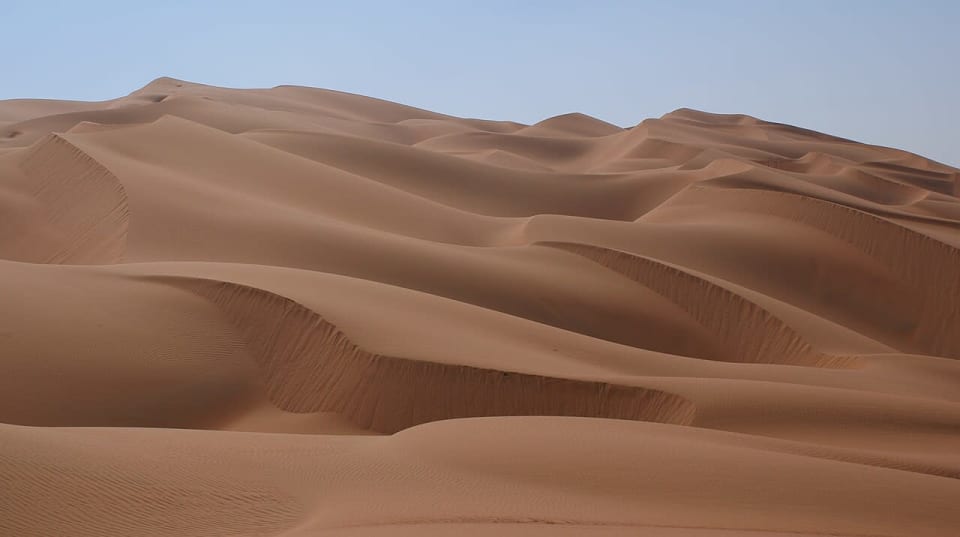

Crystals grow out of the ground, the rocks and even the plants. They cut, they ring in the wind, and they throw light in every direction, so that noon dazzles and the night glows. Sand, gravel and bare rock under a fierce sun, with little rain and far fewer dunes than tales suggest. Life gathers at oases and wells, travel follows them, and the nights are colder than strangers expect.
Over the year it averages 24 °C.
Hear it
- Crystal: Crystal Desert (On Patreon, Guardian tier)
- At night: Crystal Desert At Night (On Patreon, Guardian tier)
- In the rain: Crystal Rain (In the album RPG Ambiences Vol. 9)
- By day: Desert (In the album RPG Ambiences Vol. 8)
- On foot: Walking in a Desert (On Patreon, Guardian tier)
- On foot at night: Walking in a Desert At Night (On Patreon, Guardian tier)
- In the wind: Windy Desert (In the album RPG Ambiences Vol. 1)
- Sandstorm: Sandstorm (In the album RPG Ambiences Vol. 5)
- In a storm: Desert Rain and Thunder (On Patreon, Guardian tier)
- An oasis: Oasis (In the album RPG Ambiences Vol. 1)
- A canyon: Desert Canyon (In the album RPG Ambiences Vol. 3)
- At camp: Desert Camp at Night (On Patreon, Guardian tier)
- In a tent: Tent During Sandstorm (In the album RPG Ambiences Vol. 7)
- Getting lost: Walking in a Desert Canyon (On Patreon, Guardian tier)
For the table
- Ground
- rough, about 20 km a day on foot
- Seasons
- 14 °C in the heart of winter, 34 °C in the heart of summer
- Water
- scarce
- Foraging
- nothing
Hazards
- Crushing heat. At midday the heat wears a walker down far faster than the road. Those who know the land travel at dawn and dusk and rest in the shade.
- Thirst. Water is far apart and not always where the map says. A day without drinking in the heat is enough to put a traveller down.
- Strong wind. Steady wind tires walkers, blows out fires and, on sand or snow, blinds and buries the track.
- Flash flood. A storm far off sends a wall of water down a dry bed. A camp in a wadi can be swept away under a clear sky.
- Getting lost. Under the trees, in the dunes or in the dark, every direction looks alike. Without a guide or a sure landmark, a party walks in circles.
- Crystal shards. Crystal edges hide under grass and sand, sharp as glass. Boots last a week; bare feet, an hour.
- Singing stone. When the wind blows the crystals ring, one long note that never stops. After a day of it, nobody hears anything else, and some stop sleeping.
- Crystal glare. At midday the light bounces from every face of the crystals. Without a veil or slitted goggles, the eyes burn.
D&D 5e
- Plays as
- desert, normal pace at most
- Checks
- forage: Survival DC 20 · find the way: DC 10 · search: DC 10
- Creatures are spotted at
- 6d6 × 10 ft
- Crushing heat. At 38 °C (100 °F) or hotter, anyone exposed without drinkable water makes a Constitution save at the end of each hour, DC 5 then 1 higher each hour, or gains 1 Exhaustion. Medium or heavy armour gives Disadvantage; fire resistance passes automatically.
- Thirst. Each Medium creature needs about 4 litres (1 gallon) of water a day. Drinking less than half of it brings 1 Exhaustion at the end of the day, which does not go until a full day's water is drunk.
- Strong wind. Disadvantage on ranged weapon attacks; open flames go out and fog clears; a flyer must land at the end of its turn or fall. In a desert it can raise a sandstorm: Disadvantage on Wisdom (Perception) checks.
- Crystal shards. (House rule) The ground is Difficult Terrain. A creature that moves at a fast pace makes a DC 12 Dexterity save each hour or takes 1d6 slashing damage and has its speed reduced by 10 feet until healed.
- Singing stone. (House rule) On windy days, creatures have Disadvantage on Wisdom (Perception) checks that rely on hearing. A creature that sleeps without stopping its ears makes a DC 12 Constitution save or gains 1 Exhaustion.
- Crystal glare. (House rule) A creature that travels at midday without eye cover makes a DC 12 Constitution save or has the Blinded condition until it rests an hour in shade.
This work includes material from the System Reference Document 5.2.1 ("SRD 5.2.1") by Wizards of the Coast LLC, available at https://www.dndbeyond.com/srd. The SRD 5.2.1 is licensed under the Creative Commons Attribution 4.0 International License, available at https://creativecommons.org/licenses/by/4.0/legalcode.
Pathfinder Second Edition
- Plays as (Pathfinder Second Edition)
- desert, difficult terrain, about 16 km a day at Speed 25
- Checks
- Subsist: Survival DC 30 · Sense Direction: Survival DC 30
- Random encounters
- flat check DC 17 each day
- Crushing heat. Temperature bands (GM Core p. 95): from 35 °C (mild heat) travellers tire after 4 hours; from 41 °C (severe heat) they take minor fire damage (1d6 to 2d6) every hour; from 46 °C (extreme heat), every 10 minutes. In high humidity the mild and severe thresholds are about 8 °C lower.
- Thirst. Without enough water a creature is fatigued; after its Constitution modifier + 1 days without drinking it takes 1d4 damage an hour, which cannot be healed until it drinks (GM Core p. 43).
- Strong wind. Wind gives a –1 to –4 penalty to Perception that relies on hearing and to physical ranged attacks, and puts out handheld flames; strong wind can call for Athletics to move, a critical failure pushing back and knocking prone (GM Core p. 95).
- Flash flood. A flash flood works like an avalanche of water that carries creatures away rather than burying them; then the drowning rules apply (GM Core p. 96).
- Getting lost. Sense Direction (Player Core p. 246): a Survival check once a day, –2 without a compass; DC 15 in ordinary wild land, 20 in deep forest or underground, 30 in a featureless desert. Getting lost has no fixed penalty: the GM decides where the party ends up.
This product is licensed under the ORC License located at the Library of Congress at TX 9-307-067 and available online at various locations including paizo.com/orclicense, azoralaw.com/orclicense, and others. All warranties are disclaimed as set forth therein. Attribution: this rules layer is based on the following Licensed Material: Pathfinder Player Core © 2023 Paizo Inc., Designed by Logan Bonner, Jason Bulmahn, Stephen Radney-MacFarland, and Mark Seifter. Authors: Alexander Augunas, Kate Baker, Logan Bonner, Jason Bulmahn, Carlos Cabrera, Calder CaDavid, James Case, Eleanor Ferron, Steven Hammond, Joan Hong, Vanessa Hoskins, James Jacobs, Jenny Jarzabski, Erik Keith, Dustin Knight, Lyz Liddell, Luis Loza, Patchen Mortimer, Dennis Muldoon, Stephen Radney-MacFarland, Mikhail Rekun, David N. Ross, Michael Sayre, Mark Seifter, Kendra Leigh Speedling, Mark Thompson, Clark Valentine, Andrew White, Landon Winkler, and Linda Zayas-Palmer; Pathfinder GM Core © 2023 Paizo Inc., Designed by Logan Bonner and Mark Seifter. Authors: Amirali Attar Olyaee, Logan Bonner, Creighton Broadhurst, Jason Bulmahn, James Case, Jesse Decker, Eleanor Ferron, Fabby Garza Marroquín, Jaym Gates, Matthew Goetz, James Jacobs, Brian R. James, Jenny Jarzabski, Dustin Knight, Jason LeMaitre, Lyz Liddell, Luis Loza, Ron Lundeen, Stephen Radney-MacFarland, David N. Ross, Michael Sayre, Mark Seifter, Owen K.C. Stephens, Amber Stewart, Clark Valentine, Landon Winkler, and Linda Zayas-Palmer; Pathfinder Monster Core © 2024 Paizo Inc., Authors: Alexander Augunas, Dennis Baker, Kate Baker, Joshua Birdsong, Joseph Blomquist, Logan Bonner, Jason Bulmahn, James Case, John Compton, Paris Crenshaw, Adam Daigle, Darrin Drader, Brian Duckwitz, Robert N. Emerson, Scott Fernandez, Eleanor Ferron, Leo Glass, Matthew Goodall, BJ Hensley, Thurston Hillman, Vanessa Hoskins, James Jacobs, Jenny Jarzabski, Miko Kallio, Jason Keeley, Jeff Lee, Lyz Liddell, Luis Loza, Ron Lundeen, Robert G. McCreary, Philippe-Antoine Menard, Jacob W. Michaels, Dave Nelson, Jason Nelson, Tim Nightengale, Stephen Radney-MacFarland, Mikhail Rekun, Patrick Renie, Alex Riggs, David N. Ross, Michael Sayre, Mark Seifter, Chris S. Sims, Amber Stewart, Jeffrey Swank, William Thompson, Jason Tondro, Clark Valentine, Landon Winkler, Tonya Woldridge, and Linda Zayas-Palmer. If you use our Licensed Material in your own published work, please credit us as follows: Biomes, Pathfinder Second Edition rules layer © 2026 Michael Ghelfi. Reserved Material: the names of Biomes and its catalogues, its descriptions, sounds, art and code. Pathfinder is a registered trademark of Paizo Inc.; this site is not published, endorsed, or specifically approved by Paizo Inc.
Crossing it
Besides walking, depending on the era and the season (Biomes estimates of a day’s distance):
- On horseback: about 30 km a day
- By camel: about 32 km a day
- By wagon: about 15 km a day
- By stagecoach: about 60 km a day
- By train: about 400 km a day
- By airship: about 900 km a day
- By bush plane: about 800 km a day
- By 4x4: about 100 km a day
- By motorcar: about 60 km a day
- By rover: about 60 km a day
- By hover sled: about 100 km a day
- On a flying mount: about 150 km a day
- By flying carpet: about 100 km a day
- By car: about 200 km a day
- By truck: about 150 km a day
- By motorbike: about 150 km a day
- By armoured buggy: about 120 km a day
- By sand skimmer: about 120 km a day
A scene
- Desert. The winds whisper, and the sands shiver. As the sun rises, the land begins to seethe. Yet life will out, even here. There are those that toil on the surface. And there are those that delve and yearn. With the oceans boiled away, the bones of history lay bare. Time does not heal all wounds. Be careful where you tread. The full generator on the blog
Adventure hooks
- A jeweller pays well for crystals cut from living plants, which hold a little green inside. The plants scream when they are cut, a thin ringing scream, and the jeweller has stopped coming himself.
- The crystals ring in the wind, and someone has noticed that, played together, they make a song the oldest grandmother in the region knows. She will not sing the end of it.
- The crystals are spreading a little further each year, onto farmland, roofs and once onto a sleeping drunk. The village wants it stopped, and the drunk would like his arm back.
- A thief has stolen a sack of the crystals and hidden in the land, and every crystal he carries shines a light that can be seen for miles. He is the worst hidden man alive, and the most heavily armed.
- A caravan master hires the party to guard thirty camels loaded with salt. Halfway across, the guide admits that the well ahead dried up three years ago; he knows another, kept by a family who want him dead.
- A sandstorm has uncovered the tops of a buried town beside the oasis. The elders want it covered again before the young people start digging; the young people started yesterday.
- At a well on the caravan road, an old woman sells water at an honest price and tells every traveller one true thing, unasked. She tells one of the party they will die here. She means of old age, which bothers them more.
- A nomad family’s best racing camel has been stolen, and the thieves were seen heading into the dunes, which nobody crosses in summer. The son wants to ride after them; his mother wants someone to bring him back alive.
What grows here
- Date Palm (tree). A palm up to thirty metres tall that can live over a century, with male and female flowers on separate trees. It comes from the lands between the Gulf and India and is grown across North Africa and the Middle East in oases, on deep, alkaline sandy soils. Its sweet dates are a staple, its fronds roof huts and are woven into mats and baskets, and its sap is drunk or fermented. Gives: Dates, Date Palm Frond, Date Palm Sap.
- Desert Date (tree). A thorny tree of about ten metres, armed with long, straight green spines, found from the Sahel and the Sahara across Africa to Syria and Yemen, in arid savanna and desert, best near rivers and in valley bottoms. It shrugs off drought, flood and fire and keeps bearing in dry years. Its small fruit is sweetish but bitter and sucked fresh; the oily kernel is boiled before eating or pressed for cooking oil, and the young leaves are cooked as greens. Food of: African Bush Elephant. Gives: Desert Date Fruit, Desert Date Kernel.
- Doum Palm (tree). A fan palm up to seventeen metres whose trunk forks again and again, growing across the Sahel from Mauritania to Egypt and East Africa and into Arabia, along rivers and wadis where groundwater lies near. Its orange, fibrous fruit tastes of gingerbread and is chewed fresh or made into molasses, cakes and drinks; the unripe kernel and the young shoots are eaten too. The great fan leaves are woven into mats, baskets, rope and thatch. Gives: Doum Fruit, Doum Fronds.
- Frankincense Tree (tree). A small tree two to eight metres tall with papery, peeling bark and leaves of many paired leaflets, which grips steep slopes with buttress roots. It grows on rocky limestone slopes and ravines of Oman, Yemen, Somalia and Ethiopia, up to about 1,200 metres. Its trunk is cut to bleed the milky resin that hardens into frankincense, traded for millennia and burnt in temples. Gives: Frankincense.
- Gum Arabic Tree (tree). A small thorny deciduous tree five to twelve metres tall that fixes nitrogen and enriches poor soils. It grows in the semi-desert lands of Africa south of the Sahara, Oman, Pakistan and western India. Cuts in its bark weep gum arabic, Sudan's great export, and its roots and bark give strong cord. Gives: Gum Arabic, Gum Arabic Tree Bark.
- Honey Mesquite (tree). A thorny tree or shrub, usually six to nine metres, of the Sonoran and Chihuahuan deserts and the dry plains from California to Kansas and south into Mexico, often in dense thickets along desert washes. The Cahuilla ground its pods into meal for cakes and Pueblo peoples bake mesquite flour into bread; deer, peccaries, coyotes and jackrabbits eat the pods too. Its dense, hard wood made tools, arrow points and furniture, burns well and gives barbecue its flavour, and its gum served as glue. Gives: Mesquite Pods, Mesquite Wood.
- Myrrh Tree (tree). A very spiny small tree up to about five metres tall, with silvery-grey bark over a green inner layer and small leaves of three leaflets. It grows in eastern Africa and Arabia on desert slopes and valleys among open acacia, on thin limestone soils between 250 and 1,300 metres. The resin seeps from cuts in the bark and dries into small tears of myrrh. Gives: Myrrh.
- Saguaro (tree). The giant tree-like cactus of the Sonoran Desert in Arizona, Sonora and California, three to sixteen metres tall and living 150 to 200 years, from sea level to about 1,400 metres. Gila woodpeckers and gilded flickers dig their nests in it and bats drink the nectar of its flowers. The Tohono O'odham picked its fruit in June, boiling it down to syrup and fermenting it into a ceremonial wine, and the ribs of dead saguaros served Native Americans for building. Gives: Saguaro Fruit.
- Umbrella Thorn (tree). A flat-topped acacia that reaches twenty metres where water allows and shrinks to a wiry bush in the driest places, armed with pairs of thorns, one long and pale, one short, curved and dark. It grows across the savannas and the Sahel of Africa and into the Middle East, in heat, drought and salty soils. Its coiled pods and leaves feed goats and camels, its bark gives tannin and string, and its wood makes posts and furniture. Food of: Goat. Food of: Dromedary. Gives: Umbrella Thorn Bark, Umbrella Thorn Wood.
- Caper (shrub). A much-branched shrub with round fleshy leaves, hooked thorns and white or pink flowers with long violet stamens. It ranges from the Canaries and Morocco across the Mediterranean and Arabia to the Black Sea and the Caspian, in semi-arid and arid country from sea level up to 2,000 m. It bears fierce sun, heat and dry soil. Gives: Capers.
- Creosote Bush (shrub). An evergreen shrub of one to three metres with resinous leaves, the common bush of the Mojave, Sonoran and Chihuahuan deserts; wet with rain its leaves give off the creosote smell people call the smell of rain. Some of its clonal rings are ancient: King Clone in the Mojave is put at 11,700 years. Native peoples treated snakebite, cramps and many ills with it and boiled its reddish lac into a glue to mend pots, but health authorities warn the leaves can damage the liver and kidneys. Food of: Chuckwalla. Gives: Creosote Bush Leaves.
- Jojoba (shrub). An evergreen shrub of one to two metres from the Sonoran, Colorado and Baja California deserts and the California chaparral, on sandy or gravelly ground, with a taproot that can reach twenty-five metres down. Its seeds are about half a liquid wax, prized for skin and hair care and burnt in lamps; Native Americans made a salve of the heated seeds and used it to cure hides. The seeds are sometimes parched and eaten or brewed like coffee, but the wax purges and the seed meal is toxic to many mammals in quantity. Gives: Jojoba Seed.
- Prickly Pear (shrub). A cactus shrub up to five metres, built of flat jointed pads, born in central Mexico and now wild in dry, rocky places around the Mediterranean, in North Africa and in many frost-free lands, invasive in some. Its sweet fruits are eaten raw, cooked or dried, the young pads are cooked as a vegetable (nopalitos), and spineless forms feed cattle through droughts. Mind the glochids: tiny barbed bristles that come off at a touch and are hard to get out of the skin. Gives: Prickly Pears, Prickly Pear Pads.
- Aloe Vera (herb). A stemless succulent up to a metre tall from the Hajar Mountains of Oman and the Emirates, now wild in North Africa, Sudan and the Atlantic islands, on desert ground and on coastal sands and rocks. The clear gel of its leaves soothes minor burns, scrapes and insect bites, a skin cure recorded since the fourth millennium BCE. The bitter yellow latex under the leaf skin is a strong laxative; taken by mouth, aloe can bring cramps, and hepatitis if kept up. Gives: Aloe Vera Gel.
- Century Plant (herb). A big agave of sandy desert scrub in Texas and eastern Mexico, now naturalised round the Mediterranean, in Africa and far beyond, with grey-green spine-tipped leaves. Despite its name it lives ten to thirty years, flowers once on a stalk eight or nine metres tall, then dies, leaving shoots at its base. Cut before it flowers, its heart gives a sweet sap, aguamiel, that ferments into pulque, and its leaves give a strong fibre for rope, nets and cloth; the fresh sap can inflame sensitive skin. Gives: Aguamiel, Century Plant Fibre.
- Syrian Rue (herb). A bushy, foul-smelling perennial of dry and often salty ground in temperate deserts and Mediterranean lands, from Morocco and Spain across the Middle East and Central Asia to western Mongolia and northern China, where it grows on salty sands near oases. Its roots go deep and it is near impossible to uproot. It poisons livestock, above all in drought. In Iran, Turkey and Azerbaijan strings of its dried capsules hang in homes and vehicles against the evil eye, and its seeds, esfand, are burnt at Persian weddings. Gives: Esfand Seeds.
- Colocynth (vine). A trailing desert vine of two to three metres on the sands and dunes of North Africa and the Sahara, through Arabia to Pakistan and India, with hard round fruits five to ten centimetres across, marbled yellow when ripe. The pulp is fiercely bitter and poisonous: a little was the old purgative, too much brings vomiting, diarrhoea and damage to the liver and kidneys. The seeds, thoroughly cooked, were eaten in the Sahara and Sahel, roasted or ground into meal, and their oil lights lamps and makes soap. Gives: Colocynth Seeds, Colocynth Fruit.
Animals
- African Bush Elephant (man-killer, in herds, day and night)
- Cougar (man-killer, alone, by night)
- Deathstalker (man-killer, alone, by night)
- Leopard (man-killer, alone, by night)
- Black Rhinoceros (can wound or kill, alone, by day)
- Gila Monster (can wound or kill, alone, by day)
- Horned Viper (can wound or kill, alone, by night)
- Spotted Hyena (can wound or kill, in packs, by night)
- Bighorn Sheep (dangerous if cornered, in herds, by day)
- Desert Monitor (dangerous if cornered, alone, by day)
- Eurasian Eagle-Owl (dangerous if cornered, alone, by night)
- Red Fox (dangerous if cornered, alone, by night)
- Red Kangaroo (dangerous if cornered, in herds, at dawn and dusk)
- Addax (harmless, in herds, by day)
- Chuckwalla (harmless, alone, by day)
- Common Raven (harmless, in pairs, by day)
- Desert Locust (harmless, in swarms, day and night)
- Dorcas Gazelle (harmless, in herds, at dawn and dusk)
- Fennec Fox (harmless, in families, by night)
- Rock Dove (harmless, in flocks, by day)
- Spotted Sandgrouse (harmless, in flocks, by day)
Kept here
- Dromedary (dangerous if cornered, in herds, by day)
Creatures
- Earth Elemental (deadly, Challenge 5)
- Xorn (a fight to fear, Challenge 5)
Also met here
- Giant Lizard (a threat to the unwary, Challenge 1/4)
- Giant Venomous Snake (a threat to the unwary, Challenge 1/4)
- Giant Wolf Spider (a threat to the unwary, Challenge 1/4)
- Dust Mephit (a threat to the unwary, Challenge 1/2)
- Gnoll (a threat to the unwary, Challenge 1/2)
- Brass Dragon (a fight to fear, Challenge 1-20)
- Death Dog (a fight to fear, Challenge 1)
- Giant Hyena (a fight to fear, Challenge 1)
- Giant Vulture (a fight to fear, Challenge 1)
- Swarm of Venomous Snakes (a fight to fear, Challenge 2)
- Basilisk (deadly, Challenge 3)
- Blue Dragon (deadly, Challenge 3-23)
- Giant Scorpion (a fight to fear, Challenge 3)
- Manticore (a fight to fear, Challenge 3)
- Lamia (a fight to fear, Challenge 4)
- Djinni (a fight to fear, Challenge 11)
- Efreeti (deadly, Challenge 11)
- Purple Worm (deadly, Challenge 15)
This work includes material from the System Reference Document 5.2.1 ("SRD 5.2.1") by Wizards of the Coast LLC, available at https://www.dndbeyond.com/srd. The SRD 5.2.1 is licensed under the Creative Commons Attribution 4.0 International License, available at https://creativecommons.org/licenses/by/4.0/legalcode.
To gather
Aloe Vera Gel, Bighorn Sheep Meat, Camel Fat, Capers, Century Plant Fibre, Aguamiel, Chuckwalla Meat, Colocynth Fruit, Colocynth Seeds, Creosote Bush Leaves, Dates, Date Palm Frond, Date Palm Sap, Desert Date Fruit, Desert Date Kernel, Dorcas Gazelle Hide, Dorcas Gazelle Meat, Doum Fruit, Doum Fronds, Camel Hide, Camel Milk, Camel Wool, Goat Milk, Gum Arabic Tree Bark, Gum Arabic, Mesquite Pods, Mesquite Wood, Jojoba Seed, Prickly Pears, Prickly Pear Pads, Red Fox Pelt, Kangaroo Hide, Kangaroo Meat, Saguaro Fruit, Spotted Hyena Paw, Spotted Hyena Tail, Umbrella Thorn Bark, Umbrella Thorn Wood, African Bush Elephant Hide, Bighorn Sheep Horn, Cougar Pelt, Elephant Ivory Powder, Frankincense, Esfand Seeds, Horned Viper Venom, Myrrh, Rhinoceros Horn Powder, Addax Hide, Addax Meat, Black Rhinoceros Horn, Deathstalker Venom, Desert Monitor Skin, Gila Monster Venom, Leopard Pelt, Agave Leaf, Beetle Wing, Datura Leaf, Giant Hyena Blood, Scorpion Venom, Snake Venom, Vulture Throat, Ash Lizard Egg, Black Powder, Treated Dragon's Blood Resin, Dragonblood Sap, Fixed Nitre, Gnoll Fang, Iodine Powder, Jasper Powder, Sal Ammoniac, Selenite Sliver, Turquoise Powder, Concentrated Venom, Jackalwere Fur, Lamia Nose, Leucrotta Jaw, Mirage Shimmer, Djinn Dust, Manticore Eye, Meteorite Fragment, Mummy Soul, Whirlwind Heart, Adult Dragon Tonsils, Dragon Tongue, Lycanthrope Fur, Medusa Heart, Mummy Lord Heart Dust
Beneath
Near the surface the rock keeps the year's mean warmth, without seasons; it warms as one goes down.
- At the surface
- 24 °C
- 100 m
- 27 °C
- 500 m
- 38 °C
- 1 km
- 52 °C
- 3 km
- 107 °C
A town here
How large a town this land can feed, what it makes and what it must buy. Build it in Hearth
The same milieu, otherwise
Hot Desert, Cursed Hot Desert, Blessed Hot Desert, Haunted Hot Desert, Dead Hot Desert, Eldritch Hot Desert, Toxic Hot Desert, Burning Hot Desert
Open it in Biomes — MGS Toolbox