Toxic Swamp
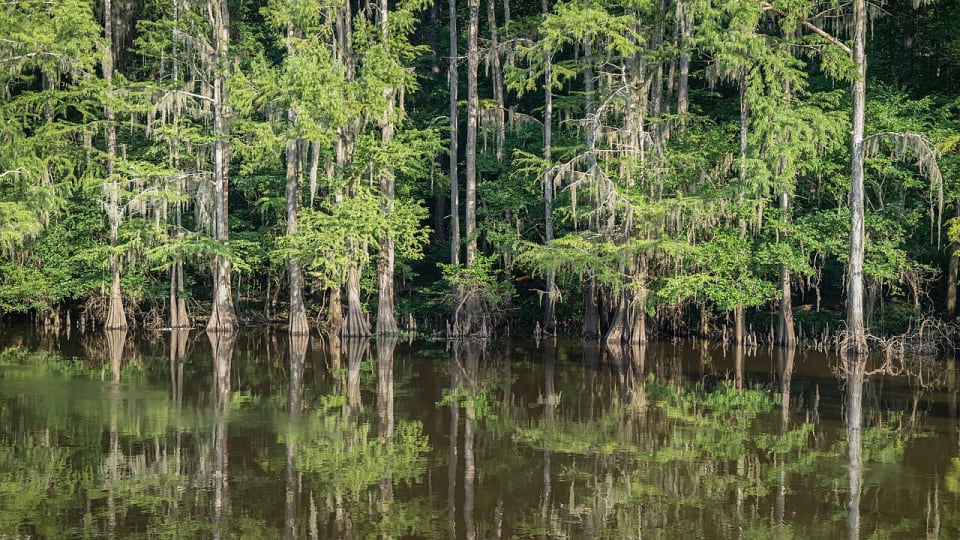

The land itself is poisoned. Yellow water stands in the hollows, the air stings the eyes, and the few plants that still grow are bitter and oddly coloured. Whatever lives here has learned to live with poison, or carries it. Flooded forest where trees stand in dark, still water. Paths vanish, mud holds the feet, insects swarm, and boats go where legs cannot.
Hear it
- Water: Toxic River (On Patreon, Raven tier)
- Toxic: Sinister Field of Mud and Geysers (In the album RPG Ambiences Vol. 3)
- In the rain: Acid Rain (In the album RPG Ambiences Vol. 5)
- By day: Swamp (In the album RPG Ambiences Vol. 1)
- At night: Swamp At Night (On Patreon, Raven tier)
- Among thorns: Thorny Swamp (In the album RPG Ambiences Vol. 7)
- In a storm: Thunder in Swamp (On Patreon, Guardian tier)
- A storm at night: Thunder in Swamp at Night (On Patreon, Guardian tier)
- By boat: Rowboat on Large Swamp River (On Patreon, Guardian tier)
- At camp: Campfire in Swamp (In the album RPG Ambiences Vol. 1)
- Fevers: Tropical Swamp (In the album RPG Ambiences Vol. 8)
- Biting insects: Swamp with Insect Swarm (On Patreon, Raven tier)
- Getting lost: Enclosed Forest (In the album RPG Ambiences Vol. 7)
For the table
- Ground
- hard going, about 10 km a day on foot
- Water
- plentiful
- Foraging
- poor
Hazards
- Sucking mud. Firm-looking ground opens onto deep mud or peat. Alone and laden, a traveller can be held until the water rises or the cold comes.
- Fevers. Warm stagnant water breeds the fevers that emptied whole expeditions before anyone knew the mosquito carried them.
- Biting insects. In the warm season, clouds of mosquitoes and flies bite day and night. Sleep and tempers wear thin.
- Getting lost. Under the trees, in the dunes or in the dark, every direction looks alike. Without a guide or a sure landmark, a party walks in circles.
- Poisoned water. Springs and pools look clear and taste of metal. Boiling does not clean them.
- Choking vapours. In still hollows the vapours pool, heavy and unseen. Birds that land there do not fly off again.
- Caustic mud. Some patches of mud bubble and smoke. They eat through leather in an hour, and through skin faster.
D&D 5e
- Plays as
- swamp, slow pace at most
- Checks
- forage: Survival DC 10 · find the way: DC 15 · search: DC 20
- Creatures are spotted at
- 2d8 × 10 ft
- Poisoned water. (House rule) A creature that drinks the land’s water, boiled or not, makes a DC 13 Constitution save or has the Poisoned condition for 24 hours. Only water carried in, or made pure by magic, is safe.
- Choking vapours. A creature in the vapours must hold its breath, for 1 plus its Constitution modifier minutes (never less than 30 seconds). After that it gains 1 Exhaustion level at the end of each of its turns, and loses them all as soon as it can breathe again.
- Caustic mud. (House rule) A DC 13 Wisdom (Survival) check spots a patch before anyone steps in. A creature that steps in makes a DC 12 Dexterity save or takes 2d6 Acid damage, and its boots are ruined.
This work includes material from the System Reference Document 5.2.1 ("SRD 5.2.1") by Wizards of the Coast LLC, available at https://www.dndbeyond.com/srd. The SRD 5.2.1 is licensed under the Creative Commons Attribution 4.0 International License, available at https://creativecommons.org/licenses/by/4.0/legalcode.
Pathfinder Second Edition
- Plays as (Pathfinder Second Edition)
- swamp, greater difficult terrain, about 11 km a day at Speed 25
- Checks
- Subsist: Survival DC 15 · Sense Direction: Survival DC 20
- Random encounters
- flat check DC 14 each day
- Sucking mud. Quicksand (GM Core p. 107): a hidden patch about 5 m wide (Stealth +12; Survival DC 18 to spot by disturbing it). Stepping in sinks a traveller to the waist, then one step each round (neck, then under); Athletics DC 20 climbs back a step, and allies can pull with Athletics DC 20.
- Getting lost. Sense Direction (Player Core p. 246): a Survival check once a day, –2 without a compass; DC 15 in ordinary wild land, 20 in deep forest or underground, 30 in a featureless desert. Getting lost has no fixed penalty: the GM decides where the party ends up.
This product is licensed under the ORC License located at the Library of Congress at TX 9-307-067 and available online at various locations including paizo.com/orclicense, azoralaw.com/orclicense, and others. All warranties are disclaimed as set forth therein. Attribution: this rules layer is based on the following Licensed Material: Pathfinder Player Core © 2023 Paizo Inc., Designed by Logan Bonner, Jason Bulmahn, Stephen Radney-MacFarland, and Mark Seifter. Authors: Alexander Augunas, Kate Baker, Logan Bonner, Jason Bulmahn, Carlos Cabrera, Calder CaDavid, James Case, Eleanor Ferron, Steven Hammond, Joan Hong, Vanessa Hoskins, James Jacobs, Jenny Jarzabski, Erik Keith, Dustin Knight, Lyz Liddell, Luis Loza, Patchen Mortimer, Dennis Muldoon, Stephen Radney-MacFarland, Mikhail Rekun, David N. Ross, Michael Sayre, Mark Seifter, Kendra Leigh Speedling, Mark Thompson, Clark Valentine, Andrew White, Landon Winkler, and Linda Zayas-Palmer; Pathfinder GM Core © 2023 Paizo Inc., Designed by Logan Bonner and Mark Seifter. Authors: Amirali Attar Olyaee, Logan Bonner, Creighton Broadhurst, Jason Bulmahn, James Case, Jesse Decker, Eleanor Ferron, Fabby Garza Marroquín, Jaym Gates, Matthew Goetz, James Jacobs, Brian R. James, Jenny Jarzabski, Dustin Knight, Jason LeMaitre, Lyz Liddell, Luis Loza, Ron Lundeen, Stephen Radney-MacFarland, David N. Ross, Michael Sayre, Mark Seifter, Owen K.C. Stephens, Amber Stewart, Clark Valentine, Landon Winkler, and Linda Zayas-Palmer; Pathfinder Monster Core © 2024 Paizo Inc., Authors: Alexander Augunas, Dennis Baker, Kate Baker, Joshua Birdsong, Joseph Blomquist, Logan Bonner, Jason Bulmahn, James Case, John Compton, Paris Crenshaw, Adam Daigle, Darrin Drader, Brian Duckwitz, Robert N. Emerson, Scott Fernandez, Eleanor Ferron, Leo Glass, Matthew Goodall, BJ Hensley, Thurston Hillman, Vanessa Hoskins, James Jacobs, Jenny Jarzabski, Miko Kallio, Jason Keeley, Jeff Lee, Lyz Liddell, Luis Loza, Ron Lundeen, Robert G. McCreary, Philippe-Antoine Menard, Jacob W. Michaels, Dave Nelson, Jason Nelson, Tim Nightengale, Stephen Radney-MacFarland, Mikhail Rekun, Patrick Renie, Alex Riggs, David N. Ross, Michael Sayre, Mark Seifter, Chris S. Sims, Amber Stewart, Jeffrey Swank, William Thompson, Jason Tondro, Clark Valentine, Landon Winkler, Tonya Woldridge, and Linda Zayas-Palmer. If you use our Licensed Material in your own published work, please credit us as follows: Biomes, Pathfinder Second Edition rules layer © 2026 Michael Ghelfi. Reserved Material: the names of Biomes and its catalogues, its descriptions, sounds, art and code. Pathfinder is a registered trademark of Paizo Inc.; this site is not published, endorsed, or specifically approved by Paizo Inc.
Crossing it
Besides walking, depending on the era and the season (Biomes estimates of a day’s distance):
- By river boat: about 35 km a day
- By airship: about 900 km a day
- By bush plane: about 800 km a day
- By rover: about 20 km a day
- By hover sled: about 80 km a day
- By elephant: about 20 km a day
- On a flying mount: about 150 km a day
- By flying carpet: about 100 km a day
- By armoured buggy: about 40 km a day
Adventure hooks
- A herbalist has lived thirty years in the poisoned land in perfect health, and she sells a tonic she swears is the reason. The tonic is pond water: she is well because she has swallowed a little poison every day of her life, and now she wants to move to town to meet her grandchildren.
- A lord has heard that the poison yields the finest yellow dye in the kingdom and has sent his steward to fetch a barrel of it. The steward is terrified, unfailingly polite, and under orders not to come home with less than a full barrel.
- The poison spreads a mile further every year, and it has a source: for a century the alchemists of the nearest town have buried their failed brews here. Their new mistress did not know, and now that she does, she has decided it would be cheaper to make sure nobody else ever finds out.
- A boy from the edge of the poisoned land has tamed one of its creatures, small, bright and deadly to touch, and his father wants it killed. It has saved the boy’s life twice already, and the water it drinks from runs clear for a day afterwards.
- A ferryman poles travellers through the flooded forest and asks no money, only a story. He has stopped his boat halfway across, because the story he has just heard was about him.
- A healer who lives on stilts in the swamp sells remedies to the town, and the council has decided she poisoned the mayor. She wants the real poisoner found, and she pays in leeches, very good ones.
- Loggers float cypress trunks out of the swamp on the high water. One raft came out with a coffin lashed to it, well roped, the foreman’s own name carved into the lid.
- An alligator the town calls the Bishop has swallowed half of the tax collector’s boat, strongbox and all. The town wants the strongbox back, and is in no hurry about the tax collector.
What grows here
- Açaí Palm (tree). A slender palm over 20 m tall, often with several stems from one base, up to about 12, growing in the swamps, river edges and seasonally flooded forest of the eastern Amazon, above all in the Brazilian state of Pará. Its small black-purple fruit is mostly seed, with a thin layer of pulp. The fruit is picked about six months of the year and not in the rainy season. Gives: Açaí Berry, Açaí Palm Heart.
- Bald Cypress (tree). A deciduous conifer of 10 to 40 m whose feathery needles turn copper-red and fall each autumn, its trunk ringed by woody knees rising from the roots. It once dominated the swamps and river bottoms of the southeastern United States and can live over 2,000 years. Its water-resistant wood was used for canoes, coffins and shingles. Gives: Bald Cypress Wood.
- Black Alder (tree). A tree of 20 to 30 m along riverbanks, in swamps and wet woods of Europe, southwest Asia and North Africa; it bears standing water better than other alders. Bacteria in its roots fix nitrogen, so it grows on poor soil and enriches it, and its roots hold riverbanks. Birds feed on its seeds in winter. Gives: Alder Wood, Alder Bark.
- Buriti Palm (tree). A palm up to 35 m tall that grows in and near swamps and periodically flooded ground across tropical South America, from the Amazon to the Orinoco and Trinidad. Humboldt called it the 'tree of life': tapirs, peccaries, fish and monkeys depend on its scaly chestnut fruit. People eat the fruit fresh, as juice, jam or a fermented drink, take a sago starch from the trunk, drink the sap, eat the palm-weevil grubs in the trunk, and twist the leaf fibre into ropes, nets and hammocks. Food of: South American Tapir. Food of: White-lipped Peccary. Gives: Buriti Fruit, Buriti Sago, Buriti Fibre.
- Pond Apple (tree). A fruit tree up to 12 m, a cousin of the soursop, native to Florida, the Caribbean, Central and South America and West Africa, and common in the Everglades. It grows in swamps, tolerates salt water and cannot grow in dry soil; its fruit floats and drifts on the floods to new ground. It is also called alligator apple, because American alligators often eat the fruit, and wild boar eat it too. It has become an invasive weed in Sri Lanka and Australia. Food of: American Alligator. Food of: Wild Boar. Gives: Pond Apples.
- Sago Palm (tree). A palm of 7 to 25 m with leaves up to 10 m long, native to the Moluccas and New Guinea, standing in the freshwater swamps of the lowland rainforest. Felled just before it flowers, one trunk holds 180 to 350 kg of starch, enough to feed a person for a year. Sago is the staple of peoples of New Guinea such as the Korowai, and fed coastal China before rice. Gives: Sago, Sago Palm Leaf.
- Cranberry (shrub). A tiny creeping evergreen with trailing stems that root as they go, small leathery leaves and pink flowers, crawling over the sphagnum hummocks of bogs, fens and conifer swamps across the cool north of Europe, Asia and America. Its red berries stay on the plant for months. Native American peoples ate them and used them as medicine, and some Iñupiat cook them with fish eggs and blubber. Food of: Black grouse. Gives: Cranberry.
- Salal (shrub). An evergreen shrub of the heather family, 0.4 to 3 m, that carpets the understory of the coastal conifer forests from Alaska to California and forms near impenetrable thickets on dunes, bluffs and forested peat. Its dark blue berries were a major food of coastal peoples, eaten fresh or dried into cakes. Deer and elk browse it in winter, and bears, grouse and squirrels eat the berries. Food of: American Black Bear. Food of: Wapiti. Gives: Salal Berries, Salal Leaves.
- Broadleaf Arrowhead (herb). A wetland perennial of 60 to 120 cm with arrow-shaped leaves and white flowers in July to September, forming dense colonies in ponds, swamps and along lakes and rivers from southern Canada to South America. Its tubers, the wapato or duck-potato, were a major food of Native peoples. Beavers, porcupines and muskrats eat the whole plant, tubers included. Food of: Muskrat. Gives: Wapato.
- Mangrove Fern (herb). A big leathery fern with fronds up to 2 m (4 m in Malaysian swamps), found across the tropics in mangroves, salt marshes, swamps and on riverbanks; it is the only fern that can grow in, and even be flooded by, the sea. Its very young fronds are eaten raw or cooked: in salads in Cambodia, in a spicy coconut gravy in Goa. Dried fronds are strung on rods and used instead of straw to thatch roofs. Gives: Mangrove Fern Fronds.
- Sweet Flag (herb). A wetland herb up to 2 m tall with sword-shaped leaves with crimped edges, spreading by rhizomes in marshes, swamps and pond edges. Native to the Irtysh valley of Kazakhstan, it was brought to Europe in the 13th century and is now found across Europe, Asia, Australia and North America. Its fragrant rhizome is a medicine and a flavouring, but its oil holds beta-asarone, which can cause long vomiting and is suspected of causing cancer; the US banned it from food in 1968. Gives: Calamus Root.
- Taro (herb). A tropical perennial with big heart-shaped leaves and a starchy corm, thought native to southern India and Southeast Asia, growing in wetlands, marshes and low ground along streams and rivers. It is one of the oldest crops: traces of taro about 10,000 years old have been found at Kuk Swamp in New Guinea. Raw, the plant is full of needle-like oxalate crystals that burn the mouth and throat: it must be cooked. Food of: Cattle. Gives: Taro Corm, Taro Leaves.
- Giant Water Lily (herb). The giant water lily of the Amazon basin, the Pantanal and Guyana, with floating leaves up to 3 m across on stalks 7 to 8 m long, in calm warm water and the várzeas flooded by the rains. A leaf has held over 100 kg, but the stems and the undersides bristle with spines. Its lentil-sized seeds, rich in starch, pop in the heat like popcorn, and the rhizome and leaf stalks are eaten like manioc. Gives: Giant Water Lily Seeds, Giant Water Lily Rhizome.
- Yellow Water-lily (herb). An aquatic perennial with thick rhizomes, leathery floating leaves of 16 to 30 cm and fragrant yellow flowers, found in shallow lakes, ponds, swamps, slow rivers and stream margins of Europe, northwest Africa and western Asia, up to 3,000 m. It bears polluted water less well than the white water-lilies. Deer, elk and birds eat its leaves, stems and roots. Gives: Water-lily Rhizome, Water-lily Seeds.
- Longstamen Rice (grass). A perennial wild rice with creeping rhizomes, native to most of Africa south of the Sahara and Madagascar, growing in swamps, ponds, lake and river sides and flooded grasslands, it can blanket flooded meadows and grows in water up to 4 m deep, though usually less than 1 m. The grain is cooked and tastes good, but it falls from the ear at a touch, so people reap it unripe or shake the ripe heads over baskets; it is a famine food. The tall straw makes thatch. Gives: African Wild Rice, Wild Rice Straw.
- Antelope Grass (grass). A tall, reed-like perennial grass of tropical and subtropical Africa, growing in dense even stands on seasonally flooded grassland, in swamps and along rivers and lakes; it makes up much of the vegetation of the Sudd. It grows in the wet season, dies back in the dry season and resprouts hard after wildfire. It is grown as fodder for livestock and withstands heavy grazing. Gives: Antelope Grass Grain.
- Bourgou (grass). A floating water grass of tropical Africa and Asia whose spongy stems trail up to 2 m and form nearly pure mats in swamps and standing water. The Fulani once grew it widely in the Inner Niger Delta: they ate the seeds and brewed drinks from it, and the sweet stems are chewed for their juice or boiled down to brown sugar. It still gives hay for animals and holds flood banks against erosion. Gives: Bourgou Stem, Bourgou Seeds.
- Hippo Grass (grass). A thick-stemmed, hairy aquatic grass of Africa, from Senegal to Egypt and south to Namibia, and of Assam, Bangladesh and northern Indochina, growing in dense stands in water up to 5.5 m deep. On the Kafue Flats of Zambia it rules the slow, rich waters, and the great herds of lechwe live on it through the dry season. When the floods rise, whole clumps tear loose and drift as floating islands that other sedges and herbs colonise.
- Papyrus (sedge). A tall sedge of 4 to 5 m whose triangular stems end in a green mop of thread-like rays. It forms vast pure stands in the swamps and on the lake and river margins of tropical Africa, and in deep water floats in mats that make the sudd. The Egyptians made paper, boats, mats and rope from it. Gives: Papyrus Stem, Papyrus Rhizome.
Animals
- American Alligator (man-killer, alone, day and night)
- Cougar (man-killer, alone, by night)
- Hippopotamus (man-killer, in herds, by night)
- Jaguar (man-killer, alone, at dawn and dusk)
- King Cobra (man-killer, alone, by day)
- Nile Crocodile (man-killer, in colonies, day and night)
- Saltwater Crocodile (man-killer, alone, day and night)
- Tiger (man-killer, alone, by night)
- American Black Bear (can wound or kill, alone, at dawn and dusk)
- Green Anaconda (can wound or kill, alone, at dawn and dusk)
- Moose (can wound or kill, alone, at dawn and dusk)
- Wild Boar (can wound or kill, in families, by night)
- Eurasian Beaver (dangerous if cornered, in families, by night)
- Green Iguana (dangerous if cornered, alone, by day)
- South American Tapir (dangerous if cornered, alone, by night)
- Yacare Caiman (dangerous if cornered, in colonies, day and night)
- Capybara (harmless, in herds, at dawn and dusk)
- Common crane (harmless, in flocks, by day)
- Eurasian Otter (harmless, alone, by night)
- Marsh Deer (harmless, alone, at dawn and dusk)
- Nile Lechwe (harmless, in herds, at dawn and dusk)
- Red Lechwe (harmless, in herds, by day)
- Scarlet Ibis (harmless, in colonies, by day)
- Shoebill (harmless, alone, by day)
- Sitatunga (harmless, alone, at dawn and dusk)
- Wild Turkey (harmless, in flocks, by day)
Kept here
- Water Buffalo (can wound or kill, in herds, day and night)
Creatures
- Gray Ooze (a threat to the unwary, Challenge 1/2)
- Swarm of Insects (a threat to the unwary, Challenge 1/2)
- Ochre Jelly (a fight to fear, Challenge 2)
- Black Pudding (a fight to fear, Challenge 4)
- Chuul (a fight to fear, Challenge 4)
- Otyugh (deadly, Challenge 5)
Also met here
- Stirge (a threat to the unwary, Challenge 1/8)
- Giant Frog (a threat to the unwary, Challenge 1/4)
- Giant Lizard (a threat to the unwary, Challenge 1/4)
- Giant Venomous Snake (a threat to the unwary, Challenge 1/4)
- Troll (deadly, Challenge 1/2-5)
- Giant Toad (a fight to fear, Challenge 1)
- Black Dragon (deadly, Challenge 2-21)
- Giant Constrictor Snake (a fight to fear, Challenge 2)
- Swarm of Venomous Snakes (a fight to fear, Challenge 2)
- Will-o'-Wisp (a fight to fear, Challenge 2)
- Green Hag (a fight to fear, Challenge 3)
- Giant Crocodile (deadly, Challenge 5)
- Shambling Mound (deadly, Challenge 5)
- Hydra (deadly, Challenge 8)
This work includes material from the System Reference Document 5.2.1 ("SRD 5.2.1") by Wizards of the Coast LLC, available at https://www.dndbeyond.com/srd. The SRD 5.2.1 is licensed under the Creative Commons Attribution 4.0 International License, available at https://creativecommons.org/licenses/by/4.0/legalcode.
To gather
Ooze Portion, Catoblepas Eye Gland, Açaí Berry, Açaí Palm Heart, African Wild Rice, Wild Rice Straw, Alder Bark, Alder Wood, American Alligator Meat, Black Bear Fat, Black Bear Hide, Black Bear Meat, Antelope Grass Grain, Bald Cypress Wood, Bourgou Seeds, Bourgou Stem, Buriti Fibre, Buriti Fruit, Buriti Sago, Capybara Hide, Capybara Meat, Cranberry, Crocodile Glands, Eurasian Beaver Pelt, Eurasian Otter Pelt, Iguana Eggs, Iguana Meat, Horsehair, Mangrove Fern Fronds, Moose Hide, Nile Crocodile Egg, Papyrus Rhizome, Papyrus Stem, Pond Apples, Sago Palm Leaf, Sago, Salal Berries, Salal Leaves, Saltwater Crocodile Meat, Scarlet Ibis Egg, Sitatunga Meat, Tapir Hide, Tapir Meat, Taro Corm, Taro Leaves, Wapato, Buffalo Hide, Buffalo Milk, Wild Boar Bristles, Wild Turkey Egg, Wild Turkey Feathers, Wild Turkey Meat, Willow Bark, Yacare Caiman Hide, Yacare Caiman Meat, Water-lily Rhizome, Water-lily Seeds, American Alligator Hide, Calamus Root, Cougar Pelt, Eurasian Beaver Castoreum, Green Anaconda Fat, Hippopotamus Hide, Hippopotamus Ivory, Jaguar Fang, Jaguar Pelt, King Cobra Meat, Marsh Deer Meat, Nile Crocodile Hide, Saltwater Crocodile Hide, Scarlet Ibis Feather, Sitatunga Hide, Giant Water Lily Rhizome, Giant Water Lily Seeds, Yacare Caiman Urine, Crane Meat, King Cobra Venom, Marsh Deer Antler, Tiger Bone, Tiger Pelt, Beetle Wing, Frog Lung, Giant Mosquito Wing, Orchid Flower, Snake Venom, Wolf Aloe Leaf, Grung Venom, Hag Index Finger, Pitcher Plant Nectar, Sundew Tentacle, Will-o'-Wisp Spark, Concentrated Venom, Corpse Flower Petal, Electric Eel Gland, Ghost Orchid, Hag Brain, Sea Hag Gill, Troll Bone Marrow, Will-o'-Wisp Trail, Hag Moldy Heart, Naga Perfect Scale, Wandering Mound Mother Root, Adult Dragon Tonsils, Dragon Tongue, Froghemoth Tongue, Hydra Bile, Witch's Eye
The same milieu, otherwise
Swamp, Cursed Swamp, Corrupted Swamp, Fungal Swamp, Dead Swamp, Primeval Swamp, Eldritch Swamp, Frozen Swamp
Open it in Biomes — MGS Toolbox