Taiga
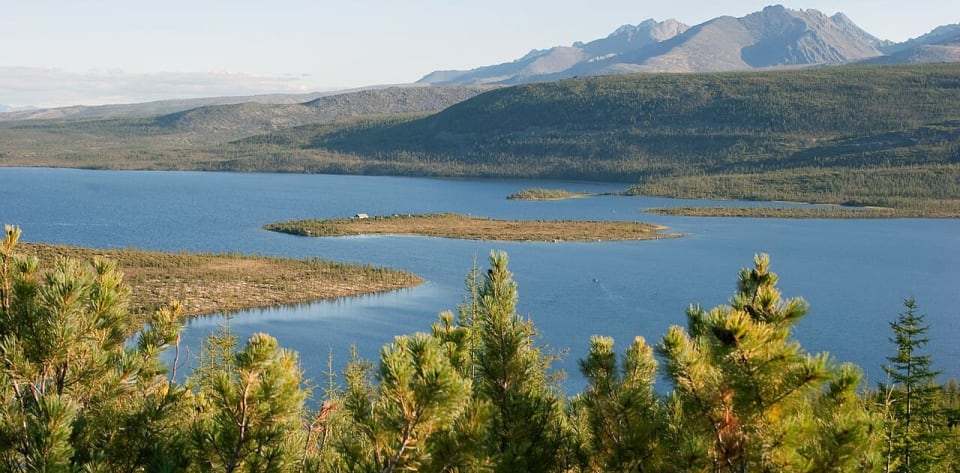

The great northern forest of spruce, pine, larch and birch, broken by bogs, lakes and slow rivers. Winters are long and bitter, summers short and full of mosquitoes, and people live from furs, fish and the reindeer.
Over the year it averages -2 °C.
Hear it
- By day: Taiga (In the album RPG Ambiences Vol. 2)
- In winter: Winter Forest with Wolves (On Patreon, Raven tier)
- Wolves: Wolves in the Snow (On Patreon, Guardian tier)
- In a storm: Thundering Taiga (On Patreon, Raven tier)
- Bitter cold: Strong Snowy Wind (On Patreon, Guardian tier)
- Deep snow: Snowing (In the album RPG Ambiences Vol. 6)
- Biting insects: Tundra with Insect Swarm (On Patreon, Guardian tier)
- Thin ice: Winter River (In the album RPG Ambiences Vol. 6)
- Getting lost: Enclosed Forest (In the album RPG Ambiences Vol. 7)
For the table
- Ground
- rough, about 20 km a day on foot
- Seasons
- -18 °C in the heart of winter, 15 °C in the heart of summer
- Water
- plentiful
- Foraging
- fair
Hazards
- Bitter cold. Without furs, a fire and shelter at night, the cold numbs, then kills. Frostbite takes fingers and toes first.
- Deep snow. Without snowshoes or skis, every step sinks to the knee and a day's march shrinks to a few kilometres.
- Biting insects. In the warm season, clouds of mosquitoes and flies bite day and night. Sleep and tempers wear thin.
- Thin ice. Frozen lakes and rivers are the easy road in winter, until the ice gives way. The water beneath kills in minutes.
- Getting lost. Under the trees, in the dunes or in the dark, every direction looks alike. Without a guide or a sure landmark, a party walks in circles.
D&D 5e
- Plays as
- forest, normal pace at most
- Checks
- forage: Survival DC 10 · find the way: DC 15 · search: DC 15
- Creatures are spotted at
- 2d8 × 10 ft
- Bitter cold. At −18 °C (0 °F) or colder, anyone exposed makes a DC 10 Constitution save at the end of each hour or gains 1 Exhaustion. Cold resistance passes automatically; sleeping in a bedroll does too, and a blanket gives Advantage.
- Deep snow. Heavy snow is difficult terrain. On arctic ground a group keeps a fast pace only with gear such as skis or snowshoes.
- Thin ice. A 3 m (10 ft) square of thin ice holds 3d10 × 5 kg (× 10 lb); past that it breaks and drops everyone on it into frigid water. In frigid water a creature lasts as many minutes as its Constitution score, then makes a DC 10 Constitution save each minute or gains 1 Exhaustion. Slippery ice is difficult terrain: a DC 10 Dexterity save on entering it or fall Prone.
This work includes material from the System Reference Document 5.2.1 ("SRD 5.2.1") by Wizards of the Coast LLC, available at https://www.dndbeyond.com/srd. The SRD 5.2.1 is licensed under the Creative Commons Attribution 4.0 International License, available at https://creativecommons.org/licenses/by/4.0/legalcode.
Pathfinder Second Edition
- Plays as (Pathfinder Second Edition)
- forest, difficult terrain, about 16 km a day at Speed 25
- Checks
- Subsist: Survival DC 15 · Sense Direction: Survival DC 20
- Random encounters
- flat check DC 14 each day
- Bitter cold. Temperature bands (GM Core p. 95): at 0 °C to −11 °C (mild cold) travellers tire after 4 hours; at −11 °C to −29 °C (severe cold) they also take minor cold damage (1d6 to 2d6) every hour; at −29 °C to −62 °C (extreme cold), every 10 minutes. Cold-weather gear removes severe-cold damage and turns extreme cold into severe. A soaked traveller counts the band one colder.
- Deep snow. Snow is difficult terrain, or greater difficult terrain when deep (GM Core pp. 90-91): a day's travel is halved, or cut to a third.
- Thin ice. Ice is difficult terrain and uneven ground (GM Core p. 90): moving across it can call for Acrobatics to Balance.
- Getting lost. Sense Direction (Player Core p. 246): a Survival check once a day, –2 without a compass; DC 15 in ordinary wild land, 20 in deep forest or underground, 30 in a featureless desert. Getting lost has no fixed penalty: the GM decides where the party ends up.
This product is licensed under the ORC License located at the Library of Congress at TX 9-307-067 and available online at various locations including paizo.com/orclicense, azoralaw.com/orclicense, and others. All warranties are disclaimed as set forth therein. Attribution: this rules layer is based on the following Licensed Material: Pathfinder Player Core © 2023 Paizo Inc., Designed by Logan Bonner, Jason Bulmahn, Stephen Radney-MacFarland, and Mark Seifter. Authors: Alexander Augunas, Kate Baker, Logan Bonner, Jason Bulmahn, Carlos Cabrera, Calder CaDavid, James Case, Eleanor Ferron, Steven Hammond, Joan Hong, Vanessa Hoskins, James Jacobs, Jenny Jarzabski, Erik Keith, Dustin Knight, Lyz Liddell, Luis Loza, Patchen Mortimer, Dennis Muldoon, Stephen Radney-MacFarland, Mikhail Rekun, David N. Ross, Michael Sayre, Mark Seifter, Kendra Leigh Speedling, Mark Thompson, Clark Valentine, Andrew White, Landon Winkler, and Linda Zayas-Palmer; Pathfinder GM Core © 2023 Paizo Inc., Designed by Logan Bonner and Mark Seifter. Authors: Amirali Attar Olyaee, Logan Bonner, Creighton Broadhurst, Jason Bulmahn, James Case, Jesse Decker, Eleanor Ferron, Fabby Garza Marroquín, Jaym Gates, Matthew Goetz, James Jacobs, Brian R. James, Jenny Jarzabski, Dustin Knight, Jason LeMaitre, Lyz Liddell, Luis Loza, Ron Lundeen, Stephen Radney-MacFarland, David N. Ross, Michael Sayre, Mark Seifter, Owen K.C. Stephens, Amber Stewart, Clark Valentine, Landon Winkler, and Linda Zayas-Palmer; Pathfinder Monster Core © 2024 Paizo Inc., Authors: Alexander Augunas, Dennis Baker, Kate Baker, Joshua Birdsong, Joseph Blomquist, Logan Bonner, Jason Bulmahn, James Case, John Compton, Paris Crenshaw, Adam Daigle, Darrin Drader, Brian Duckwitz, Robert N. Emerson, Scott Fernandez, Eleanor Ferron, Leo Glass, Matthew Goodall, BJ Hensley, Thurston Hillman, Vanessa Hoskins, James Jacobs, Jenny Jarzabski, Miko Kallio, Jason Keeley, Jeff Lee, Lyz Liddell, Luis Loza, Ron Lundeen, Robert G. McCreary, Philippe-Antoine Menard, Jacob W. Michaels, Dave Nelson, Jason Nelson, Tim Nightengale, Stephen Radney-MacFarland, Mikhail Rekun, Patrick Renie, Alex Riggs, David N. Ross, Michael Sayre, Mark Seifter, Chris S. Sims, Amber Stewart, Jeffrey Swank, William Thompson, Jason Tondro, Clark Valentine, Landon Winkler, Tonya Woldridge, and Linda Zayas-Palmer. If you use our Licensed Material in your own published work, please credit us as follows: Biomes, Pathfinder Second Edition rules layer © 2026 Michael Ghelfi. Reserved Material: the names of Biomes and its catalogues, its descriptions, sounds, art and code. Pathfinder is a registered trademark of Paizo Inc.; this site is not published, endorsed, or specifically approved by Paizo Inc.
Crossing it
Besides walking, depending on the era and the season (Biomes estimates of a day’s distance):
- On horseback: about 30 km a day
- By wagon: about 15 km a day
- By river boat: about 40 km a day
- By dog sled: about 45 km a day
- By train: about 400 km a day
- By airship: about 900 km a day
- By bush plane: about 800 km a day
- By 4x4: about 100 km a day
- By snowmobile: about 100 km a day
- By rover: about 60 km a day
- On a flying mount: about 150 km a day
- By flying carpet: about 100 km a day
- By bicycle: about 40 km a day
- By car: about 200 km a day
- By truck: about 150 km a day
- By motorbike: about 150 km a day
- By armoured buggy: about 120 km a day
A scene
- Snowing. The wind shrieks and it’s snowing in a harsh, driving storm. Beneath the temptest’s roar is a rhythmic crunch. Footsteps, perhaps. What hides in this grey? The full generator on the blog
Adventure hooks
- A fur trader is ten days late at the trading post, and his sled dogs came back alone with their traces chewed through. The sable pelts he carried were promised to a prince, who has sent a man to ask about them.
- In high summer, the mosquitoes drive a reindeer herd mad and it scatters across the bogs. The herder’s daughter offers a share of the calves to anyone who helps gather them before the wolves do.
- A fishing village moves onto the frozen lake every winter in huts on runners. This year something knocks under the ice at night, three times, always beneath the headman’s hut.
- A trapper swears one wolverine has robbed his traps for eleven winters and has lately started leaving him small gifts in exchange. He wants a witness, so that the other trappers will stop laughing at him.
What grows here
- Norway Spruce (tree). A tall evergreen conifer of 35 to 55 m with hanging branchlets and the longest cones of any spruce, growing in the boreal forest of northern Europe and in the mountains further south. It is one of Europe's chief timber trees and the violin maker's tonewood; its young shoots flavour drinks and food, and its resin served in Nordic folk medicine for wounds. Gives: Norway Spruce Wood, Norway Spruce Resin, Norway Spruce Shoots.
- Scots Pine (tree). A pine of up to 35 m with short blue-green needles and orange-red upper bark, ranging from western Europe to eastern Siberia and past the Arctic Circle, on poor sandy soils, rock outcrops and peat bogs. It gave building timber, rosin and turpentine, and in Scandinavia its stumps and roots were burnt down into tar. Gives: Scots Pine Wood, Scots Pine Resin.
- Siberian Larch (tree). A deciduous conifer of 20 to 50 m whose soft needles turn bright yellow and fall each autumn, native to western Russia from the Finnish border to the Yenisei valley. Its rot-resistant wood made posts, railway sleepers and mine props, and its resin is chewed as a natural gum in Russia. Gives: Siberian Larch Wood, Siberian Larch Resin.
- Silver Birch (tree). A slender tree of 15 to 25 m with white peeling bark and drooping twigs, native from Europe across Siberia, a pioneer of bare and burnt ground on dry acid soils. Its pale wood made furniture, skis and utensils, its spring sap was drunk fresh or made into syrup and wine, and its bark was distilled into tar and used for tanning. Host of: Chaga. Gives: Silver Birch Bark, Silver Birch Sap, Silver Birch Wood.
- Bilberry (shrub). A low deciduous shrub of 10 to 50 cm with blue-black berries ripening from July to September, found across the northern lands on acid soils of heaths, boggy barrens and open pine and spruce forests. The berries are eaten fresh or in pies, jams and syrups, and in Britain they once dyed food and cloth. Gives: Bilberry.
- Common Juniper (shrub). A shrub or small conifer of very variable shape, with needles in whorls of three and berry-like cones that take eighteen months to ripen to purple-black. It has the widest range of any woody plant, around the cool north of the world from the Arctic southwards, on heaths, mountains, tundra and in open forest. Its berries flavour gin, beer and meat, and its fragrant wood made dairy vessels in Scandinavia. Gives: Treated Juniper Berry, Juniper Wood.
- Labrador tea (shrub). A low evergreen shrub with wrinkled leaves, rusty-felted beneath, and sweet-scented white flowers, growing in the bogs, muskegs, open tundra and conifer woods of northern North America and Greenland. Native peoples brewed the leaves as a medicinal tea, colonists drank it in place of imported tea, and in Europe it flavoured ale before hops. Take care: it holds alkaloids that poison livestock and can harm people in strong doses, and it can be mistaken for a very toxic kalmia (Kalmia angustifolia) that grows near it. Gives: Labrador Tea Leaves.
- Cloudberry (herb). A low herb of 10 to 25 cm with palmate leaves and white flowers, growing on acid bogs, wet meadows and tundra around the North Pole. Its amber berries, rich in vitamin C, kept scurvy away from Arctic peoples and are made into jams and liqueurs in the Nordic countries. Gives: Cloudberry.
- Large Bittercress (herb). A perennial of the cabbage family that often forms large colonies, with white flowers and violet anthers from April to June, found across Europe, above all in the centre and north. It wants clayey soil rich in organic matter: its typical places are the edges of springs, spruce swamps, brooks, ditches and the thickets of banks. Pieces of its runners break off and travel downstream to root elsewhere; unlike the cuckooflower, it has no rosette at its base.
- Round-leaved sundew (herb). A small carnivorous rosette 3 to 5 cm across, its round leaves covered in red hairs that bead with sticky glue to trap and digest insects. It grows in sunny acid bogs, fens and wet sphagnum under black spruce, all around the northern hemisphere. Healers gave it against coughs and inflammation, but it irritates in strong doses; it is strictly protected in France. Gives: Round-leaved Sundew.
- Peat Moss (moss). The bog mosses of the genus Sphagnum, whose spongy cells hold many times their dry weight in water; they build the peat bogs of the north, and grow in conifer forests and moist tundra. Dried, they dressed wounds in place of cotton up to the First World War, and the peat they lay down was burnt as fuel. Gives: Peat Moss.
- Reindeer Lichen (lichen). A pale grey, much-branched lichen that forms mats up to 10 cm deep on the ground of boreal pine forests, tundra and low alpine slopes across the Northern Hemisphere. It is a chief food of reindeer; people soaked it in wood ash to take away its bitterness and ate it, and some northern peoples boiled it as a remedy. Food of: Reindeer. Gives: Reindeer Lichen.
- Rock Tripe (lichen). Leathery lichens fixed to bare rock by a single navel-like point, found on cold stone on every continent, from the Arctic and the mountains to the boreal forest. The Cree, Inuit and Chipewyan ate it when nothing else was left, and it kept voyageurs and Franklin's 1819-1822 party alive on the Barren Grounds. It must be soaked and boiled again and again; even then it is bitter and upsets the gut. The English name comes from Canadian French. Gives: Rock Tripe.
- Chaga (fungus). A fungus of the circumboreal forests that grows mostly on birch, where it bursts from the trunk as a black, cracked mass like burnt charcoal and slowly rots the heartwood. Russian and Siberian folk medicine brewed it as a tea, and northern peoples used it as tinder that holds an ember; it is very rich in oxalates. Grows on: Silver Birch. Gives: Chaga Conk.
- Fly Agaric (fungus). The red, white-warted toadstool of the fairy tales, found in conifer and broadleaf woods across the temperate and boreal Northern Hemisphere, living in partnership with pine, oak, spruce, fir and birch. It is poisonous and hallucinogenic: one cap holds about an active dose, with nausea, twitching, delirium and hallucinations starting after 30 to 90 minutes, though deaths are extremely rare. Its name comes from its use, recorded by Albertus Magnus before 1256, as a fly poison powdered into milk. The peoples of Siberia took it as an inebriant, and among the Koryak the poor drank the urine of the rich who could afford the mushrooms. Gives: Fly Agaric.
- Matsutake (fungus). A white-fleshed mushroom with a cap up to 40 cm and a ring on its stem, hidden under the litter of fir and pine forests in Japan, Korea, China, northern Europe and northern North America. Its name means "pine mushroom", and its spicy, cinnamon scent makes it the most prized mushroom in Japan, above the truffle. Hard to find, it must be raced fresh to market; a small poisonous lookalike exists. Gives: Matsutake.
- Porcini (fungus). A big brown-capped bolete, the cap up to 30 cm, that lives bound to the roots of pine, spruce, hemlock and fir, and also chestnut, beech and oak, across Europe, North America and Asia. It comes up in summer and autumn, in rafts after warm rain. One of the safest wild mushrooms to pick: its worst lookalikes are the devil's bolete (red stem, bruises blue) and the very bitter bitter bolete. Gives: Porcini Cap.
Animals
- Brown Bear (man-killer, alone, at dawn and dusk)
- American Bison (can wound or kill, in herds, by day)
- American Black Bear (can wound or kill, alone, at dawn and dusk)
- Grey Wolf (can wound or kill, in packs, by night)
- Moose (can wound or kill, alone, at dawn and dusk)
- Red Deer (can wound or kill, in herds, at dawn and dusk)
- Wapiti (can wound or kill, in herds, at dawn and dusk)
- Eurasian Eagle-Owl (dangerous if cornered, alone, by night)
- Eurasian Lynx (dangerous if cornered, alone, at dawn and dusk)
- Golden Eagle (dangerous if cornered, in pairs, by day)
- Red Fox (dangerous if cornered, alone, by night)
- Reindeer (dangerous if cornered, in herds, by day)
- Sable (dangerous if cornered, alone, at dawn and dusk)
- Wolverine (dangerous if cornered, alone, by night)
- Black grouse (harmless, in flocks, by day)
- Bushy-tailed Woodrat (harmless, alone, by night)
- Common crane (harmless, in flocks, by day)
- European Pine Marten (harmless, alone, by night)
- Moor frog (harmless, alone, by night)
- Red Squirrel (harmless, alone, by day)
- Western Capercaillie (harmless, alone, by day)
- Willow Ptarmigan (harmless, in flocks, by day)
Kept here
- Goat (dangerous if cornered, in herds, by day)
Creatures
- Giant Weasel (a threat to the unwary, Challenge 1/8)
- Giant Owl (harmless, Challenge 1/4)
- Scout (a threat to the unwary, Challenge 1/2)
- Troll (deadly, Challenge 1/2-5)
- Dire Wolf (a fight to fear, Challenge 1)
- Berserker (a fight to fear, Challenge 2)
- Druid (a threat to the unwary, Challenge 2)
- Giant Elk (a threat to the unwary, Challenge 2)
- Green Dragon (deadly, Challenge 2-22)
- Ogre (a fight to fear, Challenge 2)
- Owlbear (a fight to fear, Challenge 3)
- Werewolf (a fight to fear, Challenge 3)
- Winter Wolf (a fight to fear, Challenge 3)
- Werebear (a fight to fear, Challenge 5)
- Mammoth (deadly, Challenge 6)
- Treant (a fight to fear, Challenge 9)
This work includes material from the System Reference Document 5.2.1 ("SRD 5.2.1") by Wizards of the Coast LLC, available at https://www.dndbeyond.com/srd. The SRD 5.2.1 is licensed under the Creative Commons Attribution 4.0 International License, available at https://creativecommons.org/licenses/by/4.0/legalcode.
To gather
American Bison Meat, Black Bear Fat, Black Bear Hide, Black Bear Meat, Bilberry, Juniper Wood, Goat Hide, Goat Wool, Grey Wolf Pelt, Labrador Tea Leaves, Moose Hide, Norway Spruce Shoots, Norway Spruce Resin, Norway Spruce Wood, Peat Moss, Porcini Cap, Red Deer Antler, Red Deer Hide, Red Fox Pelt, Reindeer Antler, Reindeer Hide, Reindeer Lichen, Rock Tripe, Scots Pine Resin, Scots Pine Wood, Siberian Larch Resin, Siberian Larch Wood, Silver Birch Bark, Silver Birch Sap, Silver Birch Wood, Wapiti Antler, Wapiti Hide, Wapiti Meat, Willow Ptarmigan, American Bison Hide, Black Grouse Meat, Brown Bear Bile, Brown Bear Hide, Chaga Conk, Cloudberry, Eurasian Lynx Pelt, Pine Marten Pelt, Golden Eagle Feather, Squirrel Fur, Round-leaved Sundew, Capercaillie Meat, Wolverine Pelt, Crane Meat, Matsutake, Sable Pelt, Activated Charcoal, Beetle Wing, Holly Leaf, Alchemical Resin, Potassium Powder, First Morning Dew, Lightning Strike Ash, Lycanthrope Fur, Solar Flare Fragment
Beneath
Near the surface the rock keeps the year's mean warmth, without seasons; it warms as one goes down.
- At the surface
- -2 °C
- 100 m
- 1 °C
- 500 m
- 12 °C
- 1 km
- 26 °C
- 3 km
- 81 °C
A town here
How large a town this land can feed, what it makes and what it must buy. Build it in Hearth
Fantasy variants
Cursed Taiga, Corrupted Taiga, Fungal Taiga, Dead Taiga, Primeval Taiga, Frozen Taiga
Nearby biomes
Tropical Rainforest, Tropical Dry Forest, Temperate Forest, Temperate Conifer Forest, Savanna, Grassland, Flooded Grassland, Alpine Meadow, Tundra, Mediterranean Scrub, Hot Desert, Cold Desert, Ice Sheet, Barrens
Open it in Biomes — MGS Toolbox