Blessed Savanna
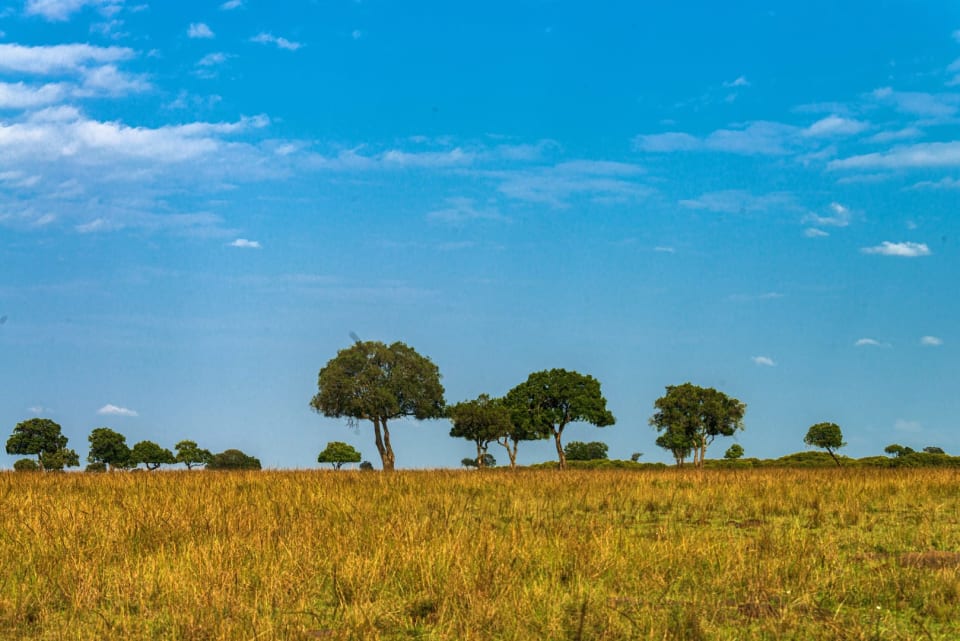

Holy ground. Springs heal, wounds close cleanly, and the dead stay in their graves. Travellers wake rested, and the beasts here are calm. Warm grassland scattered with trees such as acacias and baobabs, green in the rains and golden in the dry season. It holds the great herds and the hunters that follow them, and the horizon is always far.
Over the year it averages 24 °C.
Hear it
- Blessed: Blessed Forest (On Patreon, Raven tier)
- By day: Savannah (In the album RPG Ambiences Vol. 1)
- By the river: River in Savannah (On Patreon, Guardian tier)
- At night: Savannah Night Camp (In the album RPG Ambiences Vol. 1)
- At camp: Stone Age Camp on Savannah (On Patreon, Guardian tier)
- Crushing heat: Cicadas Field (On Patreon, Raven tier)
- Thirst: Windy Desert (In the album RPG Ambiences Vol. 1)
- Wildfire: Burning Forest (In the album RPG Ambiences Vol. 2)
For the table
- Ground
- open, about 30 km a day on foot
- Seasons
- 21 °C in the heart of winter, 28 °C in the heart of summer
- Water
- by season
- Foraging
- rich
Hazards
- Crushing heat. At midday the heat wears a walker down far faster than the road. Those who know the land travel at dawn and dusk and rest in the shade.
- Thirst. Water is far apart and not always where the map says. A day without drinking in the heat is enough to put a traveller down.
- Wildfire. In the dry season, grass and scrub burn fast, driven by the wind. A fire front outruns a person on foot.
- Healing spring. A spring of very clear, very cold water. Those who drink and wash in it feel their wounds close and their fever drop.
- Sanctuary ground. No beast attacks inside the old boundary stones, and the dead do not cross them. A camp here is a quiet camp.
- Pilgrim light. A soft light shows the way at dusk, always toward water and shelter. Those who walk with ill intent do not see it.
D&D 5e
- Plays as
- grassland, fast pace at most
- Checks
- forage: Survival DC 15 · find the way: DC 5 · search: DC 15
- Creatures are spotted at
- 6d6 × 10 ft
- Crushing heat. At 38 °C (100 °F) or hotter, anyone exposed without drinkable water makes a Constitution save at the end of each hour, DC 5 then 1 higher each hour, or gains 1 Exhaustion. Medium or heavy armour gives Disadvantage; fire resistance passes automatically.
- Thirst. Each Medium creature needs about 4 litres (1 gallon) of water a day. Drinking less than half of it brings 1 Exhaustion at the end of the day, which does not go until a full day's water is drunk.
- Healing spring. (House rule) A short rest by the spring heals as if each creature had spent one Hit Point Die more, rolled at its maximum. Once a day, its water ends the Poisoned condition.
- Sanctuary ground. (House rule) Undead and fiends must succeed on a DC 15 Charisma save to enter the boundary. A long rest taken inside removes 1 more Exhaustion level.
- Pilgrim light. (House rule) While following the light, the party cannot get lost and has Advantage on Survival checks to find water or shelter.
This work includes material from the System Reference Document 5.2.1 ("SRD 5.2.1") by Wizards of the Coast LLC, available at https://www.dndbeyond.com/srd. The SRD 5.2.1 is licensed under the Creative Commons Attribution 4.0 International License, available at https://creativecommons.org/licenses/by/4.0/legalcode.
Pathfinder Second Edition
- Plays as (Pathfinder Second Edition)
- plains, open terrain, about 32 km a day at Speed 25
- Checks
- Subsist: Survival DC 15 · Sense Direction: Survival DC 15
- Random encounters
- flat check DC 12 each day
- Crushing heat. Temperature bands (GM Core p. 95): from 35 °C (mild heat) travellers tire after 4 hours; from 41 °C (severe heat) they take minor fire damage (1d6 to 2d6) every hour; from 46 °C (extreme heat), every 10 minutes. In high humidity the mild and severe thresholds are about 8 °C lower.
- Thirst. Without enough water a creature is fatigued; after its Constitution modifier + 1 days without drinking it takes 1d4 damage an hour, which cannot be healed until it drinks (GM Core p. 43).
- Wildfire. A wildfire front advances up to about 20 m a round in forest, twice that on plains; flames are hazardous terrain (moderate damage, 4d6 to 6d6, plus persistent fire), smoke works like fog and can suffocate (GM Core p. 97).
This product is licensed under the ORC License located at the Library of Congress at TX 9-307-067 and available online at various locations including paizo.com/orclicense, azoralaw.com/orclicense, and others. All warranties are disclaimed as set forth therein. Attribution: this rules layer is based on the following Licensed Material: Pathfinder Player Core © 2023 Paizo Inc., Designed by Logan Bonner, Jason Bulmahn, Stephen Radney-MacFarland, and Mark Seifter. Authors: Alexander Augunas, Kate Baker, Logan Bonner, Jason Bulmahn, Carlos Cabrera, Calder CaDavid, James Case, Eleanor Ferron, Steven Hammond, Joan Hong, Vanessa Hoskins, James Jacobs, Jenny Jarzabski, Erik Keith, Dustin Knight, Lyz Liddell, Luis Loza, Patchen Mortimer, Dennis Muldoon, Stephen Radney-MacFarland, Mikhail Rekun, David N. Ross, Michael Sayre, Mark Seifter, Kendra Leigh Speedling, Mark Thompson, Clark Valentine, Andrew White, Landon Winkler, and Linda Zayas-Palmer; Pathfinder GM Core © 2023 Paizo Inc., Designed by Logan Bonner and Mark Seifter. Authors: Amirali Attar Olyaee, Logan Bonner, Creighton Broadhurst, Jason Bulmahn, James Case, Jesse Decker, Eleanor Ferron, Fabby Garza Marroquín, Jaym Gates, Matthew Goetz, James Jacobs, Brian R. James, Jenny Jarzabski, Dustin Knight, Jason LeMaitre, Lyz Liddell, Luis Loza, Ron Lundeen, Stephen Radney-MacFarland, David N. Ross, Michael Sayre, Mark Seifter, Owen K.C. Stephens, Amber Stewart, Clark Valentine, Landon Winkler, and Linda Zayas-Palmer; Pathfinder Monster Core © 2024 Paizo Inc., Authors: Alexander Augunas, Dennis Baker, Kate Baker, Joshua Birdsong, Joseph Blomquist, Logan Bonner, Jason Bulmahn, James Case, John Compton, Paris Crenshaw, Adam Daigle, Darrin Drader, Brian Duckwitz, Robert N. Emerson, Scott Fernandez, Eleanor Ferron, Leo Glass, Matthew Goodall, BJ Hensley, Thurston Hillman, Vanessa Hoskins, James Jacobs, Jenny Jarzabski, Miko Kallio, Jason Keeley, Jeff Lee, Lyz Liddell, Luis Loza, Ron Lundeen, Robert G. McCreary, Philippe-Antoine Menard, Jacob W. Michaels, Dave Nelson, Jason Nelson, Tim Nightengale, Stephen Radney-MacFarland, Mikhail Rekun, Patrick Renie, Alex Riggs, David N. Ross, Michael Sayre, Mark Seifter, Chris S. Sims, Amber Stewart, Jeffrey Swank, William Thompson, Jason Tondro, Clark Valentine, Landon Winkler, Tonya Woldridge, and Linda Zayas-Palmer. If you use our Licensed Material in your own published work, please credit us as follows: Biomes, Pathfinder Second Edition rules layer © 2026 Michael Ghelfi. Reserved Material: the names of Biomes and its catalogues, its descriptions, sounds, art and code. Pathfinder is a registered trademark of Paizo Inc.; this site is not published, endorsed, or specifically approved by Paizo Inc.
Crossing it
Besides walking, depending on the era and the season (Biomes estimates of a day’s distance):
- On horseback: about 45 km a day
- By camel: about 40 km a day
- By wagon: about 25 km a day
- By stagecoach: about 100 km a day
- By river boat: about 40 km a day
- By train: about 500 km a day
- By airship: about 900 km a day
- By bush plane: about 800 km a day
- By 4x4: about 250 km a day
- By motorcar: about 150 km a day
- By rover: about 120 km a day
- By hover sled: about 150 km a day
- By elephant: about 35 km a day
- On a flying mount: about 150 km a day
- By flying carpet: about 100 km a day
- By bicycle: about 80 km a day
- By car: about 450 km a day
- By truck: about 350 km a day
- By motorbike: about 350 km a day
- By armoured buggy: about 200 km a day
Adventure hooks
- A war band is marching to cross the blessed land, because their wounded heal there in a night. The pilgrims who keep the holy ground want them turned aside, and the war band has never been turned aside.
- A man condemned for murder has fled onto the holy ground, where no blood may be shed. He is guilty, and he is the only one who knows where the murdered child’s body lies.
- A merchant has bought the rights to bottle the healing water and sell it in town. The bottled water does nothing, and now people come to the source itself, by the thousand.
- The blessing is fading, a little each year, and the abbot has kept it secret. A novice has found the reason in the old books: it was a promise, and the land is waiting for it to be kept.
- The great herds are late, and the lion prides have turned to the herders’ cattle. The elders forbid killing a lion before the herds return; the young men will not wait much longer.
- The hollow of an old baobab is the village water store, sealed with clay. Someone broke the seal and drank it dry, two weeks before the rains, and the footprints lead toward the neighbouring village.
- An old guide offers to show the party a waterhole nobody else knows, if they escort his grandson’s bride-price, forty goats, to a village eight days away. The goats have opinions about the route.
- A grass fire has swept the plain, and in the ash stands a ring of standing stones nobody remembers seeing. Vultures circle above it all day without ever landing.
What grows here
- African Baobab (tree). A savanna tree five to twenty-five metres tall with an enormous trunk up to fourteen metres across, bare of leaves for about eight months a year. It grows across the dry, hot savannas of mainland Africa and can store over a hundred thousand litres of water in its trunk. People eat the powdery fruit pulp and the young leaves, press the seeds for oil and twist the bark fibre into rope and cloth. Food of: African Bush Elephant. Gives: Baobab Fruit, Baobab Leaves, Baobab Bark Fibre.
- Desert Date (tree). A thorny tree of about ten metres, armed with long, straight green spines, found from the Sahel and the Sahara across Africa to Syria and Yemen, in arid savanna and desert, best near rivers and in valley bottoms. It shrugs off drought, flood and fire and keeps bearing in dry years. Its small fruit is sweetish but bitter and sucked fresh; the oily kernel is boiled before eating or pressed for cooking oil, and the young leaves are cooked as greens. Food of: African Bush Elephant. Gives: Desert Date Fruit, Desert Date Kernel.
- Doum Palm (tree). A fan palm up to seventeen metres whose trunk forks again and again, growing across the Sahel from Mauritania to Egypt and East Africa and into Arabia, along rivers and wadis where groundwater lies near. Its orange, fibrous fruit tastes of gingerbread and is chewed fresh or made into molasses, cakes and drinks; the unripe kernel and the young shoots are eaten too. The great fan leaves are woven into mats, baskets, rope and thatch. Gives: Doum Fruit, Doum Fronds.
- Gum Arabic Tree (tree). A small thorny deciduous tree five to twelve metres tall that fixes nitrogen and enriches poor soils. It grows in the semi-desert lands of Africa south of the Sahara, Oman, Pakistan and western India. Cuts in its bark weep gum arabic, Sudan's great export, and its roots and bark give strong cord. Gives: Gum Arabic, Gum Arabic Tree Bark.
- Jackalberry (tree). A tree usually four to six metres tall but reaching twenty-five, spread across sub-Saharan Africa and into Yemen, in savanna and riverside forest, often rooted in termite mounds. Its small yellow fruit, sweet like a persimmon when ripe, is eaten fresh, dried, ground into flour or brewed into beer and brandy; jackals and many other animals feast on it. Elephants and buffalo eat the leaves, and the black heartwood of old trees, almost proof against termites, is a prized ebony for furniture, floors and canoes. Food of: African Bush Elephant. Food of: African Buffalo. Gives: Jackalberry Fruit, Jackalberry Heartwood.
- Kapok (tree). A giant of the tropical forest, up to 60 m tall, with huge buttress roots and a spiny trunk; it flowers while bare of leaves and is pollinated by bats. Native to the American tropics and probably to West and Central Africa, it is held sacred by the Maya and in Caribbean and Surinamese traditions. People take the floss of its pods, oil from its seeds and a light wood. Food of: Goat. Food of: Sheep. Food of: Cattle. Gives: Kapok Floss, Kapok Seed, Kapok Wood.
- Marula (tree). A deciduous tree up to eighteen metres with a broad, spreading crown and grey mottled bark, growing in the savanna woodlands of East, West and southern Africa and in Madagascar. Its yellow fruits, three to four centimetres long, are tart and strongly flavoured, eaten fresh or fermented into marula beer, and the hard stones hide an edible, nutty kernel rich in oil. Elephants, giraffes and rhinoceroses browse it; elephants also eat its bark and fruit and spread the seeds in their dung. Food of: African Bush Elephant. Food of: Giraffe. Gives: Marula Fruit, Marula Kernel.
- Mopane (tree). A tree with butterfly-shaped leaves that covers vast woodlands in the hot, dry lowlands of southern Africa, from Angola and Namibia to Mozambique; on clay it stays a shrub of one to three metres, on open ground it reaches ten to fifteen. It is the main food tree of the mopane worm, a protein-rich caterpillar people gather, grill and dry, and elephants and giraffes browse it. Its very dense, termite-proof wood builds houses, fences and mine props and burns hot with little ash. Food of: Mopane Worm. Food of: African Bush Elephant. Food of: Giraffe. Gives: Mopane Wood.
- Pequi (tree). A tree up to ten metres of the Brazilian cerrado, the great savanna of central Brazil reaching into Paraguay and Bolivia, where it forms groves on plateaus and in valleys. Its yellow, strongly scented pulp is cooked with rice and chicken, a beloved dish of central-west Brazil; the stone beneath is packed with fine spines that break off in the mouth, hurt badly and are hard to remove, so it is eaten with care. The seed gives an edible oil, also made into soap. Gives: Pequi Fruit, Pequi Seed.
- Sal (tree). A great tree of 30 to 40 metres from the foot of the Himalaya across Nepal, India, Bangladesh and Myanmar, often ruling whole forests; it keeps its leaves where it is wet and drops them from February to April where it is dry. Its hard, resinous wood is one of the chief timbers of India, its resin is temple incense, and its dried leaves are pressed into plates and bowls that cattle eat after the meal. The Buddha passed away in a sal grove. Gives: Sal Seeds, Sal Dammar, Sal Wood.
- Sausage Tree (tree). A tree up to twenty-four metres found across tropical Africa in the wetter savannas and along rivers, hung with fruits up to sixty centimetres long and five to ten kilograms each, like sausages on long cords. The fruit is not edible: raw it is poisonous and purgative. In Kenya the dried or baked fruit is fermented into a mead-like beer, and the fruit and bark are a widespread folk remedy; elephants and baboons eat the fruit, and the light wood makes dugout canoes. Food of: African Bush Elephant. Gives: Sausage Tree Fruit, Sausage Tree Wood.
- Shea Tree (tree). A deciduous tree of seven to fifteen metres that grows in the dry savanna belt running more than five thousand kilometres from Senegal to South Sudan. Its sweet fruit pulp is eaten fresh at the start of the rainy season, when food stores run low, and its oily kernels are boiled and pounded into shea butter, a main cooking fat of West Africa. The butter also makes soap, candles and skin salve; a tree bears only after ten to fifteen years. Gives: Shea Fruit, Shea Butter.
- Tamarind (tree). A long-lived tree up to twenty-five or thirty metres, native to the dry savannas of tropical Africa and long planted across India, Southeast Asia and the Caribbean; in the wild it grows in low woodland, savanna and bush, often on termite mounds. Its brown pods hold a sticky pulp, both sour and sugary, used in curries, chutneys, sauces and sweet drinks, and the young leaves are eaten too. Its hard, dark red heartwood makes furniture and tools, and the pulp polishes brass and copper. Gives: Tamarind Pulp, Tamarind Leaves.
- Umbrella Thorn (tree). A flat-topped acacia that reaches twenty metres where water allows and shrinks to a wiry bush in the driest places, armed with pairs of thorns, one long and pale, one short, curved and dark. It grows across the savannas and the Sahel of Africa and into the Middle East, in heat, drought and salty soils. Its coiled pods and leaves feed goats and camels, its bark gives tannin and string, and its wood makes posts and furniture. Food of: Goat. Food of: Dromedary. Gives: Umbrella Thorn Bark, Umbrella Thorn Wood.
- Elephant Grass (grass). A giant perennial grass of the African savannas that grows in dense clumps three to seven metres tall, sometimes eight, in damp grassland and along forest edges; it has run wild across the tropics and invades riverbanks and wetlands. It is the main fodder crop of East African dairy farms and one of the elephant's favourite foods. People cook the young leaves and shoots in soups, and use the dried canes for fences, hut walls and thatch. Food of: African Bush Elephant. Food of: Cattle. Gives: Elephant Grass Shoots, Elephant Grass Canes.
Animals
- African Buffalo (man-killer, in herds, day and night)
- African Bush Elephant (man-killer, in herds, day and night)
- Black Mamba (man-killer, alone, by day)
- King Cobra (man-killer, alone, by day)
- Leopard (man-killer, alone, by night)
- Lion (man-killer, in packs, by night)
- Tiger (man-killer, alone, by night)
- Black Rhinoceros (can wound or kill, alone, by day)
- Common Ostrich (can wound or kill, in flocks, by day)
- Green Anaconda (can wound or kill, alone, at dawn and dusk)
- Spotted Hyena (can wound or kill, in packs, by night)
- White-lipped Peccary (can wound or kill, in herds, by night)
- Common Eland (dangerous if cornered, in herds, at dawn and dusk)
- Common Vampire Bat (dangerous if cornered, in colonies, by night)
- Common Warthog (dangerous if cornered, in families, by day)
- Giraffe (dangerous if cornered, in herds, by day)
- Plains Zebra (dangerous if cornered, in herds, by day)
- Red Kangaroo (dangerous if cornered, in herds, at dawn and dusk)
- Western Honey Bee (dangerous if cornered, in colonies, by day)
- Blue Wildebeest (harmless, in herds, by day)
- Capybara (harmless, in herds, at dawn and dusk)
- Dorcas Gazelle (harmless, in herds, at dawn and dusk)
- Helmeted Guineafowl (harmless, in flocks, by day)
- Impala (harmless, in herds, by day)
- Marsh Deer (harmless, alone, at dawn and dusk)
- Mopane Worm (harmless, in swarms, by day)
- Red Lechwe (harmless, in herds, by day)
Kept here
- Cattle (can wound or kill, in herds, by day)
- Water Buffalo (can wound or kill, in herds, day and night)
- Goat (dangerous if cornered, in herds, by day)
- Horse (dangerous if cornered, in herds, at dawn and dusk)
Creatures
- Unicorn (a threat to the unwary, Challenge 5)
- Guardian Naga (a fight to fear, Challenge 10)
- Planetar (a fight to fear, Challenge 16)
Also met here
- Axe Beak (a threat to the unwary, Challenge 1/4)
- Giant Venomous Snake (a threat to the unwary, Challenge 1/4)
- Giant Wolf Spider (a threat to the unwary, Challenge 1/4)
- Gnoll (a threat to the unwary, Challenge 1/2)
- Brass Dragon (a fight to fear, Challenge 1-20)
- Giant Hyena (a fight to fear, Challenge 1)
- Giant Vulture (a fight to fear, Challenge 1)
- Ankheg (a fight to fear, Challenge 2)
- Centaur (a threat to the unwary, Challenge 2)
- Weretiger (a fight to fear, Challenge 4)
This work includes material from the System Reference Document 5.2.1 ("SRD 5.2.1") by Wizards of the Coast LLC, available at https://www.dndbeyond.com/srd. The SRD 5.2.1 is licensed under the Creative Commons Attribution 4.0 International License, available at https://creativecommons.org/licenses/by/4.0/legalcode.
To gather
Holy Water Flask, Consecrated Incense Smoke, Angel Perfect Feather, Couatl Tongue, Empyrean Tongue, Pegasus Perfect Feather, African Buffalo Hide, African Buffalo Meat, Baobab Bark Fibre, Baobab Fruit, Baobab Leaves, Beeswax Block, Wildebeest Hide, Wildebeest Meat, Capybara Hide, Capybara Meat, Cattle Fat, Cattle Hide, Cow Milk, Eland Hide, Eland Meat, Eland Milk, Ostrich Egg, Ostrich Plume, Ostrich Leather, Warthog Meat, Desert Date Fruit, Desert Date Kernel, Dorcas Gazelle Hide, Dorcas Gazelle Meat, Doum Fruit, Doum Fronds, Elephant Grass Canes, Elephant Grass Shoots, Giraffe Hide, Giraffe Meat, Goat Hide, Goat Milk, Goat Wool, Gum Arabic Tree Bark, Gum Arabic, Guineafowl Egg, Guineafowl Feather, Guineafowl Meat, Honey Comb, Horsehair, Impala Meat, Jackalberry Fruit, Kapok Floss, Kapok Seed, Kapok Wood, Lion Mane, Marula Fruit, Marula Kernel, Mopane Wood, Dried Mopane Worms, Pequi Fruit, Pequi Seed, Plains Zebra Hide, Plains Zebra Meat, Kangaroo Hide, Kangaroo Meat, Sal Dammar, Sal Seeds, Sausage Tree Fruit, Sausage Tree Wood, Shea Butter, Shea Fruit, Spotted Hyena Paw, Spotted Hyena Tail, Tamarind Leaves, Tamarind Pulp, Umbrella Thorn Bark, Umbrella Thorn Wood, Buffalo Hide, Buffalo Milk, Western Honey Bee Propolis, Peccary Hide, Peccary Meat, African Bush Elephant Hide, Warthog Tusk, Crystallized Honey, Elephant Ivory Powder, Giraffe Tail Hair, Green Anaconda Fat, Jackalberry Heartwood, King Cobra Meat, Lion Claw, Lion Tail, Marsh Deer Meat, Rhinoceros Horn Powder, Sal Wood, Black Mamba Venom, Black Rhinoceros Horn, King Cobra Venom, Leopard Pelt, Marsh Deer Antler, Tiger Bone, Tiger Pelt, Agave Leaf, Amaranth Seed, Beetle Wing, Dinosaur Skin, Snake Venom, Enchanted Sugar Pinch, Eucalyptus Leaf, Concentrated Venom, First Morning Dew, Jackalwere Fur, Leucrotta Jaw, Lightning Strike Ash, Whirlwind Heart, Lycanthrope Fur
Beneath
Near the surface the rock keeps the year's mean warmth, without seasons; it warms as one goes down.
- At the surface
- 24 °C
- 100 m
- 27 °C
- 500 m
- 38 °C
- 1 km
- 52 °C
- 3 km
- 107 °C
A town here
How large a town this land can feed, what it makes and what it must buy. Build it in Hearth
The same milieu, otherwise
Savanna, Dead Savanna, Primeval Savanna, Burning Savanna
Open it in Biomes — MGS Toolbox