Lake
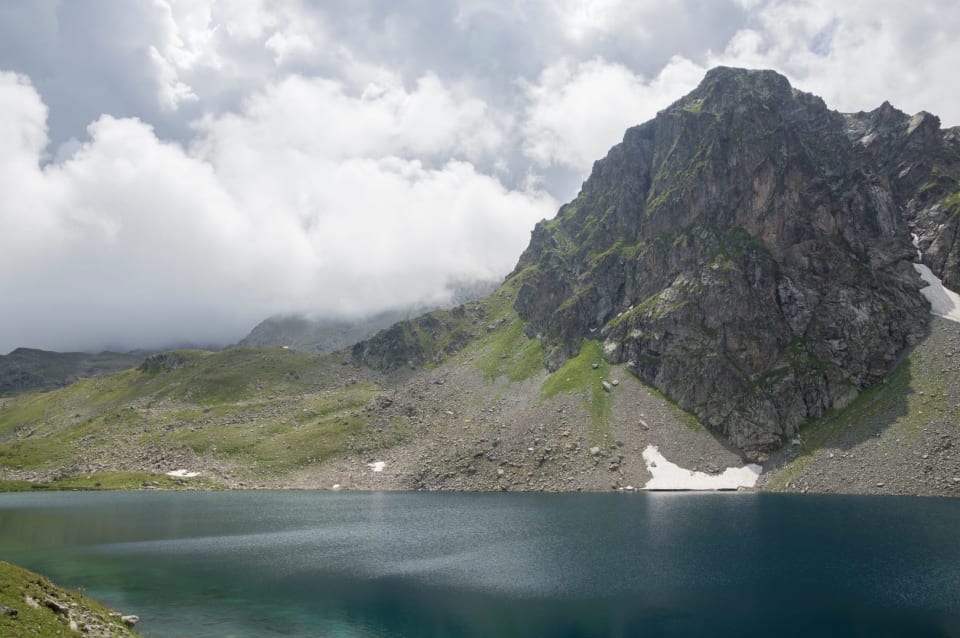

Wide still water, deep enough to hide what lives in it, ringed with reeds, woods or bare mountains. On calm days it holds the sky like a mirror; in wind it raises short, steep waves that sink small boats, and its shores smell of weed and wet stone. Pike, perch and char live in it, ducks, grebes and swans on it, and sometimes a seal or a sturgeon in the great northern lakes. Fishing villages line its shores, ferries cross it, and in the north it freezes hard enough to carry carts and fishing huts. People fear its sudden storms, its cold depths that give back no one, and the ice that cracks in spring. Lake Geneva, deep and long between the Alps and the Jura, is a lake of this kind.
Hear it
- By day: Lake Shore (In the album RPG Ambiences Vol. 8)
- Calm: Calm Lake Shore (On Patreon, Guardian tier)
- At night: Lake Shore at Night (On Patreon, Guardian tier)
- At the dock: Lakeside Dock (On Patreon, Guardian tier)
Adventure hooks
- Every seven years the lake gives back a bell from the drowned village under it, and the bell rings for a death in the valley. It has been six years, and the bell rang last night.
- An ice fisher pulled a pike out of a hole in the frozen lake with a gold ring in its belly. Now half the valley is out on the ice cutting holes, and the ice has started to groan.
- An old ferrywoman wants to row across the lake one last time, to the far shore where she was born, and needs strong arms. She will not say why nobody from her village has ever rowed back.
- A lord stocked his lake with pike to impress a visiting duke. The pike have eaten the trout, the ducklings and, this morning, the duke’s favourite lapdog.
What grows here
- Broadleaf Arrowhead (herb). A wetland perennial of 60 to 120 cm with arrow-shaped leaves and white flowers in July to September, forming dense colonies in ponds, swamps and along lakes and rivers from southern Canada to South America. Its tubers, the wapato or duck-potato, were a major food of Native peoples. Beavers, porcupines and muskrats eat the whole plant, tubers included. Food of: Muskrat. Gives: Wapato.
- Broadleaf Cattail (herb). A wetland plant of 1.5 to 3 m with broad strap leaves and a brown sausage-shaped seed head, always in or beside shallow water. It grows across Eurasia and North America and more locally in Africa and South America, from sea level to 2,300 m. Nearly every part is edible, and its leaves thatch roofs and seat chairs. Food of: Horse. Gives: Cattail Rhizome, Cattail Leaf, Cattail Pollen.
- Sacred Lotus (herb). An aquatic plant of calm water 30 cm to 2.5 m deep, in ponds, lakes, marshes and the floodplains and deltas of slow rivers, native from East Asia to India and spread by people across Southeast Asia and northern Australia. Its round leaves reach 80 to 100 cm across and its flowers 35 cm, warming themselves to 30 to 35 °C. Almost every part is eaten, and it is holy to Buddhists and Hindus. Its seeds keep for centuries: 1,300-year-old seeds from a dry lakebed in China have sprouted. Gives: Lotus Root, Sacred Lotus Seed.
- Sea Pea (herb). A trailing perennial with stems 50 to 80 cm long, waxy grey-green leaves and purple flowers, growing on sandy or stony seashores across the temperate north and in Argentina, and on lake shores in North America. Its seeds float in seawater for up to five years, which is how it spread around the world. The pods can be eaten, but like other wild peas the seeds can cause lathyrism, a paralysis. Gives: Sea Pea Pods.
- Giant Water Lily (herb). The giant water lily of the Amazon basin, the Pantanal and Guyana, with floating leaves up to 3 m across on stalks 7 to 8 m long, in calm warm water and the várzeas flooded by the rains. A leaf has held over 100 kg, but the stems and the undersides bristle with spines. Its lentil-sized seeds, rich in starch, pop in the heat like popcorn, and the rhizome and leaf stalks are eaten like manioc. Gives: Giant Water Lily Seeds, Giant Water Lily Rhizome.
- Water Caltrop (herb). A floating annual with rosettes of diamond-shaped leaves, rooted in the mud of calm, shallow fresh water across Eurasia and Africa; it needs water above 22 °C for at least two months a year. Its horned nut was eaten since the Neolithic in Europe and for 3,000 years in China. The spines are sharp enough to pierce straw sandals. Brought to North America around 1874, it is now an invasive weed there. Food of: Eurasian Beaver. Food of: Muskrat. Food of: Mute Swan. Gives: Water Caltrop Nut.
- Water Hyacinth (herb). A free-floating plant of tropical South America, buoyed by swollen leaf stalks, with glossy leaves, purple-black hanging roots and spikes of lavender flowers. It spreads by cloning itself and now chokes waters across the world: in the Sudd it has largely replaced the Nile cabbage, and on Lake Victoria it blocks the harbours and thins the fish. As it rots it robs the water of oxygen and kills fish. It cannot stand brackish water, and fresh plants hold prickly crystals that make the skin itch. Gives: Water Hyacinth Stalks.
- Yellow Water-lily (herb). An aquatic perennial with thick rhizomes, leathery floating leaves of 16 to 30 cm and fragrant yellow flowers, found in shallow lakes, ponds, swamps, slow rivers and stream margins of Europe, northwest Africa and western Asia, up to 3,000 m. It bears polluted water less well than the white water-lilies. Deer, elk and birds eat its leaves, stems and roots. Gives: Water-lily Rhizome, Water-lily Seeds.
- Longstamen Rice (grass). A perennial wild rice with creeping rhizomes, native to most of Africa south of the Sahara and Madagascar, growing in swamps, ponds, lake and river sides and flooded grasslands, it can blanket flooded meadows and grows in water up to 4 m deep, though usually less than 1 m. The grain is cooked and tastes good, but it falls from the ear at a touch, so people reap it unripe or shake the ripe heads over baskets; it is a famine food. The tall straw makes thatch. Gives: African Wild Rice, Wild Rice Straw.
- Antelope Grass (grass). A tall, reed-like perennial grass of tropical and subtropical Africa, growing in dense even stands on seasonally flooded grassland, in swamps and along rivers and lakes; it makes up much of the vegetation of the Sudd. It grows in the wet season, dies back in the dry season and resprouts hard after wildfire. It is grown as fodder for livestock and withstands heavy grazing. Gives: Antelope Grass Grain.
- Bourgou (grass). A floating water grass of tropical Africa and Asia whose spongy stems trail up to 2 m and form nearly pure mats in swamps and standing water. The Fulani once grew it widely in the Inner Niger Delta: they ate the seeds and brewed drinks from it, and the sweet stems are chewed for their juice or boiled down to brown sugar. It still gives hay for animals and holds flood banks against erosion. Gives: Bourgou Stem, Bourgou Seeds.
- Common Reed (grass). A tall wetland grass of 1.5 to 4 m, found worldwide, that forms vast reed beds in shallow fresh or brackish water, like the 1,700 km² of the Danube Delta. Its purple plumes turn grey and silky in autumn and the stems stand through the winter. It is the classic thatch of Europe. Food of: Goat. Food of: Cattle. Gives: Reed Stem, Reed Rhizome.
- Wild Rice (grass). An annual aquatic grass of shallow, calm water in small lakes and slow streams, native to the Great Lakes and the boreal lakes of Manitoba, Saskatchewan, Ontario and Minnesota. Often only its flowering head rises above the water. The Ojibwe call it manoomin and hold it sacred; it was a staple grain of the Ojibwe, Dakota and Algonquin peoples. Food of: Mallard. Gives: Wild Rice.
- Lake Clubrush (sedge). A sedge 0.8 to 3.5 m tall with round green stems 5 to 15 mm thick and almost no leaves, forming the waterward edge of reed beds in still and slow fresh water, from Europe to Mongolia, in North Africa and in southern Africa. It bears deeper water than common reed or bulrush, and is planted to protect banks. Gives: Clubrush Stems.
- Papyrus (sedge). A tall sedge of 4 to 5 m whose triangular stems end in a green mop of thread-like rays. It forms vast pure stands in the swamps and on the lake and river margins of tropical Africa, and in deep water floats in mats that make the sudd. The Egyptians made paper, boats, mats and rope from it. Gives: Papyrus Stem, Papyrus Rhizome.
- Sawgrass (sedge). A sedge 1.5 to 3 m tall from the Americas, the plant of the Everglades' 'River of Grass', where sawgrass marsh covers the land from Lake Okeechobee to Florida Bay. Its leaves have hard serrated edges, and harvesting it can leave deep cuts. Fire burns it above the water but spares the roots, and alligators nest in its dense stands. In Europe the same sedge was once an important thatch, and it is sometimes made into cheap paper. Gives: Sawgrass Thatch.
Animals
- American Alligator (man-killer, alone, day and night)
- Hippopotamus (man-killer, in herds, by night)
- Nile Crocodile (man-killer, in colonies, day and night)
- Green Anaconda (can wound or kill, alone, at dawn and dusk)
- Moose (can wound or kill, alone, at dawn and dusk)
- Common Snapping Turtle (dangerous if cornered, alone, by day)
- Coypu (dangerous if cornered, in colonies, by night)
- Eurasian Beaver (dangerous if cornered, in families, by night)
- Green Iguana (dangerous if cornered, alone, by day)
- Harbour Seal (dangerous if cornered, alone, by day)
- Medicinal Leech (dangerous if cornered, alone, day and night)
- Mute Swan (dangerous if cornered, in pairs, by day)
- Yacare Caiman (dangerous if cornered, in colonies, day and night)
- Capybara (harmless, in herds, at dawn and dusk)
- Eurasian Otter (harmless, alone, by night)
- European Herring Gull (harmless, in colonies, by day)
- Grey Heron (harmless, alone, at dawn and dusk)
- Greylag Goose (harmless, in flocks, by day)
- Jabiru (harmless, in pairs, by day)
- Mallard (harmless, in flocks, by day)
- Muskrat (harmless, in families, at dawn and dusk)
- White-throated Dipper (harmless, in pairs, by day)
Kept here
- Water Buffalo (can wound or kill, in herds, day and night)
Creatures
- Giant Frog (a threat to the unwary, Challenge 1/4)
- Swarm of Piranhas (a fight to fear, Challenge 1)
- Gold Dragon (a fight to fear, Challenge 3-24)
- Hydra (deadly, Challenge 8)
This work includes material from the System Reference Document 5.2.1 ("SRD 5.2.1") by Wizards of the Coast LLC, available at https://www.dndbeyond.com/srd. The SRD 5.2.1 is licensed under the Creative Commons Attribution 4.0 International License, available at https://creativecommons.org/licenses/by/4.0/legalcode.
To gather
African Wild Rice, Wild Rice Straw, American Alligator Meat, Antelope Grass Grain, Bourgou Seeds, Bourgou Stem, Cattail Leaf, Cattail Pollen, Cattail Rhizome, Capybara Hide, Capybara Meat, Clubrush Stems, Reed Rhizome, Reed Stem, Snapping Turtle Meat, Coypu Meat, Coypu Pelt, Crocodile Glands, Eurasian Beaver Pelt, Eurasian Otter Pelt, European Herring Gull Egg, European Herring Gull Feathers, Iguana Eggs, Iguana Meat, Greylag Goose Egg, Greylag Goose Feathers, Greylag Goose Meat, Harbour Seal Blubber, Harbour Seal Pelt, Mallard Meat, Medicinal Leech, Moose Hide, Muskrat Meat, Muskrat Pelt, Nile Crocodile Egg, Papyrus Rhizome, Papyrus Stem, Lotus Root, Sawgrass Thatch, Sea Pea Pods, Wapato, Buffalo Hide, Buffalo Milk, Water Caltrop Nut, Water Hyacinth Stalks, Wild Rice, Yacare Caiman Hide, Yacare Caiman Meat, Water-lily Rhizome, Water-lily Seeds, American Alligator Hide, Eurasian Beaver Castoreum, Green Anaconda Fat, Grey Heron Meat, Hippopotamus Hide, Hippopotamus Ivory, Jabiru Feathers, Jabiru Meat, Mute Swan Feather, Mute Swan Meat, Nile Crocodile Hide, Giant Water Lily Rhizome, Giant Water Lily Seeds, Yacare Caiman Urine, River Pearl Grit, Full Moon Reflection, Sturgeon Roe
Nearby biomes
Open it in Biomes — MGS Toolbox