Pond
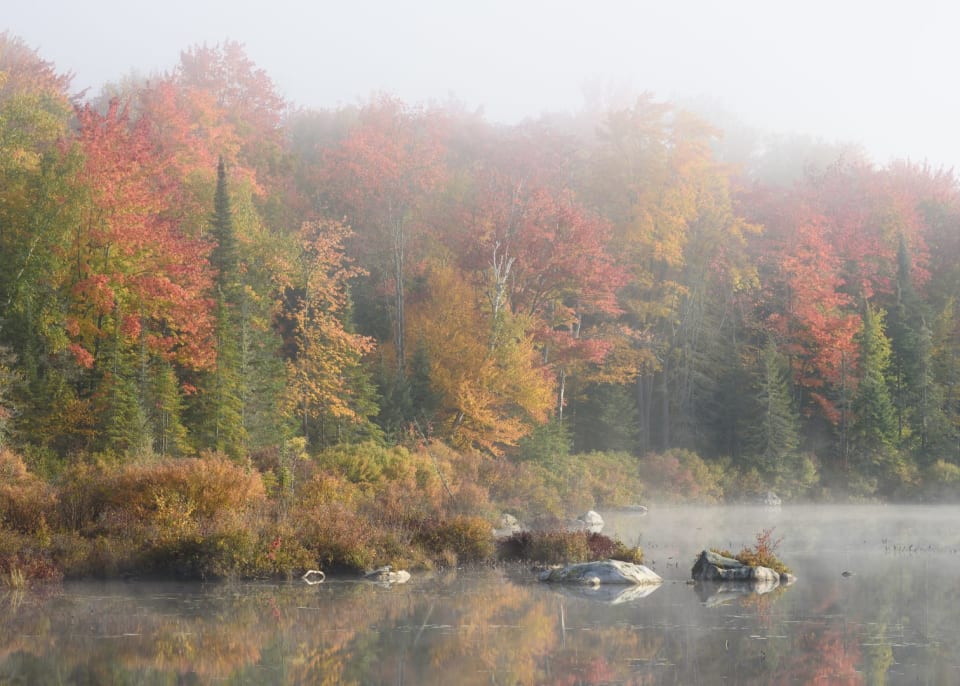

Small still water, often warm and green, thick with weed, lilies and the hum of insects. On summer evenings it is loud with frogs, and it smells of mud, mint and something rotting gently at the bottom. Newts, carp, dragonflies and water snails live in it, and herons and grass snakes come to hunt them. Many ponds are dug by people: to water cattle, to raise fish for fast days, to drive a mill or to put out fires. They are shallow enough to wade, yet children drown in them every year, and old ponds are said to hide what was thrown in at night. The village ponds of the French countryside, mares where cattle drank, are ponds of this kind.
Hear it
- By day: Duck Pond (In the album RPG Ambiences Vol. 5)
- Frogs: Enclosed Forest Frogs (On Patreon, Guardian tier)
Adventure hooks
- A village dug a pond for its cattle a generation ago, and this summer it has dried out for the first time. In the cracked mud at the bottom lies a pair of iron manacles, still locked.
- Someone is stealing one carp a night from the abbey’s fishponds before Lent. The thief is an otter, and the abbot will accept no explanation that does not include the devil.
- A miller’s daughter says a voice in the millpond promised her a husband if she threw in her mother’s ring. She threw it; the husband turned up this morning, dripping, and very polite.
- The frogs of the village pond have started croaking in a strict rhythm, and the children have made a dance of it. The schoolmaster is sure it is a message, and wants it read before the harvest feast.
What grows here
- Bogbean (herb). A water-loving herb with three-part leaves and fringed white star flowers, its thick creeping rootstock building treacherous quaking mats in the fens, bogs and shallow waters of Europe, Asia and North America. Swedish peasants put its very bitter leaves in their beer instead of hops, and the bitterness also goes into schnapps. In a famine the rootstock can be ground into a poor flour. Gives: Bogbean Leaves, Bogbean Rootstock.
- Broadleaf Arrowhead (herb). A wetland perennial of 60 to 120 cm with arrow-shaped leaves and white flowers in July to September, forming dense colonies in ponds, swamps and along lakes and rivers from southern Canada to South America. Its tubers, the wapato or duck-potato, were a major food of Native peoples. Beavers, porcupines and muskrats eat the whole plant, tubers included. Food of: Muskrat. Gives: Wapato.
- Broadleaf Cattail (herb). A wetland plant of 1.5 to 3 m with broad strap leaves and a brown sausage-shaped seed head, always in or beside shallow water. It grows across Eurasia and North America and more locally in Africa and South America, from sea level to 2,300 m. Nearly every part is edible, and its leaves thatch roofs and seat chairs. Food of: Horse. Gives: Cattail Rhizome, Cattail Leaf, Cattail Pollen.
- Brooklime (herb). A fleshy, low perennial with smooth, often reddish stems, paired blunt leaves and small bright blue flowers (May to September), growing at the edge of brooks, ditches, ponds and marshes across Europe, North Africa and western Asia, up to 2,500 m. Leaves and stems are eaten raw in salad or cooked, and it was taken against scurvy with watercress. It can carry the liver fluke: do not eat it raw near pastures. Gives: Brooklime Leaves.
- Fool's Watercress (herb). A low, often sprawling perennial of western Europe with a hollow stem rooting at the nodes and glossy leaves of paired, toothed leaflets that smell of carrot when crushed. It often grows with watercress in ditches, springs, fens and ponds, and in brackish marshes too. It is not poisonous, but is easily confused with the lesser water parsnip, said to be. Its young leaves and shoots are gathered wild in Spain, Italy, Portugal and Morocco. Gives: Fool's Watercress Shoots.
- Sacred Lotus (herb). An aquatic plant of calm water 30 cm to 2.5 m deep, in ponds, lakes, marshes and the floodplains and deltas of slow rivers, native from East Asia to India and spread by people across Southeast Asia and northern Australia. Its round leaves reach 80 to 100 cm across and its flowers 35 cm, warming themselves to 30 to 35 °C. Almost every part is eaten, and it is holy to Buddhists and Hindus. Its seeds keep for centuries: 1,300-year-old seeds from a dry lakebed in China have sprouted. Gives: Lotus Root, Sacred Lotus Seed.
- Sweet Flag (herb). A wetland herb up to 2 m tall with sword-shaped leaves with crimped edges, spreading by rhizomes in marshes, swamps and pond edges. Native to the Irtysh valley of Kazakhstan, it was brought to Europe in the 13th century and is now found across Europe, Asia, Australia and North America. Its fragrant rhizome is a medicine and a flavouring, but its oil holds beta-asarone, which can cause long vomiting and is suspected of causing cancer; the US banned it from food in 1968. Gives: Calamus Root.
- Water Caltrop (herb). A floating annual with rosettes of diamond-shaped leaves, rooted in the mud of calm, shallow fresh water across Eurasia and Africa; it needs water above 22 °C for at least two months a year. Its horned nut was eaten since the Neolithic in Europe and for 3,000 years in China. The spines are sharp enough to pierce straw sandals. Brought to North America around 1874, it is now an invasive weed there. Food of: Eurasian Beaver. Food of: Muskrat. Food of: Mute Swan. Gives: Water Caltrop Nut.
- Water Hyacinth (herb). A free-floating plant of tropical South America, buoyed by swollen leaf stalks, with glossy leaves, purple-black hanging roots and spikes of lavender flowers. It spreads by cloning itself and now chokes waters across the world: in the Sudd it has largely replaced the Nile cabbage, and on Lake Victoria it blocks the harbours and thins the fish. As it rots it robs the water of oxygen and kills fish. It cannot stand brackish water, and fresh plants hold prickly crystals that make the skin itch. Gives: Water Hyacinth Stalks.
- Water Mint (herb). A strongly minty perennial up to 90 cm, with square stems, toothed leaves and round heads of tiny purple flowers in summer, growing in the shallow edges of streams, rivers, pools, ditches, marshes and fens of Europe, North Africa and western Asia. It is used as a kitchen herb like spearmint and for herbal tea, though peppermint (its hybrid) tastes better. Folk medicine took mints as a tonic and for digestion, and rubbed them on against colds and headaches. Gives: Water Mint Leaves.
- Yellow Water-lily (herb). An aquatic perennial with thick rhizomes, leathery floating leaves of 16 to 30 cm and fragrant yellow flowers, found in shallow lakes, ponds, swamps, slow rivers and stream margins of Europe, northwest Africa and western Asia, up to 3,000 m. It bears polluted water less well than the white water-lilies. Deer, elk and birds eat its leaves, stems and roots. Gives: Water-lily Rhizome, Water-lily Seeds.
- Longstamen Rice (grass). A perennial wild rice with creeping rhizomes, native to most of Africa south of the Sahara and Madagascar, growing in swamps, ponds, lake and river sides and flooded grasslands, it can blanket flooded meadows and grows in water up to 4 m deep, though usually less than 1 m. The grain is cooked and tastes good, but it falls from the ear at a touch, so people reap it unripe or shake the ripe heads over baskets; it is a famine food. The tall straw makes thatch. Gives: African Wild Rice, Wild Rice Straw.
- Common Reed (grass). A tall wetland grass of 1.5 to 4 m, found worldwide, that forms vast reed beds in shallow fresh or brackish water, like the 1,700 km² of the Danube Delta. Its purple plumes turn grey and silky in autumn and the stems stand through the winter. It is the classic thatch of Europe. Food of: Goat. Food of: Cattle. Gives: Reed Stem, Reed Rhizome.
- Lake Clubrush (sedge). A sedge 0.8 to 3.5 m tall with round green stems 5 to 15 mm thick and almost no leaves, forming the waterward edge of reed beds in still and slow fresh water, from Europe to Mongolia, in North Africa and in southern Africa. It bears deeper water than common reed or bulrush, and is planted to protect banks. Gives: Clubrush Stems.
Animals
- American Alligator (man-killer, alone, day and night)
- Hippopotamus (man-killer, in herds, by night)
- Green Anaconda (can wound or kill, alone, at dawn and dusk)
- Moose (can wound or kill, alone, at dawn and dusk)
- Common Snapping Turtle (dangerous if cornered, alone, by day)
- Eurasian Beaver (dangerous if cornered, in families, by night)
- Medicinal Leech (dangerous if cornered, alone, day and night)
- Mute Swan (dangerous if cornered, in pairs, by day)
- Edible Frog (harmless, alone, day and night)
- Eurasian Otter (harmless, alone, by night)
- Grey Heron (harmless, alone, at dawn and dusk)
- Jabiru (harmless, in pairs, by day)
- Mallard (harmless, in flocks, by day)
- Moor frog (harmless, alone, by night)
- Muskrat (harmless, in families, at dawn and dusk)
Kept here
- Water Buffalo (can wound or kill, in herds, day and night)
Creatures
- Giant Frog (a threat to the unwary, Challenge 1/4)
This work includes material from the System Reference Document 5.2.1 ("SRD 5.2.1") by Wizards of the Coast LLC, available at https://www.dndbeyond.com/srd. The SRD 5.2.1 is licensed under the Creative Commons Attribution 4.0 International License, available at https://creativecommons.org/licenses/by/4.0/legalcode.
To gather
African Wild Rice, Wild Rice Straw, American Alligator Meat, Bogbean Leaves, Bogbean Rootstock, Cattail Leaf, Cattail Pollen, Cattail Rhizome, Brooklime Leaves, Clubrush Stems, Reed Rhizome, Reed Stem, Snapping Turtle Meat, Edible Frog Legs, Eurasian Beaver Pelt, Eurasian Otter Pelt, Fool's Watercress Shoots, Mallard Meat, Medicinal Leech, Moose Hide, Muskrat Meat, Muskrat Pelt, Lotus Root, Wapato, Buffalo Hide, Buffalo Milk, Water Caltrop Nut, Water Hyacinth Stalks, Water Mint Leaves, Water-lily Rhizome, Water-lily Seeds, American Alligator Hide, Calamus Root, Eurasian Beaver Castoreum, Green Anaconda Fat, Grey Heron Meat, Hippopotamus Hide, Hippopotamus Ivory, Jabiru Feathers, Jabiru Meat, Mute Swan Feather, Mute Swan Meat, Beetle Wing, River Pearl Grit, Full Moon Reflection, Sturgeon Roe
Nearby biomes
Open it in Biomes — MGS Toolbox