Stream
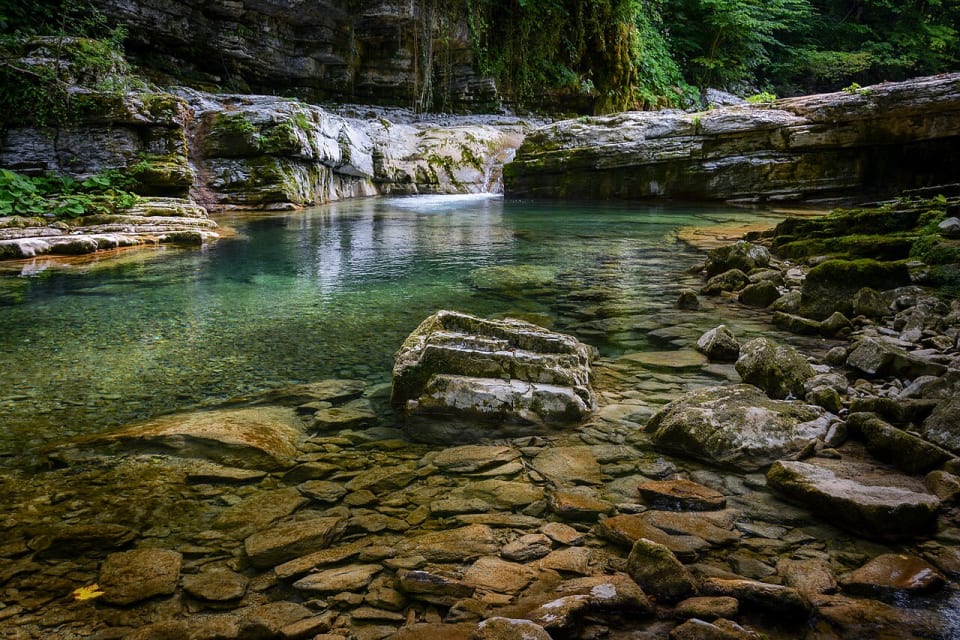

Small, fast, clear water running down from hills and woods, never far from shade. It chatters over stones, gathers in little pools under the roots and smells of moss, cress and cold rock. Trout hold under its stones, crayfish hide beneath them, and dippers walk straight into the current to feed. People drink from it, wash in it, set mills on it and use it as a boundary between fields and parishes. A stream is easy to cross most of the year, but a storm in the hills can turn it brown and loud in an hour. The clear, stony brooks of the Jura are streams of this kind.
Hear it
- By day: Forest Stream (On Patreon, Guardian tier)
- At night: Forest Stream At Night (On Patreon, Guardian tier)
- Rapids: Mountain Rapids (On Patreon, Guardian tier)
- A waterfall: Small Waterfall in a Forest (On Patreon, Guardian tier)
Adventure hooks
- A poacher has tickled the same enormous trout out of the stream three times and let it go each time, for luck. The lord has now put a prize on it, and the poacher wants nobody else to catch it before the fair is over.
- A stream has always marked the boundary between two parishes. This spring it moved twenty paces east in a single night, and the parish now on the wrong side includes the priest’s house.
- A child keeps finding small wooden boats in the stream, carved with care, each with a tiny painted face. They come from upstream, from a valley where nobody has lived since the plague.
- The brook that turns a fulling mill has run red since dawn. The fuller blames the dyer upstream; the dyer has not worked in a week, and nobody has seen him in two days.
What grows here
- Black Alder (tree). A tree of 20 to 30 m along riverbanks, in swamps and wet woods of Europe, southwest Asia and North Africa; it bears standing water better than other alders. Bacteria in its roots fix nitrogen, so it grows on poor soil and enriches it, and its roots hold riverbanks. Birds feed on its seeds in winter. Gives: Alder Wood, Alder Bark.
- Blinks (herb). A small sprawling herb with thin reddish stems, fleshy spoon-shaped leaves in pairs and tiny white flowers, native on every continent but Antarctica and absent only from southern Asia; its name fontana means 'of the spring'. It grows in freshwater springs in the uplands, in pools and along streams, and in winter-wet acid grassland in the lowlands; as a plant of clean water it is valued in conservation. It is gathered wild and eaten as a salad in Spain and Portugal. Gives: Blinks.
- Broadleaf Cattail (herb). A wetland plant of 1.5 to 3 m with broad strap leaves and a brown sausage-shaped seed head, always in or beside shallow water. It grows across Eurasia and North America and more locally in Africa and South America, from sea level to 2,300 m. Nearly every part is edible, and its leaves thatch roofs and seat chairs. Food of: Horse. Gives: Cattail Rhizome, Cattail Leaf, Cattail Pollen.
- Brooklime (herb). A fleshy, low perennial with smooth, often reddish stems, paired blunt leaves and small bright blue flowers (May to September), growing at the edge of brooks, ditches, ponds and marshes across Europe, North Africa and western Asia, up to 2,500 m. Leaves and stems are eaten raw in salad or cooked, and it was taken against scurvy with watercress. It can carry the liver fluke: do not eat it raw near pastures. Gives: Brooklime Leaves.
- Common Camas (herb). A perennial of western North America, from British Columbia and Alberta to California and east to Montana and Wyoming, with grass-like leaves, a black-skinned bulb and star-shaped blue flowers in late spring. It fills moist meadows and prairies, rocky ground, open woods and the banks of streams and rivers. Its bulb was an important food of many native peoples of the West, but the white-flowered death camas grows in the same places and its bulb is hard to tell apart. Gives: Camas Bulb.
- Fool's Watercress (herb). A low, often sprawling perennial of western Europe with a hollow stem rooting at the nodes and glossy leaves of paired, toothed leaflets that smell of carrot when crushed. It often grows with watercress in ditches, springs, fens and ponds, and in brackish marshes too. It is not poisonous, but is easily confused with the lesser water parsnip, said to be. Its young leaves and shoots are gathered wild in Spain, Italy, Portugal and Morocco. Gives: Fool's Watercress Shoots.
- Large Bittercress (herb). A perennial of the cabbage family that often forms large colonies, with white flowers and violet anthers from April to June, found across Europe, above all in the centre and north. It wants clayey soil rich in organic matter: its typical places are the edges of springs, spruce swamps, brooks, ditches and the thickets of banks. Pieces of its runners break off and travel downstream to root elsewhere; unlike the cuckooflower, it has no rosette at its base.
- Maidenhair Fern (herb). A delicate fern with black, wiry stalks and light green, finely divided fronds, native to warm, humid regions around the world and north to southern Scotland. It grows on moist, shaded limestone and sandstone, in gorges, by streams and at desert cliff seeps and springs; hot mineral springs let it live far north of its range, at Fairmont Hot Springs in British Columbia and Cascade Springs in the Black Hills. In 2020 it was found thriving in the 14th-century tunnels under Znojmo in Moravia, in the damp and the tourists' lamplight. Gives: Maidenhair Fronds.
- Meadowsweet (herb). A perennial of 1 to 2 m with creamy-white flowers of a strong, sweet smell, dominating damp meadows, fens, wet woods, ditches, stream banks and the edges of alder woods in Europe and western Asia. Its English name comes from flavouring mead. In 1838 salicylic acid was drawn from its buds, and aspirin is named after its old name, Spiraea. Gives: Meadowsweet Flowers, Meadowsweet Root.
- Mountain Sorrel (herb). A low herb with kidney-shaped, sour leaves, common in the Arctic tundra and on high mountains all around the north, in meadows, scree, late snow-beds and beside streams. The leaves taste sharp from oxalic acid and are eaten raw or cooked; the Inuit and the Sami counted on it, and it carries vitamin C. Deer and elk graze it. Gives: Mountain Sorrel Leaves.
- Ramsons (herb). A bulbous wild relative of onion and garlic, native to Eurasia from Ireland to the Caucasus, that carpets moist deciduous woods and forms wide colonies along streams; it marks ancient woodland. Its white starry flowers open from April to June, before the trees leaf out, and the crushed leaves smell of garlic. All of it is edible, but every year in Europe foragers are poisoned after picking lily of the valley or autumn crocus by mistake. Food of: Brown Bear. Gives: Ramsons Leaves.
- Seep Monkeyflower (herb). A yellow-flowered, bee-pollinated annual or perennial of western North America, from sea level high into the mountains, and very common by water in New Zealand. It grows along streams and seeps, and in many other places besides: the splash zone of the Pacific, the chaparral of California, the western deserts, the geysers of Yellowstone, alpine meadows, and even the toxic tailings of copper mines. Its slightly bitter leaves are eaten raw or cooked, sometimes in salads in place of lettuce. Gives: Monkeyflower Leaves.
- Taro (herb). A tropical perennial with big heart-shaped leaves and a starchy corm, thought native to southern India and Southeast Asia, growing in wetlands, marshes and low ground along streams and rivers. It is one of the oldest crops: traces of taro about 10,000 years old have been found at Kuk Swamp in New Guinea. Raw, the plant is full of needle-like oxalate crystals that burn the mouth and throat: it must be cooked. Food of: Cattle. Gives: Taro Corm, Taro Leaves.
- Water Mint (herb). A strongly minty perennial up to 90 cm, with square stems, toothed leaves and round heads of tiny purple flowers in summer, growing in the shallow edges of streams, rivers, pools, ditches, marshes and fens of Europe, North Africa and western Asia. It is used as a kitchen herb like spearmint and for herbal tea, though peppermint (its hybrid) tastes better. Folk medicine took mints as a tonic and for digestion, and rubbed them on against colds and headaches. Gives: Water Mint Leaves.
- Watercress (herb). A fast-growing perennial of the cabbage family, with hollow stems and small white flowers, growing in clear, shallow, slow-flowing, non-acidic water from Europe and North Africa to China, up to 2,000 m. It is one of the oldest leaf vegetables eaten by people. Wild cress from water reached by livestock dung can carry the liver fluke: never eat it raw. Gives: Watercress.
- Yellow Water-lily (herb). An aquatic perennial with thick rhizomes, leathery floating leaves of 16 to 30 cm and fragrant yellow flowers, found in shallow lakes, ponds, swamps, slow rivers and stream margins of Europe, northwest Africa and western Asia, up to 3,000 m. It bears polluted water less well than the white water-lilies. Deer, elk and birds eat its leaves, stems and roots. Gives: Water-lily Rhizome, Water-lily Seeds.
- Wild Rice (grass). An annual aquatic grass of shallow, calm water in small lakes and slow streams, native to the Great Lakes and the boreal lakes of Manitoba, Saskatchewan, Ontario and Minnesota. Often only its flowering head rises above the water. The Ojibwe call it manoomin and hold it sacred; it was a staple grain of the Ojibwe, Dakota and Algonquin peoples. Food of: Mallard. Gives: Wild Rice.
Animals
- American Alligator (man-killer, alone, day and night)
- Hippopotamus (man-killer, in herds, by night)
- King Cobra (man-killer, alone, by day)
- Green Anaconda (can wound or kill, alone, at dawn and dusk)
- Common Snapping Turtle (dangerous if cornered, alone, by day)
- Coypu (dangerous if cornered, in colonies, by night)
- Eurasian Beaver (dangerous if cornered, in families, by night)
- Green Iguana (dangerous if cornered, alone, by day)
- Common snipe (harmless, alone, by day)
- Eurasian Otter (harmless, alone, by night)
- Fire Salamander (harmless, alone, by night)
- Freshwater Pearl Mussel (harmless, in colonies, day and night)
- Gammarus (harmless, in colonies, by night)
- Grey Heron (harmless, alone, at dawn and dusk)
- Greylag Goose (harmless, in flocks, by day)
- Spring Salamander (harmless, alone, by night)
- White-throated Dipper (harmless, in pairs, by day)
Kept here
- Water Buffalo (can wound or kill, in herds, day and night)
To gather
Alder Bark, Alder Wood, American Alligator Meat, Blinks, Cattail Leaf, Cattail Pollen, Cattail Rhizome, Brooklime Leaves, Camas Bulb, Snapping Turtle Meat, Snipe Meat, Coypu Meat, Coypu Pelt, Eurasian Beaver Pelt, Eurasian Otter Pelt, Fool's Watercress Shoots, Iguana Eggs, Iguana Meat, Greylag Goose Egg, Greylag Goose Feathers, Greylag Goose Meat, Maidenhair Fronds, Meadowsweet Flowers, Meadowsweet Root, Mountain Sorrel Leaves, Ramsons Leaves, Monkeyflower Leaves, Taro Corm, Taro Leaves, Buffalo Hide, Buffalo Milk, Water Mint Leaves, Watercress, Wild Rice, Water-lily Rhizome, Water-lily Seeds, American Alligator Hide, Eurasian Beaver Castoreum, Green Anaconda Fat, Grey Heron Meat, Hippopotamus Hide, Hippopotamus Ivory, King Cobra Meat, King Cobra Venom, Freshwater Pearl, Hemlock Stem, River Pearl Grit, Electric Eel Gland, Sturgeon Roe
Nearby biomes
Open it in Biomes — MGS Toolbox