Frozen Bog
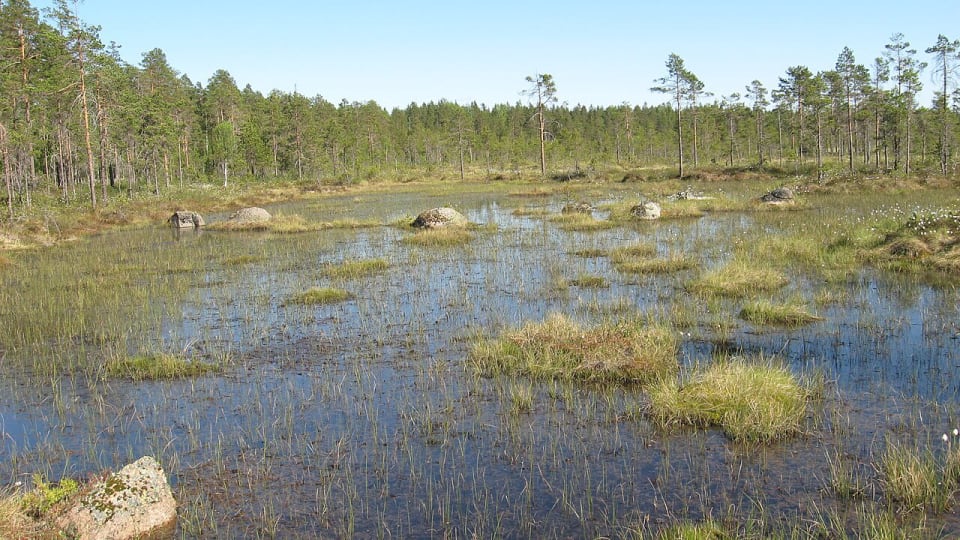

An endless winter holds the land. Snow lies in midsummer, rivers are frozen to their beds, and trees stand cased in ice that never melts. This cold does not come from the sky, and fires give less warmth than they should. Wet ground of sphagnum moss growing over deep peat, acid and poor, spread with cloudberry and heather. It looks firm and is not, and people cut its peat for fuel.
Hear it
- By the river: Winter River (In the album RPG Ambiences Vol. 6)
- At camp: Campfire on a Frozen Tundra (In the album RPG Ambiences Vol. 2)
- Blizzard: Magical Blizzard (In the album RPG Ambiences Vol. 9)
- Snowfall: Mystical Snow (On Patreon, Guardian tier)
- In the fog: Shrouded Forest (In the album RPG Ambiences Vol. 7)
- At night: Swamp At Night (On Patreon, Raven tier)
- Sucking mud: Thorny Swamp (In the album RPG Ambiences Vol. 7)
- Getting lost: Enclosed Forest (In the album RPG Ambiences Vol. 7)
For the table
- Ground
- hard going, about 10 km a day on foot
- Water
- plentiful
- Foraging
- poor
Hazards
- Sucking mud. Firm-looking ground opens onto deep mud or peat. Alone and laden, a traveller can be held until the water rises or the cold comes.
- Getting lost. Under the trees, in the dunes or in the dark, every direction looks alike. Without a guide or a sure landmark, a party walks in circles.
- Endless cold. The cold does not lift by day or by season, and a campfire only warms those who sit right beside it.
- Glazed ground. Paths, roots and stones wear a skin of clear ice that the sun never softens.
- Frostbite. Fingers and toes go white, then stop hurting, which is worse.
D&D 5e
- Plays as
- swamp, slow pace at most
- Checks
- forage: Survival DC 10 · find the way: DC 15 · search: DC 20
- Creatures are spotted at
- 2d8 × 10 ft
- Endless cold. (House rule) The extreme cold rule holds in every season, day and night: at the end of each hour outdoors, a creature makes a DC 10 Constitution save, DC 12 at night, or gains 1 Exhaustion level. Cold resistance or immunity passes automatically; furs and winter clothing give Advantage.
- Glazed ground. Slippery ice is Difficult Terrain. A creature that moves onto it for the first time on a turn, or starts its turn there, makes a DC 10 Dexterity save or has the Prone condition.
- Frostbite. (House rule) A creature that ends a day of travel with wet hands or feet makes a DC 12 Constitution save. On a failure it has Disadvantage on Dexterity checks and on attack rolls with weapons until it finishes a long rest beside a fire.
This work includes material from the System Reference Document 5.2.1 ("SRD 5.2.1") by Wizards of the Coast LLC, available at https://www.dndbeyond.com/srd. The SRD 5.2.1 is licensed under the Creative Commons Attribution 4.0 International License, available at https://creativecommons.org/licenses/by/4.0/legalcode.
Pathfinder Second Edition
- Plays as (Pathfinder Second Edition)
- swamp, greater difficult terrain, about 11 km a day at Speed 25
- Checks
- Subsist: Survival DC 20 · Sense Direction: Survival DC 20
- Random encounters
- flat check DC 14 each day
- Sucking mud. Quicksand (GM Core p. 107): a hidden patch about 5 m wide (Stealth +12; Survival DC 18 to spot by disturbing it). Stepping in sinks a traveller to the waist, then one step each round (neck, then under); Athletics DC 20 climbs back a step, and allies can pull with Athletics DC 20.
- Getting lost. Sense Direction (Player Core p. 246): a Survival check once a day, –2 without a compass; DC 15 in ordinary wild land, 20 in deep forest or underground, 30 in a featureless desert. Getting lost has no fixed penalty: the GM decides where the party ends up.
This product is licensed under the ORC License located at the Library of Congress at TX 9-307-067 and available online at various locations including paizo.com/orclicense, azoralaw.com/orclicense, and others. All warranties are disclaimed as set forth therein. Attribution: this rules layer is based on the following Licensed Material: Pathfinder Player Core © 2023 Paizo Inc., Designed by Logan Bonner, Jason Bulmahn, Stephen Radney-MacFarland, and Mark Seifter. Authors: Alexander Augunas, Kate Baker, Logan Bonner, Jason Bulmahn, Carlos Cabrera, Calder CaDavid, James Case, Eleanor Ferron, Steven Hammond, Joan Hong, Vanessa Hoskins, James Jacobs, Jenny Jarzabski, Erik Keith, Dustin Knight, Lyz Liddell, Luis Loza, Patchen Mortimer, Dennis Muldoon, Stephen Radney-MacFarland, Mikhail Rekun, David N. Ross, Michael Sayre, Mark Seifter, Kendra Leigh Speedling, Mark Thompson, Clark Valentine, Andrew White, Landon Winkler, and Linda Zayas-Palmer; Pathfinder GM Core © 2023 Paizo Inc., Designed by Logan Bonner and Mark Seifter. Authors: Amirali Attar Olyaee, Logan Bonner, Creighton Broadhurst, Jason Bulmahn, James Case, Jesse Decker, Eleanor Ferron, Fabby Garza Marroquín, Jaym Gates, Matthew Goetz, James Jacobs, Brian R. James, Jenny Jarzabski, Dustin Knight, Jason LeMaitre, Lyz Liddell, Luis Loza, Ron Lundeen, Stephen Radney-MacFarland, David N. Ross, Michael Sayre, Mark Seifter, Owen K.C. Stephens, Amber Stewart, Clark Valentine, Landon Winkler, and Linda Zayas-Palmer; Pathfinder Monster Core © 2024 Paizo Inc., Authors: Alexander Augunas, Dennis Baker, Kate Baker, Joshua Birdsong, Joseph Blomquist, Logan Bonner, Jason Bulmahn, James Case, John Compton, Paris Crenshaw, Adam Daigle, Darrin Drader, Brian Duckwitz, Robert N. Emerson, Scott Fernandez, Eleanor Ferron, Leo Glass, Matthew Goodall, BJ Hensley, Thurston Hillman, Vanessa Hoskins, James Jacobs, Jenny Jarzabski, Miko Kallio, Jason Keeley, Jeff Lee, Lyz Liddell, Luis Loza, Ron Lundeen, Robert G. McCreary, Philippe-Antoine Menard, Jacob W. Michaels, Dave Nelson, Jason Nelson, Tim Nightengale, Stephen Radney-MacFarland, Mikhail Rekun, Patrick Renie, Alex Riggs, David N. Ross, Michael Sayre, Mark Seifter, Chris S. Sims, Amber Stewart, Jeffrey Swank, William Thompson, Jason Tondro, Clark Valentine, Landon Winkler, Tonya Woldridge, and Linda Zayas-Palmer. If you use our Licensed Material in your own published work, please credit us as follows: Biomes, Pathfinder Second Edition rules layer © 2026 Michael Ghelfi. Reserved Material: the names of Biomes and its catalogues, its descriptions, sounds, art and code. Pathfinder is a registered trademark of Paizo Inc.; this site is not published, endorsed, or specifically approved by Paizo Inc.
Crossing it
Besides walking, depending on the era and the season (Biomes estimates of a day’s distance):
- By airship: about 900 km a day
- By bush plane: about 800 km a day
- By rover: about 20 km a day
- By hover sled: about 80 km a day
- On a flying mount: about 150 km a day
- By flying carpet: about 100 km a day
- By armoured buggy: about 40 km a day
Adventure hooks
- A smith whose forge no longer grows hot enough to work iron offers her best blade to whoever finds where the heat of her fire goes. It goes to a hollow nearby where, in the middle of the ice, a patch of grass grows green around a cradle someone has built there.
- A merchant has noticed that nothing kept here ever spoils and has opened a cold store for rich clients from the south. Business is splendid until a young lord comes to collect a crate laid down by his grandfather and finds the grandfather inside, alive and furious about the delay.
- Every evening an old woman walks out to talk to her son, who stands frozen in the ice where the winter caught him. She does not want him freed; she wants someone to promise to keep talking to him once she is gone.
- The village draws lots each year to choose who walks out into the cold to feed the winter. This year the lot fell on the headman’s son, and the headman has quietly decided that a passing stranger will do just as well.
- Peat cutters have struck a wooden trackway under the moss, laid plank by plank and running straight out into the bog where nobody goes. They want to know where it leads before the lord’s steward hears about it.
- A cloudberry picker swears that a little light leads her to the best patches every summer. This year it led her sister instead, and her sister has not come back.
- A merchant bought a keg of bog butter dug up by peat cutters, sold as a thousand years old and a cure for baldness. It worked far too well, and he needs another keg from the same spot to undo it.
- A farmer’s cow walked onto bright green moss and sank to the neck. Pulling her out is the easy part; finding out why the ground around her is warm, and smells of smoke, is not.
What grows here
- Scots Pine (tree). A pine of up to 35 m with short blue-green needles and orange-red upper bark, ranging from western Europe to eastern Siberia and past the Arctic Circle, on poor sandy soils, rock outcrops and peat bogs. It gave building timber, rosin and turpentine, and in Scandinavia its stumps and roots were burnt down into tar. Gives: Scots Pine Wood, Scots Pine Resin.
- Bilberry (shrub). A low deciduous shrub of 10 to 50 cm with blue-black berries ripening from July to September, found across the northern lands on acid soils of heaths, boggy barrens and open pine and spruce forests. The berries are eaten fresh or in pies, jams and syrups, and in Britain they once dyed food and cloth. Gives: Bilberry.
- Bog myrtle (shrub). An aromatic shrub up to 2 m tall with grey-green leaves, forming dense thickets in the peat bogs and marshes of northern Europe and North America. From the Middle Ages to the 16th century it went into gruit, the herb mix that flavoured beer before hops. Its sweet resinous leaves keep midges and mosquitoes away, its roots and bark dye wool and calfskin, and its waxy fruits were once made into candles. Not for pregnant women: it is listed as an abortifacient. Gives: Bog Myrtle Leaves, Bog Myrtle Bark.
- Common Heather (shrub). A low evergreen undershrub of Europe, under sixty centimetres, with tiny scale leaves and mauve flowers from July to September, the dominant plant of most European heath and moorland, also found on bogs and in acidic pine and oak woods. Grazing and light burning keep the moors in heather, and sheep and grouse feed on it. It dyed wool yellow, tanned leather, bound besoms, flavoured medieval ale before hops, and still gives a prized honey. Food of: Sheep. Food of: Willow Ptarmigan. Gives: Heather Tops.
- Cranberry (shrub). A tiny creeping evergreen with trailing stems that root as they go, small leathery leaves and pink flowers, crawling over the sphagnum hummocks of bogs, fens and conifer swamps across the cool north of Europe, Asia and America. Its red berries stay on the plant for months. Native American peoples ate them and used them as medicine, and some Iñupiat cook them with fish eggs and blubber. Food of: Black grouse. Gives: Cranberry.
- Dwarf Birch (shrub). A birch shrub no more than a metre high with shiny copper-red bark and small round toothed leaves that turn red in autumn. It grows in arctic and subarctic tundra, rocky barrens and raised bogs, and further south only high in the mountains, where it survives as a relic of the last Ice Age.
- Labrador tea (shrub). A low evergreen shrub with wrinkled leaves, rusty-felted beneath, and sweet-scented white flowers, growing in the bogs, muskegs, open tundra and conifer woods of northern North America and Greenland. Native peoples brewed the leaves as a medicinal tea, colonists drank it in place of imported tea, and in Europe it flavoured ale before hops. Take care: it holds alkaloids that poison livestock and can harm people in strong doses, and it can be mistaken for a very toxic kalmia (Kalmia angustifolia) that grows near it. Gives: Labrador Tea Leaves.
- Salal (shrub). An evergreen shrub of the heather family, 0.4 to 3 m, that carpets the understory of the coastal conifer forests from Alaska to California and forms near impenetrable thickets on dunes, bluffs and forested peat. Its dark blue berries were a major food of coastal peoples, eaten fresh or dried into cakes. Deer and elk browse it in winter, and bears, grouse and squirrels eat the berries. Food of: American Black Bear. Food of: Wapiti. Gives: Salal Berries, Salal Leaves.
- Bogbean (herb). A water-loving herb with three-part leaves and fringed white star flowers, its thick creeping rootstock building treacherous quaking mats in the fens, bogs and shallow waters of Europe, Asia and North America. Swedish peasants put its very bitter leaves in their beer instead of hops, and the bitterness also goes into schnapps. In a famine the rootstock can be ground into a poor flour. Gives: Bogbean Leaves, Bogbean Rootstock.
- Cloudberry (herb). A low herb of 10 to 25 cm with palmate leaves and white flowers, growing on acid bogs, wet meadows and tundra around the North Pole. Its amber berries, rich in vitamin C, kept scurvy away from Arctic peoples and are made into jams and liqueurs in the Nordic countries. Gives: Cloudberry.
- Round-leaved sundew (herb). A small carnivorous rosette 3 to 5 cm across, its round leaves covered in red hairs that bead with sticky glue to trap and digest insects. It grows in sunny acid bogs, fens and wet sphagnum under black spruce, all around the northern hemisphere. Healers gave it against coughs and inflammation, but it irritates in strong doses; it is strictly protected in France. Gives: Round-leaved Sundew.
- Common cottongrass (sedge). A sedge up to 1 m tall whose white cotton tufts, out from June to September, whiten the bogs, fens, wet moors and snowmelt hollows of the whole north, up to 83° N in Greenland. A dense stand can hide wet bog and marks ground to avoid. The down is too brittle to spin, but it made pillow stuffing in Sweden and England, paper and candle wicks in Germany, and the wicks of the kudlik, the Inuit oil lamp. Native peoples eat its seeds and stems. Gives: Cottongrass Down, Cottongrass Stems.
- Peat Moss (moss). The bog mosses of the genus Sphagnum, whose spongy cells hold many times their dry weight in water; they build the peat bogs of the north, and grow in conifer forests and moist tundra. Dried, they dressed wounds in place of cotton up to the First World War, and the peat they lay down was burnt as fuel. Gives: Peat Moss.
Animals
- Common Adder (can wound or kill, alone, at dawn and dusk)
- Moose (can wound or kill, alone, at dawn and dusk)
- Red Deer (can wound or kill, in herds, at dawn and dusk)
- Eurasian Beaver (dangerous if cornered, in families, by night)
- Reindeer (dangerous if cornered, in herds, by day)
- Black grouse (harmless, in flocks, by day)
- Common crane (harmless, in flocks, by day)
- Common snipe (harmless, alone, by day)
- European Golden Plover (harmless, in flocks, by day)
- Greylag Goose (harmless, in flocks, by day)
- Moor frog (harmless, alone, by night)
- Western Capercaillie (harmless, alone, by day)
- Willow Ptarmigan (harmless, in flocks, by day)
Creatures
- Ice Mephit (a threat to the unwary, Challenge 1/2)
- White Dragon (deadly, Challenge 2-20)
- Winter Wolf (a fight to fear, Challenge 3)
- Frost Giant (deadly, Challenge 8)
- Remorhaz (deadly, Challenge 11)
Also met here
- Troll (deadly, Challenge 1/2-5)
- Giant Toad (a fight to fear, Challenge 1)
- Black Dragon (deadly, Challenge 2-21)
- Will-o'-Wisp (a fight to fear, Challenge 2)
- Green Hag (a fight to fear, Challenge 3)
- Shambling Mound (deadly, Challenge 5)
This work includes material from the System Reference Document 5.2.1 ("SRD 5.2.1") by Wizards of the Coast LLC, available at https://www.dndbeyond.com/srd. The SRD 5.2.1 is licensed under the Creative Commons Attribution 4.0 International License, available at https://creativecommons.org/licenses/by/4.0/legalcode.
To gather
Winter Wolf Eye, Yeti Glands, Remorhaz Flame, Bilberry, Bog Myrtle Bark, Bog Myrtle Leaves, Bogbean Leaves, Bogbean Rootstock, Common Adder Fat, Cottongrass Down, Cottongrass Stems, Heather Tops, Snipe Meat, Cranberry, Eurasian Beaver Pelt, Golden Plover, Greylag Goose Egg, Greylag Goose Feathers, Greylag Goose Meat, Labrador Tea Leaves, Moose Hide, Peat Moss, Red Deer Antler, Red Deer Hide, Reindeer Antler, Reindeer Hide, Salal Berries, Salal Leaves, Scots Pine Resin, Scots Pine Wood, Willow Bark, Willow Ptarmigan, Black Grouse Meat, Cloudberry, Common Adder Venom, Eurasian Beaver Castoreum, Round-leaved Sundew, Capercaillie Meat, Crane Meat, Beetle Wing, Enchanted Iron Powder, Frog Lung, Giant Mosquito Wing, Orchid Flower, Wolf Aloe Leaf, Grung Venom, Hag Index Finger, Pitcher Plant Nectar, Sundew Tentacle, Will-o'-Wisp Spark, Corpse Flower Petal, Electric Eel Gland, Ghost Orchid, Hag Brain, Sea Hag Gill, Troll Bone Marrow, Will-o'-Wisp Trail, Catoblepas Eye Gland, Hag Moldy Heart, Naga Perfect Scale, Wandering Mound Mother Root, Adult Dragon Tonsils, Dragon Tongue, Froghemoth Tongue, Hydra Bile, Witch's Eye
The same milieu, otherwise
Bog, Cursed Bog, Corrupted Bog, Haunted Bog, Fungal Bog, Eldritch Bog, Toxic Bog
Open it in Biomes — MGS Toolbox