Toxic Mangrove
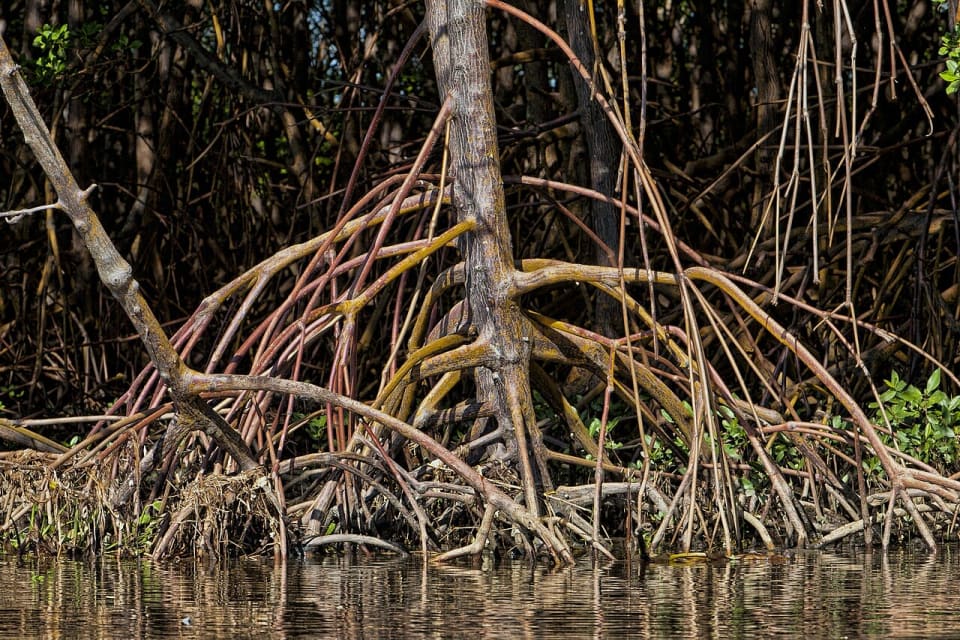

Over the channels the leaves have turned brown and drip, and a drop on bare skin leaves a red welt. The ebbing tide uncovers roots crowded with crabs whose shells are eaten thin and white, and nobody eats those any more. Bubbles rise from the black mud and burst with a sour smell, and a torch held too close makes them flare. The locals have painted red rings round the trunks of the little green-apple trees and keep their children away.
Hear it
- Water: Toxic River (On Patreon, Raven tier)
- Toxic: Sinister Field of Mud and Geysers (In the album RPG Ambiences Vol. 3)
- In the rain: Acid Rain (In the album RPG Ambiences Vol. 5)
- By day: Tropical Swamp (In the album RPG Ambiences Vol. 8)
- At night: Tropical Swamp at Night (In the album RPG Ambiences Vol. 8)
- By boat: Rowboat on Large Tropical River (On Patreon, Guardian tier)
- On the coast: Tropical Coast (In the album RPG Ambiences Vol. 8)
- Sucking mud: Thorny Swamp (In the album RPG Ambiences Vol. 7)
- Tides: Rough Sea (In the album RPG Ambiences Vol. 8)
- Biting insects: Jungle with Insect Swarm (On Patreon, Raven tier)
- Storm surge: Stormy Swamp (On Patreon, Raven tier)
- Choking vapours: Swamp with Geysers (On Patreon, Raven tier)
For the table
- Ground
- hard going, about 10 km a day on foot
- Water
- plentiful
- Foraging
- poor
Hazards
- Sucking mud. Firm-looking ground opens onto deep mud or peat. Alone and laden, a traveller can be held until the water rises or the cold comes.
- Tides. The sea comes back faster than a walker on the flats. A causeway or a beach crossed at low tide can close behind the party.
- Fevers. Warm stagnant water breeds the fevers that emptied whole expeditions before anyone knew the mosquito carried them.
- Biting insects. In the warm season, clouds of mosquitoes and flies bite day and night. Sleep and tempers wear thin.
- Storm surge. A gale from the sea piles water on top of the high tide, and the low ground floods far past the usual line. Once the wind is up, the water rises too fast to get out.
- Poisoned water. Springs and pools look clear and taste of metal. Boiling does not clean them.
- Choking vapours. In still hollows the vapours pool, heavy and unseen. Birds that land there do not fly off again.
- Caustic mud. Some patches of mud bubble and smoke. They eat through leather in an hour, and through skin faster.
- Stinging air. The air stings the eyes at once, and after a few days they run and swell half shut. Rinsing them helps, but only with clean water, which is the hardest thing to find here.
- Slow poison. Even with water carried in, the poison gets into the body a little at a time and builds up. After a week or two the hands start to shake and the gums turn grey.
D&D 5e
- Plays as
- swamp, slow pace at most
- Checks
- forage: Survival DC 10 · find the way: DC 15 · search: DC 20
- Creatures are spotted at
- 2d8 × 10 ft
- Poisoned water. (House rule) A creature that drinks the land’s water, boiled or not, makes a DC 13 Constitution save or has the Poisoned condition for 24 hours. Only water carried in, or made pure by magic, is safe.
- Choking vapours. A creature in the vapours must hold its breath, for 1 plus its Constitution modifier minutes (never less than 30 seconds). After that it gains 1 Exhaustion level at the end of each of its turns, and loses them all as soon as it can breathe again.
- Caustic mud. (House rule) A DC 13 Wisdom (Survival) check spots a patch before anyone steps in. A creature that steps in makes a DC 12 Dexterity save or takes 2d6 Acid damage, and its boots are ruined.
- Stinging air. (House rule) At the end of each day, a creature that has not rinsed its eyes with clean water makes a DC 12 Constitution save. On a failure it has Disadvantage on Wisdom (Perception) checks that rely on sight until it rinses them.
- Slow poison. (House rule) At the end of each week spent here, a creature makes a DC 13 Constitution save or gains 1 Exhaustion level. A long rest does not remove it; a week spent away from the poisoned land or a Lesser Restoration spell does.
This work includes material from the System Reference Document 5.2.1 ("SRD 5.2.1") by Wizards of the Coast LLC, available at https://www.dndbeyond.com/srd. The SRD 5.2.1 is licensed under the Creative Commons Attribution 4.0 International License, available at https://creativecommons.org/licenses/by/4.0/legalcode.
Pathfinder Second Edition
- Plays as (Pathfinder Second Edition)
- swamp, greater difficult terrain, about 11 km a day at Speed 25
- Checks
- Subsist: Survival DC 15 · Sense Direction: Survival DC 20
- Random encounters
- flat check DC 14 each day
- Sucking mud. Quicksand (GM Core p. 107): a hidden patch about 5 m wide (Stealth +12; Survival DC 18 to spot by disturbing it). Stepping in sinks a traveller to the waist, then one step each round (neck, then under); Athletics DC 20 climbs back a step, and allies can pull with Athletics DC 20.
- Fevers. Malaria (GM Core p. 88), spread by bloodsucking insects: Fortitude DC 16, onset 10 days. Sickened 1, then sickened 2, then sickened 2 with the disease coming back every 1d4 months even once cured, then unconscious, then death, one day a stage. The sickened condition cannot be reduced while it lasts.
- Storm surge. A surge that sweeps the low ground works like a flash flood, an avalanche of water that carries creatures away rather than burying them; then the drowning rules apply (GM Core p. 96, Player Core p. 437).
- Poisoned water. (House rule) A creature that drinks the land's water, boiled or not, attempts a Fortitude save DC 15 or is sickened 1 for 24 hours, sickened 2 on a critical failure. Only water carried in, or made pure by magic, is safe.
- Choking vapours. A creature in the vapours must hold its breath, 5 + its Constitution modifier rounds. Then it falls unconscious and suffocates: a Fortitude save DC 20 at the end of each of its turns, 1d10 damage on a failure and death on a critical failure, the DC rising by 5 and the damage by 1d10 each time, until it is back in clean air, where it wakes unless at 0 Hit Points (Player Core p. 437).
- Caustic mud. (House rule) A Survival check DC 15 spots a patch before anyone steps in. The mud is hazardous terrain (Player Core p. 423): a creature that steps in attempts a basic Reflex save DC 15 against minor acid damage (2d6), and on a failure its boots are ruined.
- Stinging air. (House rule) At the end of each day, a creature that has not rinsed its eyes with clean water attempts a Fortitude save DC 15. On a failure it takes a –2 circumstance penalty to Perception that relies on sight until it rinses them, and on a critical failure it is also dazzled until then.
- Slow poison. (House rule) At the end of each week here, a creature attempts a Fortitude save DC 15 or becomes drained 1, or its drained value rises by 1 (by 2 on a critical failure). A night's rest does not reduce it while the creature stays; a week away from the poisoned land, or magic that counteracts a poison, does.
This product is licensed under the ORC License located at the Library of Congress at TX 9-307-067 and available online at various locations including paizo.com/orclicense, azoralaw.com/orclicense, and others. All warranties are disclaimed as set forth therein. Attribution: this rules layer is based on the following Licensed Material: Pathfinder Player Core © 2023 Paizo Inc., Designed by Logan Bonner, Jason Bulmahn, Stephen Radney-MacFarland, and Mark Seifter. Authors: Alexander Augunas, Kate Baker, Logan Bonner, Jason Bulmahn, Carlos Cabrera, Calder CaDavid, James Case, Eleanor Ferron, Steven Hammond, Joan Hong, Vanessa Hoskins, James Jacobs, Jenny Jarzabski, Erik Keith, Dustin Knight, Lyz Liddell, Luis Loza, Patchen Mortimer, Dennis Muldoon, Stephen Radney-MacFarland, Mikhail Rekun, David N. Ross, Michael Sayre, Mark Seifter, Kendra Leigh Speedling, Mark Thompson, Clark Valentine, Andrew White, Landon Winkler, and Linda Zayas-Palmer; Pathfinder GM Core © 2023 Paizo Inc., Designed by Logan Bonner and Mark Seifter. Authors: Amirali Attar Olyaee, Logan Bonner, Creighton Broadhurst, Jason Bulmahn, James Case, Jesse Decker, Eleanor Ferron, Fabby Garza Marroquín, Jaym Gates, Matthew Goetz, James Jacobs, Brian R. James, Jenny Jarzabski, Dustin Knight, Jason LeMaitre, Lyz Liddell, Luis Loza, Ron Lundeen, Stephen Radney-MacFarland, David N. Ross, Michael Sayre, Mark Seifter, Owen K.C. Stephens, Amber Stewart, Clark Valentine, Landon Winkler, and Linda Zayas-Palmer; Pathfinder Monster Core © 2024 Paizo Inc., Authors: Alexander Augunas, Dennis Baker, Kate Baker, Joshua Birdsong, Joseph Blomquist, Logan Bonner, Jason Bulmahn, James Case, John Compton, Paris Crenshaw, Adam Daigle, Darrin Drader, Brian Duckwitz, Robert N. Emerson, Scott Fernandez, Eleanor Ferron, Leo Glass, Matthew Goodall, BJ Hensley, Thurston Hillman, Vanessa Hoskins, James Jacobs, Jenny Jarzabski, Miko Kallio, Jason Keeley, Jeff Lee, Lyz Liddell, Luis Loza, Ron Lundeen, Robert G. McCreary, Philippe-Antoine Menard, Jacob W. Michaels, Dave Nelson, Jason Nelson, Tim Nightengale, Stephen Radney-MacFarland, Mikhail Rekun, Patrick Renie, Alex Riggs, David N. Ross, Michael Sayre, Mark Seifter, Chris S. Sims, Amber Stewart, Jeffrey Swank, William Thompson, Jason Tondro, Clark Valentine, Landon Winkler, Tonya Woldridge, and Linda Zayas-Palmer. If you use our Licensed Material in your own published work, please credit us as follows: Biomes, Pathfinder Second Edition rules layer © 2026 Michael Ghelfi. Reserved Material: the names of Biomes and its catalogues, its descriptions, sounds, art and code. Pathfinder is a registered trademark of Paizo Inc.; this site is not published, endorsed, or specifically approved by Paizo Inc.
Crossing it
Besides walking, depending on the era and the season (Biomes estimates of a day’s distance):
- By river boat: about 35 km a day
- By airship: about 900 km a day
- By bush plane: about 800 km a day
- By rover: about 20 km a day
- By hover sled: about 80 km a day
- On a flying mount: about 150 km a day
- By flying carpet: about 100 km a day
- By armoured buggy: about 40 km a day
Adventure hooks
- A herbalist has lived thirty years in the poisoned land in perfect health, and she sells a tonic she swears is the reason. The tonic is pond water: she is well because she has swallowed a little poison every day of her life, and now she wants to move to town to meet her grandchildren.
- A lord has heard that the poison yields the finest yellow dye in the kingdom and has sent his steward to fetch a barrel of it. The steward is terrified, unfailingly polite, and under orders not to come home with less than a full barrel.
- The poison spreads a mile further every year, and it has a source: for a century the alchemists of the nearest town have buried their failed brews here. Their new mistress did not know, and now that she does, she has decided it would be cheaper to make sure nobody else ever finds out.
- A boy from the edge of the poisoned land has tamed one of its creatures, small, bright and deadly to touch, and his father wants it killed. It has saved the boy’s life twice already, and the water it drinks from runs clear for a day afterwards.
- Pirates hide their boats in the mangrove channels, and the fishermen are paid to keep quiet. One fisherman wants out, and the only safe way is to lead someone to the hideout and make it look like bad luck.
- Honey hunters go into the mangrove each spring, and every year a tiger takes one of them. This year a holy man has come to bless them, and insists on going along, barefoot.
- A smuggler who uses the channels at high tide pays the crab catchers in pearls to look away. The pearls are fake, the crab catchers have just found out, and the smuggler is due back tonight.
- A fisherman’s boy has found a channel that ends in a perfectly round lagoon with no trees around it. He wants someone to go with him, because his father has forbidden it without saying why.
What grows here
- Black Mangrove (tree). A mangrove shrub or tree up to 12 to 15 m, named for its dark trunk and heartwood, on the Atlantic and Pacific coasts of tropical America and the Atlantic coast of tropical Africa, just above high tide on sandy and muddy shores. Its ground is bristling with pneumatophores, breathing roots that stand out of the mud, and its leaves are often white with the salt they sweat out. It grows inland of the red mangrove and seaward of the white. Gives: Black Mangrove Wood, Black Mangrove Bark.
- Blind-your-eye Mangrove (tree). A mangrove tree up to 15 m of salt and brackish water, from India and Bangladesh to South China and Australia, growing at the back of the swamp where the water is least salty. Its milky latex blisters the skin, and a drop in the eye blinds for a time: Cook's men were blinded cutting it for wood, and Bligh forbade his crew to cut it in 1789, for even the smoke of the burning wood hurts the eyes. Gives: Blind-Your-Eye Latex.
- Cannonball Mangrove (tree). A common evergreen mangrove of the mahogany family, from Kenya and Mozambique to India, Southeast Asia, northern Australia and the Pacific islands, growing high in the intertidal zone, in estuaries and along creeks. Its buttressed trunk sends roots far to either side, and it bears woody balls 9 to 12 cm across that split into a dozen odd-shaped seeds, which give it its other name, the puzzlenut tree. Gives: Cannonball Mangrove Wood, Cannonball Mangrove Bark.
- Grey Mangrove (tree). A mangrove tree of 3 to 10 m (up to 14 m in the tropics) that sheds salt through its leaves and breathes through pencil-like roots poking out of the mud at low tide. It lines mudflats, sandy shores and estuaries around the Indian Ocean, from East Africa and Arabia to Australia and northern New Zealand, even on desert coasts. Its heavy, durable wood makes poles and boat ribs, and the smoke of the burning wood keeps mosquitoes off. Gives: Grey Mangrove Wood, Grey Mangrove Seedlings.
- Mangrove Apple (tree). A mangrove tree up to 20 m tall, ringed by cone-shaped breathing roots up to 2 m high, growing on tidal mudflats and creeks from South Asia to northern Australia and the Pacific islands. Its round, sour fruit tastes faintly of cheese and is eaten raw, cooked as a vegetable or mixed into drinks. Fishermen cut the roots into net floats, and fireflies gather in it. Gives: Mangrove Apple, Mangrove Apple Wood.
- Nipa Palm (tree). A palm with no trunk above ground: its stem creeps through the mud and only the fronds, up to 9 m long, rise from it. It grows in soft mud along tidal rivers and mangroves from India and Sri Lanka through Southeast Asia to New Guinea and northern Australia. Its sweet sap makes palm wine, vinegar and sugar, its young seeds are a sweet snack, and its fronds make excellent thatch, longer-lasting than coconut thatch. Food of: Crab-eating Macaque. Gives: Nipa Palm Sap, Nipa Palm Seeds, Nipa Palm Frond.
- Large-leafed Orange Mangrove (tree). A mangrove tree of 7 to 20 m with bright red flowers and knee-like roots, growing on the landward side of mangroves along the Indian and Pacific oceans, from South Africa to the western Pacific. Its long seedlings are full of starch: peeled and boiled in several changes of water to drive out the bitter tannin, they are a staple for the Sowek people of Papua. The bark tans leather and dyes cloth red-brown to black, and the dense wood makes posts and charcoal. Gives: Orange Mangrove Seedling, Orange Mangrove Bark, Orange Mangrove Wood.
- Red Mangrove (tree). A salt-tolerant evergreen tree, usually about 6 m, raised over the water on arching prop roots, often the most seaward of the mangroves. It grows on muddy tropical coasts and estuaries of the Americas and West Africa, and its seedlings root on the tree before dropping and floating away. Its bark was a major source of tannin. Gives: Red Mangrove Bark, Red Mangrove Wood.
- Sea Hibiscus (tree). An evergreen coastal tree of the tropics the world over, on beaches, along rivers and in mangrove forests, tolerant of salt and waterlogging. Its flowers open bright yellow with a deep red heart and turn orange, then red, before they fall at the end of the day. Austronesian voyagers carried it across Southeast Asia and Oceania for its wood and fibre. Gives: Sea Hibiscus Bast, Sea Hibiscus Wood.
- White Mangrove (tree). A mangrove tree with grey-brown or reddish fissured bark and thick, yellow-green leaves, on the coasts of West Africa from Senegal to Cameroon and on the Atlantic and Pacific coasts of the Americas, the Galápagos included. It grows in bays, lagoons and tidal creeks, usually inland of the other mangroves and well above the high-tide line; two small glands at the base of each leaf ooze sugar.
- Holly Mangrove (shrub). An erect shrub of the mangroves of Southeast Asia, Indochina, Indonesia, the Philippines and northern Australia, with stiff leaves edged in big spines like holly and two spines at the base of each leaf stalk, and pale flower spikes. Gives: Holly Mangrove.
- Glasswort (herb). A small succulent annual, 20 to 30 cm, with jointed stems so full of water they look almost translucent, which gave it the name glasswort, and leaves reduced to scales; it grows in salt marshes, on beaches and among mangroves on most coasts of Europe. Eaten as marsh samphire: young shoots raw in May and June, later boiled in plenty of unsalted water; it tastes of young spinach stems, asparagus or artichoke. Its ash long gave the alkali of glassmakers and soapmakers, and the word alkali comes from the Arabic al-qalyah, 'glasswort ash'. Gives: Marsh Samphire.
- Mangrove Fern (herb). A big leathery fern with fronds up to 2 m (4 m in Malaysian swamps), found across the tropics in mangroves, salt marshes, swamps and on riverbanks; it is the only fern that can grow in, and even be flooded by, the sea. Its very young fronds are eaten raw or cooked: in salads in Cambodia, in a spicy coconut gravy in Goa. Dried fronds are strung on rods and used instead of straw to thatch roofs. Gives: Mangrove Fern Fronds.
- Southern Cattail (herb). A cattail of 2 to 2.5 m found throughout the tropics and subtropics, in marshes and wet ground; it is one of the main plants of the Sudd and grows as an understorey in some mangroves, for it stands much saltier water than its relatives. Around some lake villages of Michoacán, in Mexico, it spreads so fast that it is cut back every month to keep it out of the fields. Gives: Southern Cattail Pollen, Southern Cattail Leaves.
Animals
- King Cobra (man-killer, alone, by day)
- Saltwater Crocodile (man-killer, alone, day and night)
- Tiger (man-killer, alone, by night)
- Giant Honey Bee (can wound or kill, in colonies, by day)
- White-lipped Peccary (can wound or kill, in herds, by night)
- Crab-eating Macaque (dangerous if cornered, in families, by day)
- Mud Crab (dangerous if cornered, alone, day and night)
- Caribbean Spiny Lobster (harmless, in colonies, by night)
- Dugong (harmless, in pairs, by day)
- Hawksbill Sea Turtle (harmless, alone, by day)
- Lowland Paca (harmless, in pairs, by night)
- Scarlet Ibis (harmless, in colonies, by day)
- Sitatunga (harmless, alone, at dawn and dusk)
Creatures
- Gray Ooze (a threat to the unwary, Challenge 1/2)
- Swarm of Insects (a threat to the unwary, Challenge 1/2)
- Chuul (a fight to fear, Challenge 4)
- Otyugh (deadly, Challenge 5)
Also met here
- Flying Snake (a threat to the unwary, Challenge 1/8)
- Black Dragon (deadly, Challenge 2-21)
- Giant Constrictor Snake (a fight to fear, Challenge 2)
- Weretiger (a fight to fear, Challenge 4)
- Giant Crocodile (deadly, Challenge 5)
- Hydra (deadly, Challenge 8)
This work includes material from the System Reference Document 5.2.1 ("SRD 5.2.1") by Wizards of the Coast LLC, available at https://www.dndbeyond.com/srd. The SRD 5.2.1 is licensed under the Creative Commons Attribution 4.0 International License, available at https://creativecommons.org/licenses/by/4.0/legalcode.
To gather
Ooze Portion, Black Mangrove Bark, Black Mangrove Wood, Cannonball Mangrove Bark, Cannonball Mangrove Wood, Wild Honey, Wild Beeswax, Marsh Samphire, Grey Mangrove Seedlings, Grey Mangrove Wood, Holly Mangrove, Mangrove Apple, Mangrove Apple Wood, Mangrove Fern Fronds, Mud Crab Meat, Nipa Palm Frond, Nipa Palm Sap, Nipa Palm Seeds, Orange Mangrove Bark, Orange Mangrove Seedling, Orange Mangrove Wood, Red Mangrove Bark, Red Mangrove Wood, Saltwater Crocodile Meat, Scarlet Ibis Egg, Sea Hibiscus Bast, Sea Hibiscus Wood, Sitatunga Meat, Southern Cattail Leaves, Southern Cattail Pollen, Peccary Hide, Peccary Meat, Blind-Your-Eye Latex, Macaque Meat, Dugong Meat, Dugong Oil, Dugong Tusk, King Cobra Meat, Paca Meat, Saltwater Crocodile Hide, Scarlet Ibis Feather, Sitatunga Hide, Tortoiseshell, King Cobra Venom, Tiger Bone, Tiger Pelt, Snake Venom, Concentrated Venom
The same milieu, otherwise
Mangrove, Corrupted Mangrove, Fungal Mangrove
Open it in Biomes — MGS Toolbox