Kelp Forest
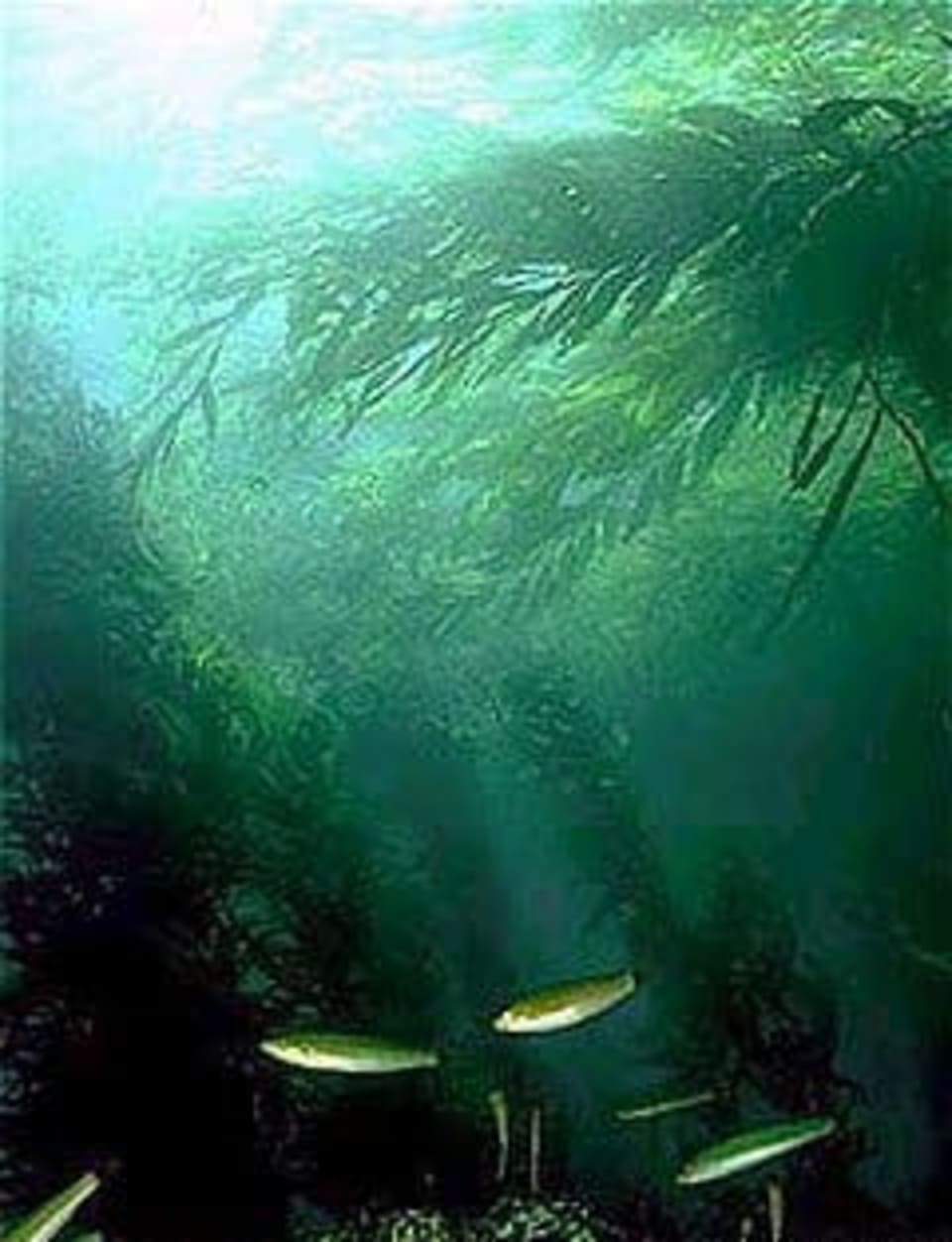

Cold coastal waters where giant seaweed rises from the rocky bottom to the surface like a submerged wood. Seen from above, it is a brown mat rocking on the swell; below, the light comes down green and golden through the swaying stalks, and on the beach the cast-up weed smells of iodine and rot. Fish shelter among the stalks, crabs and urchins graze the floor, and seals and sea otters hunt through it. People cut the kelp for soap, glass and fertiliser, fish its edges and set lobster pots among its roots. Divers and swimmers can get tangled in it, and a boat’s rudder can be caught fast at the worst moment. The kelp forests off the coast of California, home to sea otters, are forests of this kind.
Hear it
- Under the water: Underwater (In the album RPG Ambiences Vol. 2)
- Diving: Diver (On Patreon, Guardian tier)
- Calm: Calm Sea (In the album RPG Ambiences Vol. 8)
- Sea fog: Sailing Ship (In the album RPG Ambiences Vol. 1)
- Reefs and shoals: Booming Waves Cave (In the album RPG Ambiences Vol. 9)
- Storm at sea: Ship in Storm without Rain (In the album RPG Ambiences Vol. 1)
- Frigid water: Underwater and Ice (In the album RPG Ambiences Vol. 7)
- Man overboard: Rough Sea (In the album RPG Ambiences Vol. 8)
For the table
- Ground
- At sea: Sailing ship: 77 km a day, Warship: 96 km a day, Galley: 154 km a day, Longship: 115 km a day, Dhow: 223 km a day, Junk: 223 km a day, Steamship: 444 km a day, Ironclad: 401 km a day, Ocean liner: 934 km a day, Cargo ship: 667 km a day, Sailing yacht: 266 km a day, Survey craft: 888 km a day, Submersible: 355 km a day
- Water
- by season
- Foraging
- rich
Hazards
- Fouled in the weed. The kelp canopy is thick as a hedge. It wraps rudders and oars, holds a boat like a hand, and hides the rocks it grows on.
- Sea fog. A white fog lies on the water. Bells and shouts carry strangely, another ship can loom up a cable away, and the coast is wherever the lead line says it is.
- Reefs and shoals. Rock or coral a fathom under the surface, a sandbank that moved since the chart was drawn. A ship that strikes may float off at the next tide, or open her hull.
- Storm at sea. The wind rises for hours, the sea builds into grey hills and the crew reefs the sails or runs before it. No one sleeps dry; the ship goes where the storm sends it, not where the chart says.
- Frigid water. In cold seas a fall overboard is a race against the cold. The swimmer loses the use of hands, then of legs, long before drowning.
- Going under. A wave breaks over a swimmer, a diver stays down too long, a sinking hull drags someone with it. Air runs out faster than anyone thinks.
- Man overboard. A green sea sweeps the deck, or a foot slips at the rail, and someone is in the water. By the time the ship comes about, the swimmer is a dot among the waves.
D&D 5e
- Plays as
- waterborne, by the ship pace at most
- Checks
- forage: Survival DC 15 · find the way: DC 10 · search: DC 15
- Creatures are spotted at
- 6d6 × 10 ft
- Fouled in the weed. (House rule) House rule: a ship or boat that pushes into the canopy moves at half speed, and its rudder or oars are fouled on a d6 roll of 1 each hour: a DC 12 Strength (Athletics) check over the side, with a blade, clears it in 10 minutes.
- Sea fog. Heavy fog is Heavily Obscured: a creature trying to see something in it has the Blinded condition. Patchy fog is Lightly Obscured: Disadvantage on Wisdom (Perception) checks that rely on sight.
- Reefs and shoals. (House rule) House rule: the lookout makes a Wisdom (Perception) check, DC 15 by day, 20 at night or in rain. On a failure the ship strikes: it takes 4d10 Bludgeoning damage (reduced by its damage threshold as usual) and stops until the crew warps it off, about an hour of work per 10 damage taken.
- Storm at sea. Strong wind gives Disadvantage on ranged weapon attacks, puts out open flames and scatters fog; a flyer must land at the end of its turn or fall. A ship sailing into a strong wind moves at half speed.
- Frigid water. A creature can stay in frigid water for as many minutes as its Constitution score. Each minute after that, it makes a DC 10 Constitution save or gains 1 Exhaustion level. Cold resistance or immunity, or being adapted to icy water, passes automatically.
- Going under. A creature holds its breath for 1 + its Constitution modifier minutes (at least 30 seconds). After that it gains 1 Exhaustion level at the end of each of its turns until it can breathe; it then loses all the Exhaustion it gained this way.
- Man overboard. Swimming costs 1 extra foot of movement for each foot moved (none with a Swim Speed). In rough water the GM may ask a DC 15 Strength (Athletics) check to move at all.
This work includes material from the System Reference Document 5.2.1 ("SRD 5.2.1") by Wizards of the Coast LLC, available at https://www.dndbeyond.com/srd. The SRD 5.2.1 is licensed under the Creative Commons Attribution 4.0 International License, available at https://creativecommons.org/licenses/by/4.0/legalcode.
Adventure hooks
- Kelp cutters working for a soap boiler have found a fishing boat sunk among the stalks, its crew gone and its hatch bolted from the inside. The boiler wants the kelp cut anyway; the cutters want someone else to open the hatch.
- Sea otters have been stealing the village’s clam rakes and hiding them in the kelp. The village offered a reward, and the rakes now come back one at a time, each time a fish is left on the jetty.
- A smuggler sinks his kegs on weighted lines deep in the kelp and fishes them out once the customs cutter has passed. His diver drowned last week, and the next delivery is tomorrow night.
- A storm has torn up half the kelp forest and the beach is piled high with it. Sea urchins are eating what is left, and the fishermen whose fish shelter there want help clearing them before nothing remains.
What grows here
- Bull Kelp (seaweed). A kelp of the North American Pacific coast, from southern California to the Aleutians, up to 36 m long: one long stalk ending in a single gas-filled float that carries 30 to 64 blades up to 4 m long. It likes strong currents and half-sheltered spots, but not breaking waves. It is pickled and eaten as a delicacy, and the Aleuts used its long stalk as fishing line; coastal peoples also made fishing nets of it. Food of: Red Sea Urchin. Food of: Red Abalone. Gives: Bull Kelp Stalk.
- Dulse (seaweed). A leathery red seaweed, rose to purple, with fronds up to 50 cm, growing on rocks or on the stalks of kelps from mid-tide down to 20 m, on North Atlantic and North Pacific coasts. It is the most popular sea vegetable of the North Atlantic: eaten fresh, dried, fried into chips or powdered into bread and soups. In old Ireland a rock with a crop of dulse was worth three cows, sailors ate it against scurvy, and when hay ran short it went to the cattle. Grows on: Tangle. Gives: Dulse.
- Giant Kelp (seaweed). The largest of the brown seaweeds: it can grow 60 cm a day and pass 45 m in one season, held up by gas bladders, forming forests in cool waters below about 21 °C from Baja California to southeast Alaska and in the southern oceans. It has long been eaten for its iodine, potassium and other minerals; its main trade product is alginate, and in the early 20th century the California beds were cut for soda ash. Sea urchins graze it, and where urchins boom the forest can be stripped to bare rock. Food of: Red Sea Urchin. Food of: Red Abalone. Gives: Giant Kelp Frond.
- Kombu (seaweed). The edible kelp of Japan, Korea and China, probably eaten in Japan since prehistoric times; a chronicle of 797 says it was sent every year as tribute to the Yamato court. Over 90% of Japanese kombu is grown in Hokkaido, and today most is farmed on ropes floated in the sea. Dried, it keeps and travels, and it is one of the three main ingredients of dashi broth; its glutamate led to the discovery of umami in 1908. It is very rich in iodine: about 15 g a day is already too much. Gives: Dried Kombu.
- Sea Bamboo (seaweed). A kelp of the southern oceans, found along the South Atlantic coast of Africa from the far south of South Africa to northern Namibia, where it dominates the shallow temperate water and forms offshore kelp forests down to about 8 m. Its holdfast grips rock or other kelp, and a single long stalk rises to the surface, where a large gas bladder holds a tangle of blades in the light. It is harvested as a farm supplement and as food for farmed abalone.
- Sugar Kelp (seaweed). A yellowish brown kelp with a single long, narrow blade up to 5 m long and 20 cm wide, dimpled down the middle and wavy at the edges, held to rock by a claw-like holdfast between the tides and below them, in the North Atlantic, the Arctic and the North Pacific, from northern Europe down to Galicia, Long Island, Washington, Korea and Japan. Its forests shelter and feed fish and shellfish; by 2004 it had lost up to 80% of its beds in the Skagerrak. It is one of the kelps eaten as kombu, mostly in soups and stocks, and owes its name to the mannitol drawn from it as a sweetener. Gives: Sugar Kelp.
- Tangle (seaweed). A massive, leathery kelp up to 3.6 m long, living up to 15 years, of the northeast Atlantic from the North Cape and the Kola Peninsula to central Portugal, on rock from the low spring-tide line down to 10 m in murky water and 30 m in clear. Down to about 15 m it grows dense enough to be called a kelp forest; its rough stalks carry dulse and other red seaweeds, with up to 80,000 small animals on a single stalk, and where urchins swarm they graze it down to bare rock. Stalks cast up on the beaches of France, Ireland, Scotland and Norway are gathered for alginates, and since it soaks up water and holds it, it was used in wound dressings and to dilate the cervix in childbirth. Host of: Dulse. Gives: Tangle Stalk.
Animals
- Steller Sea Lion (can wound or kill, in colonies, day and night)
- Giant Pacific Octopus (dangerous if cornered, alone, by night)
- Harbour Seal (dangerous if cornered, alone, by day)
- Northern Kelp Crab (dangerous if cornered, alone, day and night)
- Purple Sea Urchin (dangerous if cornered, in colonies, day and night)
- Red Sea Urchin (dangerous if cornered, in colonies, day and night)
- California Spiny Lobster (harmless, in colonies, by night)
- Red Abalone (harmless, alone, day and night)
- Sea Otter (harmless, in colonies, by day)
- Sunflower Sea Star (harmless, alone, day and night)
Creatures
- Merfolk (a threat to the unwary, Challenge 1/8)
- Giant Seahorse (a threat to the unwary, Challenge 1/2)
- Sahuagin (a threat to the unwary, Challenge 1/2)
- Giant Octopus (a fight to fear, Challenge 1)
- Merrow (a fight to fear, Challenge 2)
- Sea Hag (a fight to fear, Challenge 2)
This work includes material from the System Reference Document 5.2.1 ("SRD 5.2.1") by Wizards of the Coast LLC, available at https://www.dndbeyond.com/srd. The SRD 5.2.1 is licensed under the Creative Commons Attribution 4.0 International License, available at https://creativecommons.org/licenses/by/4.0/legalcode.
To gather
Bull Kelp Stalk, California Spiny Lobster Meat, Dulse, Giant Kelp Frond, Giant Pacific Octopus Meat, Dried Kombu, Purple Sea Urchin Roe, Sea Lion Hide, Sea Lion Meat, Sea Lion Oil, Sugar Kelp, Tangle Stalk, Abalone Steak, Red Abalone Shell, Sea Urchin Roe, Sea Otter Pelt, Iodine Powder
Nearby biomes
Coastal Shelf, Coral Reef, Open Ocean, Deep Sea
Open it in Biomes — MGS Toolbox